This article contains advertising. My booking links are routed through a partner that adds commission tracking automatically, so if you book through one I earn a commission from the provider, at no extra cost to you. It never affects what I recommend. Affiliate disclosure
On a cool June morning, a thin mist lifts off the water at Cirencester’s open-air pool while swimmers plough up and down beneath the trees of Cirencester Park. The pool has been filled with natural spring water since 1870, which makes it one of the oldest outdoor pools in the country, and it feels a world away from a municipal leisure centre. A short walk away, the River Churn slides past — colder, shallower, privately owned and, after heavy rain, not always clean. That contrast sums up the wild swimming Cotswolds locals actually do: far more of it happens in historic lidos and managed lakes than in the secret river pools that turn up on social media, and the river swims that do exist need more care than the photographs suggest.
This guide is honest about all of it. It covers the four outdoor pools worth a detour, the open-water sessions at the Cotswold Lakes, the stretch of the upper Thames where river swimming is a realistic option, and the rules — legal, environmental and plain common sense — that apply to swimming in the Cotswolds outdoors. If you want a long, cold swim in a beautiful setting, it is all here. If you want a hidden pool with nobody about, the best advice is to lower your expectations and raise your standards.
Swimming in the Cotswolds at a glance
| Where | What it is | Season | Water | Best for |
|---|---|---|---|---|
| Sandford Parks Lido, Cheltenham | 1930s lido with a 50-metre main pool | Summer and beyond — check the current season | Heated | Proper lengths; families on the lawns |
| Cirencester Open Air Swimming Pool | Victorian spring-fed pool, 27 metres, plus a children’s pool | Mid-May to mid-September | Heated since 1931 | History, night swims, a town-centre dip |
| Stratford Park Lido, Stroud | 1937 lido | End of May to early September, about 100 days a year | Unheated — a cold-water pool | Cold-water swimmers and the brave |
| Chipping Norton Lido | 25-metre pool and a toddlers’ pool | Summer | Heated | Young families |
| Cotswold Country Park & Beach | Open-water swimming sessions on Lake 31 for adults | Summer | Lake — cold early in the season | A first open-water swim in a managed setting |
| Cleveland Lakes (Waterhay Lake) | Open-water swimming and paddleboarding run by Wild Leisure | Summer | Lake | Regular open-water training |
| Upper Thames, Lechlade to Radcot | Navigable river with the Thames Path alongside | Settled warm spells only | River — check quality after rain | Experienced river swimmers |
| Other Cotswold rivers | Small, shallow, spring-fed, mostly private | — | Cold even in summer | Paddling, not swimming |
Seasons and details checked October 2026 — outdoor pools and lake venues set their dates and prices each spring, so confirm on the operator’s own website before you travel.
Where can you legally swim outdoors in the Cotswolds?
The rules in England are less straightforward than many people assume, and they matter here because so much of the Cotswolds is private land.
- Rivers: almost all river beds and banks are privately owned, and there is no general public right to swim in a non-tidal river. Getting in from a public footpath is often tolerated, but it is technically trespass, and many Cotswold rivers — the Coln and the Windrush especially — are let to fishing syndicates who pay a great deal for quiet water and will ask you to leave.
- The Thames: from Lechlade downstream, the Thames is a public navigation, and swimming in it is generally allowed. Stay well away from locks, weirs and moored boats, and remember that you share the water with cruisers in summer.
- Canals: canal operators do not allow swimming. That includes the restored stretches of the Cotswold Canals around Stroud.
- Lakes: the 150-plus lakes of the Cotswold Lakes (formerly the Cotswold Water Park) are almost all privately owned and used for fishing, sailing, watersports or nature conservation. Swim only where a venue runs organised sessions.
- Reservoirs and quarries: do not. Steep underwater drops, very cold water and machinery make them some of the most dangerous places in the country to swim.
The practical result is that the realistic options are the lidos, the managed lake sessions and, for experienced swimmers, the upper Thames. Everything else is paddling.
Is the water clean?
This is the question that has changed outdoor swimming in England over the past few years, and the Cotswolds are not exempt. After heavy rain, sewage treatment works across the region are permitted to release diluted sewage into rivers through storm overflows, and some Cotswold rivers receive a lot of it. The Windrush has been at the centre of the national argument: a local campaign group, Windrush Against Sewage Pollution, has spent years documenting discharges into it. Lakes have their own problem — in hot, still weather, blue-green algae can bloom, and some blooms are toxic to people and dogs.
- Wait for dry weather. As a rule of thumb, avoid river swimming for at least 48 hours after heavy rain, when overflows are most likely and runoff from fields is at its worst.
- Check the data. Thames Water publishes a live map of storm overflow discharges across its region, which covers most of the Cotswold rivers that drain to the Thames, and the Surfers Against Sewage Safer Seas & Rivers app collects alerts for many inland swim spots.
- Look before you leap. Scummy or blue-green water, a bad smell or dead fish are all reasons to stay out. Keep dogs out of algae-covered water too.
- Look after yourself. Cover cuts with waterproof plasters, try not to swallow river water and shower afterwards. Leptospirosis (Weil’s disease), carried in rat urine, is rare but real — if you develop flu-like symptoms within a few weeks of a river swim, tell your doctor.
Managed lake venues test their water — Cleveland Lakes, for example, reopened for swimming only after an Environment Agency all-clear and independent laboratory testing — which is one more reason to start there.
The Cotswold lidos
The Cotswolds have an unusually good collection of historic outdoor pools, and on a hot day they are the best swimming in the region by a distance: clean, warm (mostly), lifeguarded, with lawns to lie on and cafés or kiosks nearby. Book or arrive early on hot weekends, when all of them fill up.
Sandford Parks Lido, Cheltenham
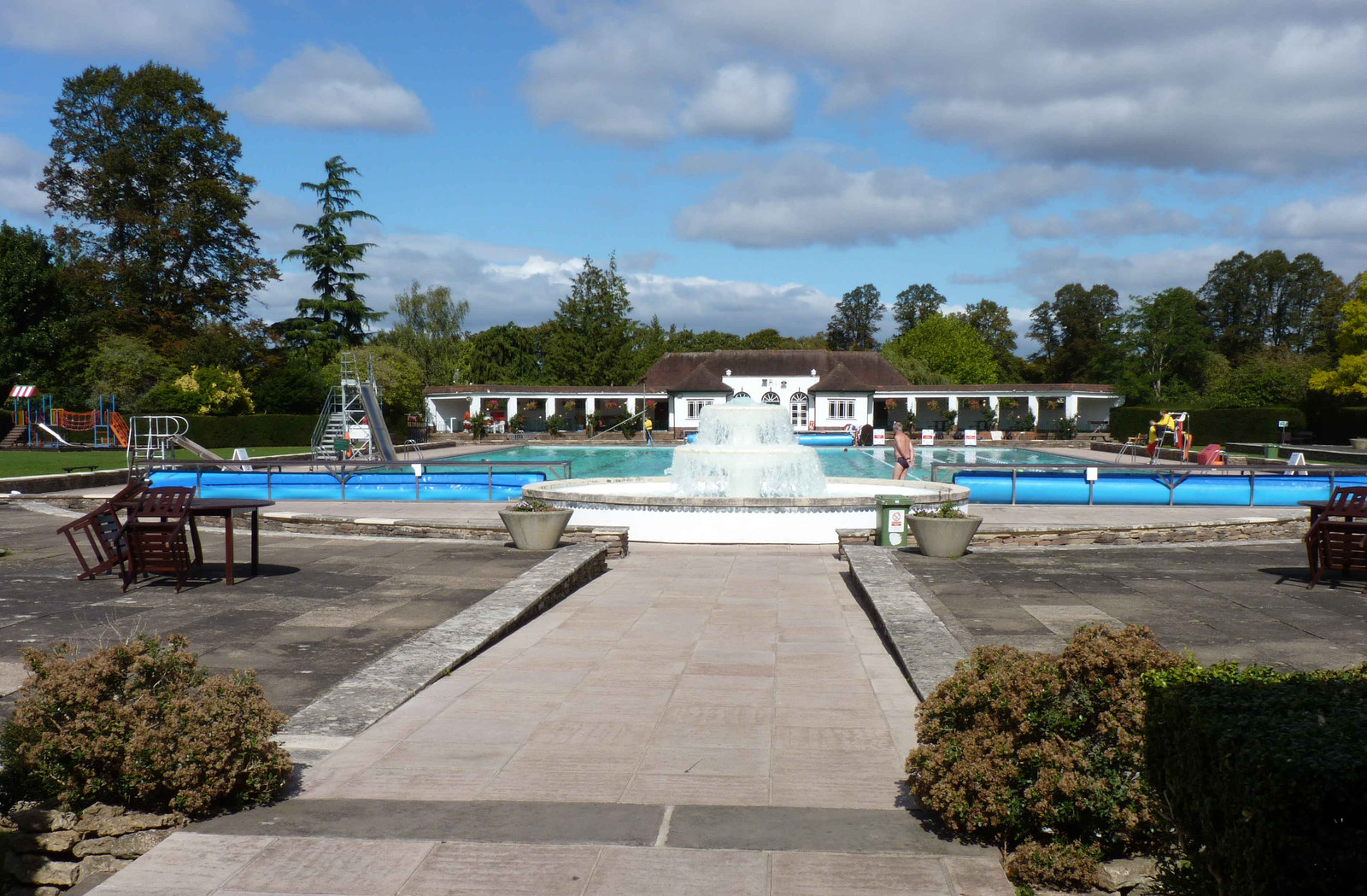
Sandford is the big one: a 1930s lido close to the centre of Cheltenham with a 50-metre heated main pool, smaller pools for children, and wide lawns that fill with families on summer weekends. It is one of the largest outdoor pools in the country and is run as a charity, and it is the place for serious lengths in the open air. Its season, opening hours and prices change from year to year, so check the lido’s own website before you go. Our Cheltenham guide covers the rest of the town.
Cirencester Open Air Swimming Pool
Tucked away on Riverside Walk beside Cirencester Park, this is one of the oldest open-air pools in Britain — it opened in 1870, is filled with natural spring water and has been heated since 1931. The main pool is 27 metres long, with a separate children’s pool, and the setting, under the trees at the edge of the park, is lovely. It opens from mid-May to mid-September and runs a busy programme of extras, including night swims and dawn swims. Standard child entry was £3.80 in 2026; check the pool’s website for adult prices and session times. It is run as a community pool and relies on its visitors, so your ticket matters. Our Cirencester guide has the town’s cafés and sights.
Stratford Park Lido, Stroud
Stroud’s lido opened in the summer of 1937 in Stratford Park, next to the leisure centre, and it is now a cold-water pool — unheated, open for about a hundred days a year from the end of May to the start of September. That makes it the closest thing in the Cotswolds to a wild swim with a lifeguard: on a cloudy June day the water is bracing, and by August it is pleasant. It suits Stroud’s outdoorsy character perfectly; our Stroud guide covers the town and its Saturday farmers’ market.
Chipping Norton Lido
Chipping Norton’s lido is the family choice: two fully heated outdoor pools — a 25-metre pool and a toddlers’ paddling pool — with a café and a big, tree-lined lawn. It opens through the summer; check the season and session times before you go. It pairs well with a morning in the town; see our Chipping Norton guide.
Open-water swimming at the Cotswold Lakes
If you want to swim in open water rather than a pool, the Cotswold Lakes are the place to do it. The landscape is flat and not especially pretty, but the water in the managed lakes is clear, the sessions are supervised, and you can swim properly — hundreds of metres in a straight line — without worrying about boats, weirs or landowners.
Cotswold Country Park & Beach
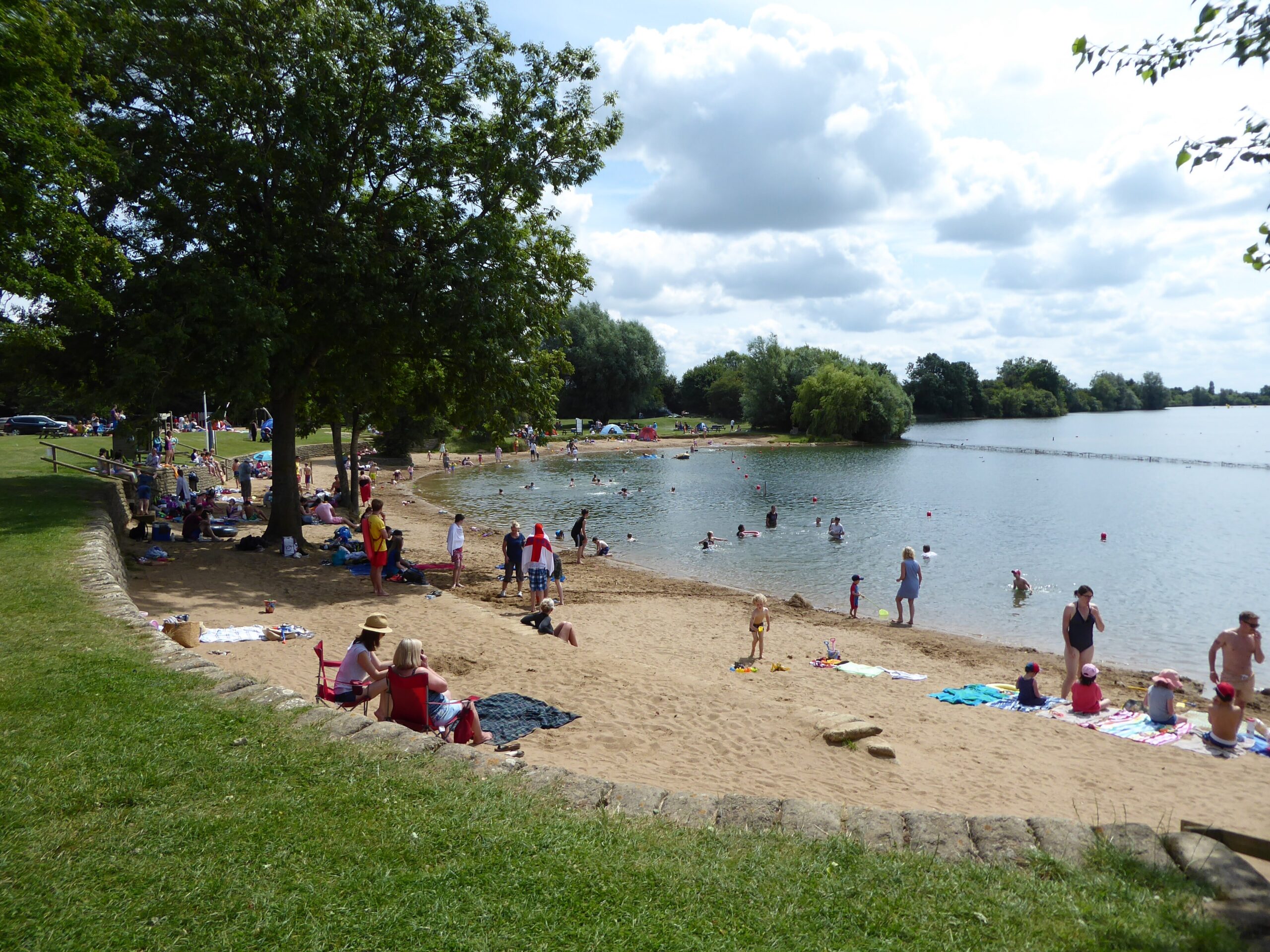
Best known for the largest inland sandy beach in the UK, Cotswold Country Park & Beach near Somerford Keynes has run open-water swimming on Lake 31 for adults, in a supervised and well-managed setting. It is a good first step if you have only ever swum in pools: there is safety cover, the course is marked and you can stop whenever you like. Sessions are pay-as-you-go, usually with a one-off registration for first-timers — check the current timetable, age limits and prices before you go.
Cleveland Lakes and Wild Leisure
Wild Leisure runs open-water swimming and paddleboarding on Waterhay Lake in the Cleveland Lakes Nature Reserve, managed by the Cotswold Lakes Trust. The water is notably clear, and the reserve setting — reedbeds, birds and very little else — makes for a peaceful swim. As above, it reopened after independent testing, and sessions are booked through the operator.
Big swims and events
The lakes also host organised swims. In 2026 the Cotswold Big Swim Festival ran in June at the Lake 32 Outdoor Centre and on Saturday 5 September at Cleveland Lakes, with distances up to 10 kilometres. If you like a target to train for, an event like this is a good reason to come back.
Why not just jump in from the bank somewhere else? Because most of the lakes are private, many are fished or sailed, and old gravel pits can shelve suddenly into deep, cold water with weed below the surface. Our Cotswold Water Park guide covers the watersports centres, the beach and the rest of what the lakes offer.
River swimming: the upper Thames and the rest
The Thames between Lechlade and Radcot
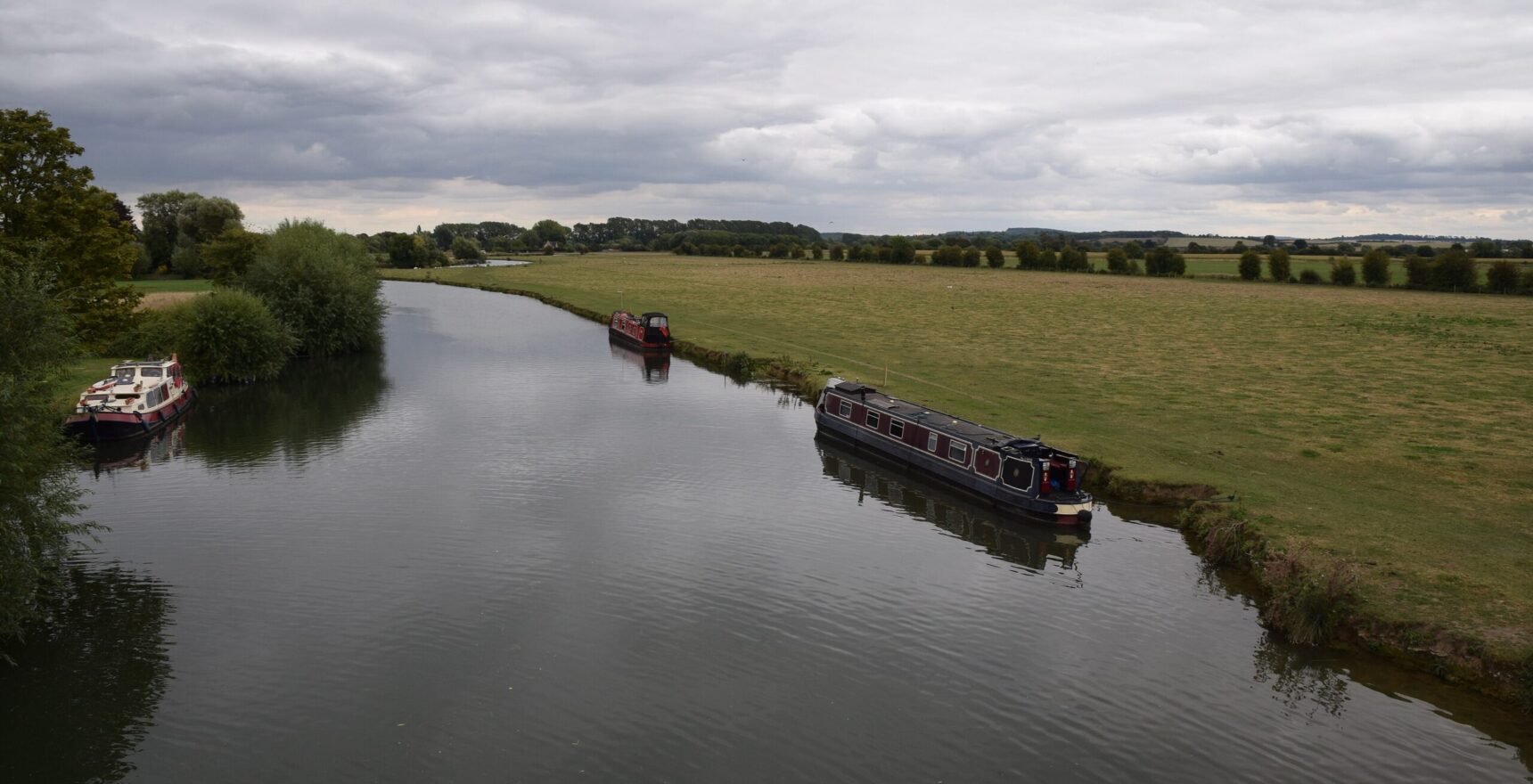
The most realistic river swimming in the Cotswolds is on the infant Thames, where it leaves the hills at Lechlade and winds across water meadows towards Kelmscott and Radcot. Here the river is a public navigation, the Thames Path runs alongside, and on a settled summer day the water is deep enough for a proper swim in places. St John’s Lock at Lechlade, watched over by a statue of Old Father Thames, is the highest lock on the river, and Buscot Lock just downstream is the smallest.
Treat it with respect. Stay well away from locks and weirs, which have strong and unpredictable currents; watch and listen for boats, which cannot see a swimmer’s head easily; get in and out where the bank is gentle; and avoid it after rain, when the river rises, cools and carries whatever has washed off the land. The meadows at Kelmscott, where William Morris spent his summers at Kelmscott Manor, make a lovely place to picnic whether or not you swim.
The Windrush, the Coln and the smaller rivers
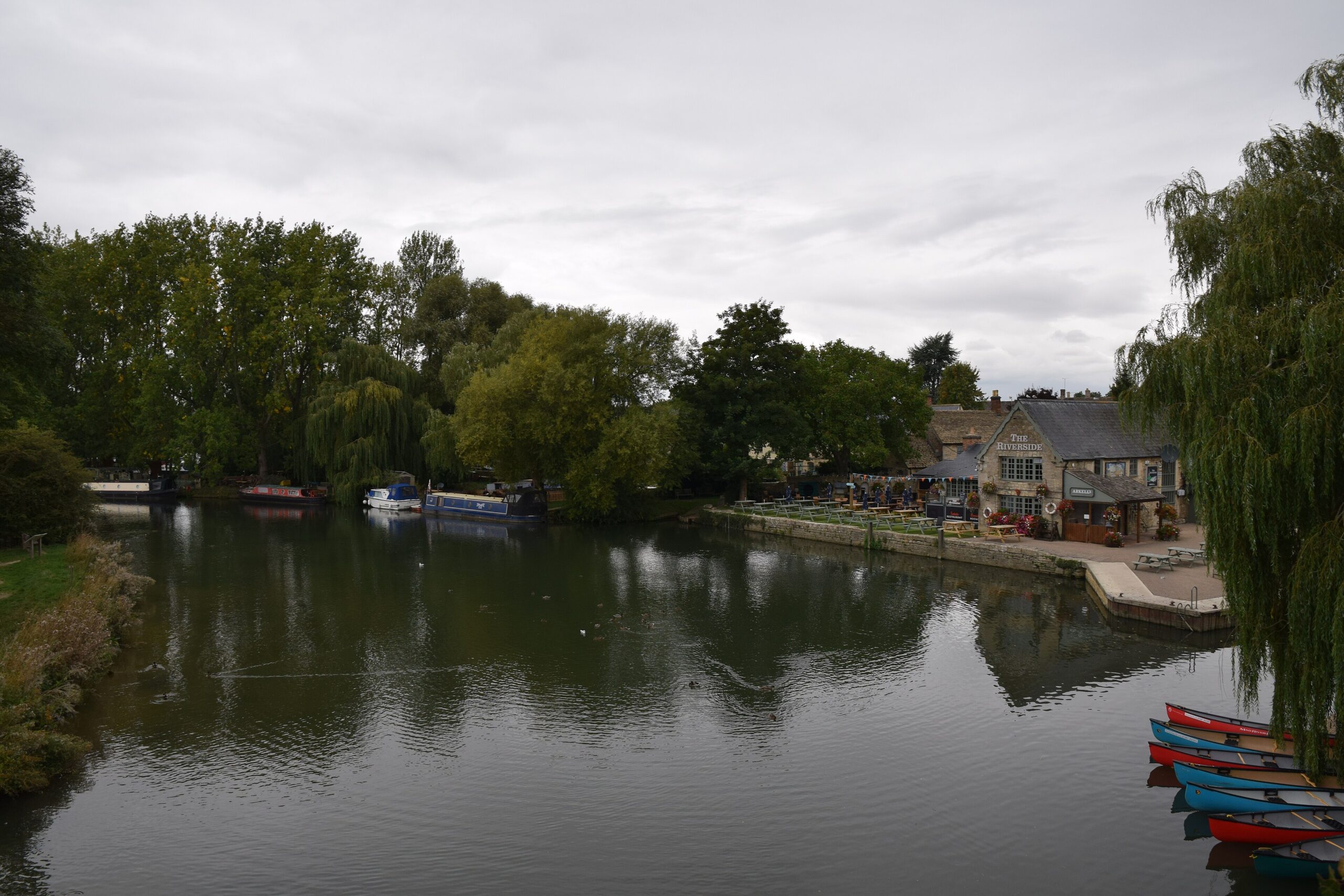
The rivers that run through the famous villages — the Windrush, Coln, Churn, Leach, Evenlode and Dikler — are beautiful, clear and tempting. They are also small, shallow, spring-fed and mostly private. Near their sources the water stays chilly even in August, and in many places it is barely knee-deep. Local swimmers do know a handful of deeper pools, but these are on private land or fishing water, and the honest advice is to enjoy them from the bank, or with your feet in, rather than going looking for a hidden swim.
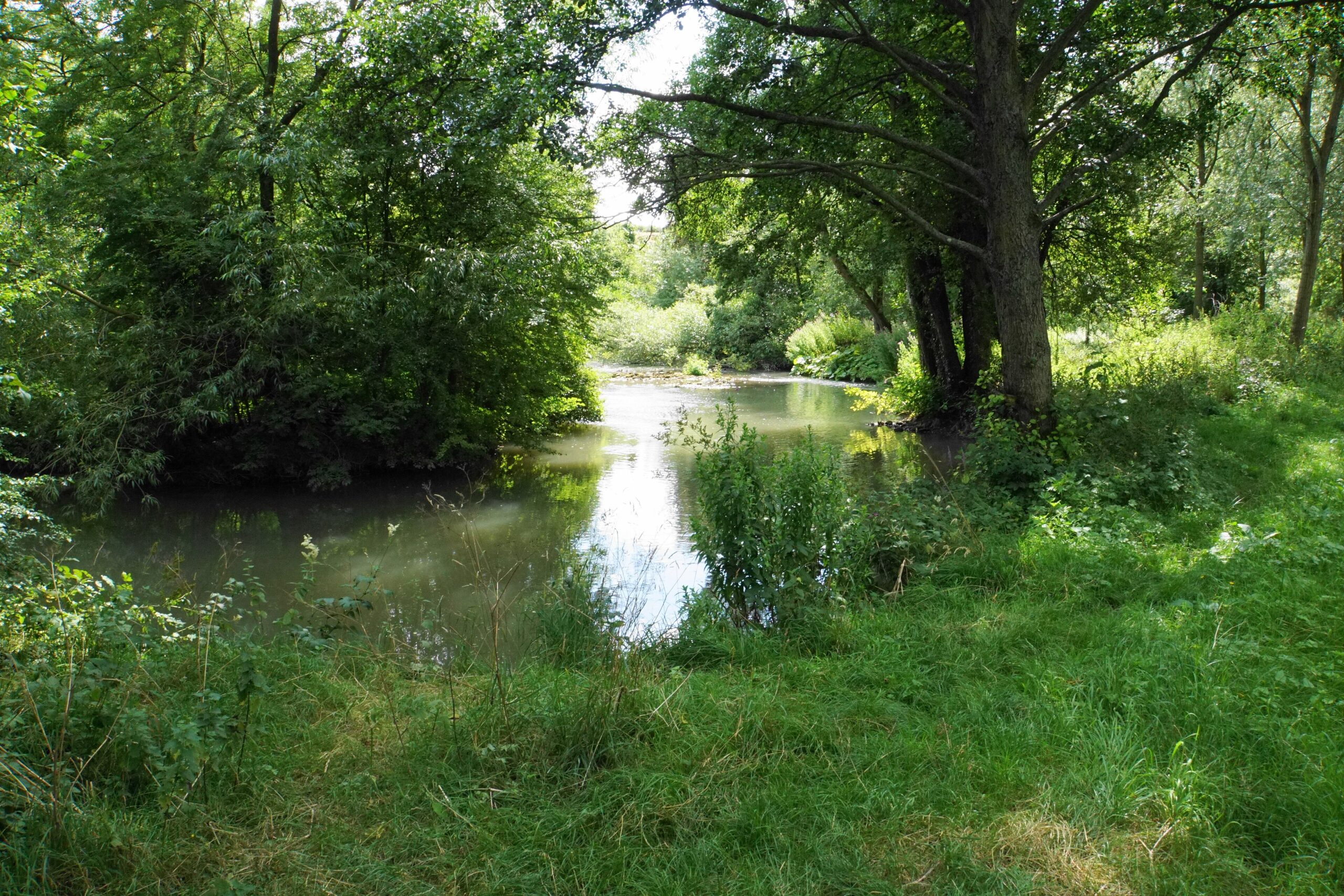
Bourton-on-the-Water deserves a special mention, because on any hot day there are children splashing in the Windrush under the bridges. That is paddling, not swimming — the river is only a few inches to a couple of feet deep through the village — and it is perfectly pleasant for small children in wellies or bare feet, with an eye on the busy banks. Our Bourton-on-the-Water guide covers the village.
How cold is the water?
Colder than you think. The lidos are the exception: the heated ones are comfortable from May to September, and Stroud’s unheated pool warms through the summer. Lakes warm slowly — chilly in May, pleasant by July and August after a settled spell, and cooling again from September. Rivers fed by limestone springs stay cold all year, especially near their sources, because the groundwater that feeds them comes out at roughly the same temperature whatever the season.
Water below about 15°C can trigger cold-water shock: an involuntary gasp and rapid breathing that can make you inhale water. Get in slowly, let your breathing settle before you start swimming, and stay close to the bank until you know how your body is reacting. If you get into difficulty, the RNLI’s advice is to float on your back until the shock passes, rather than thrash.
A safety checklist for outdoor swimming
- Never swim alone, and tell someone on the bank where you are going in and coming out.
- Use a brightly coloured tow float and hat so boats and other water users can see you.
- Never jump or dive in unless you have checked the depth yourself and know what is underneath.
- Check the weather, the flow and the water quality before you go, and do not swim in a river that is high, brown or fast after rain.
- Know your exit before you get in — steep, muddy banks are hard to climb out on when you are cold.
- Warm up gradually afterwards: dry clothes, a hat, a warm drink. Hot showers straight away can make you feel faint.
- Respect landowners and anglers. If you are asked to leave, leave.
Other ways to get on the water
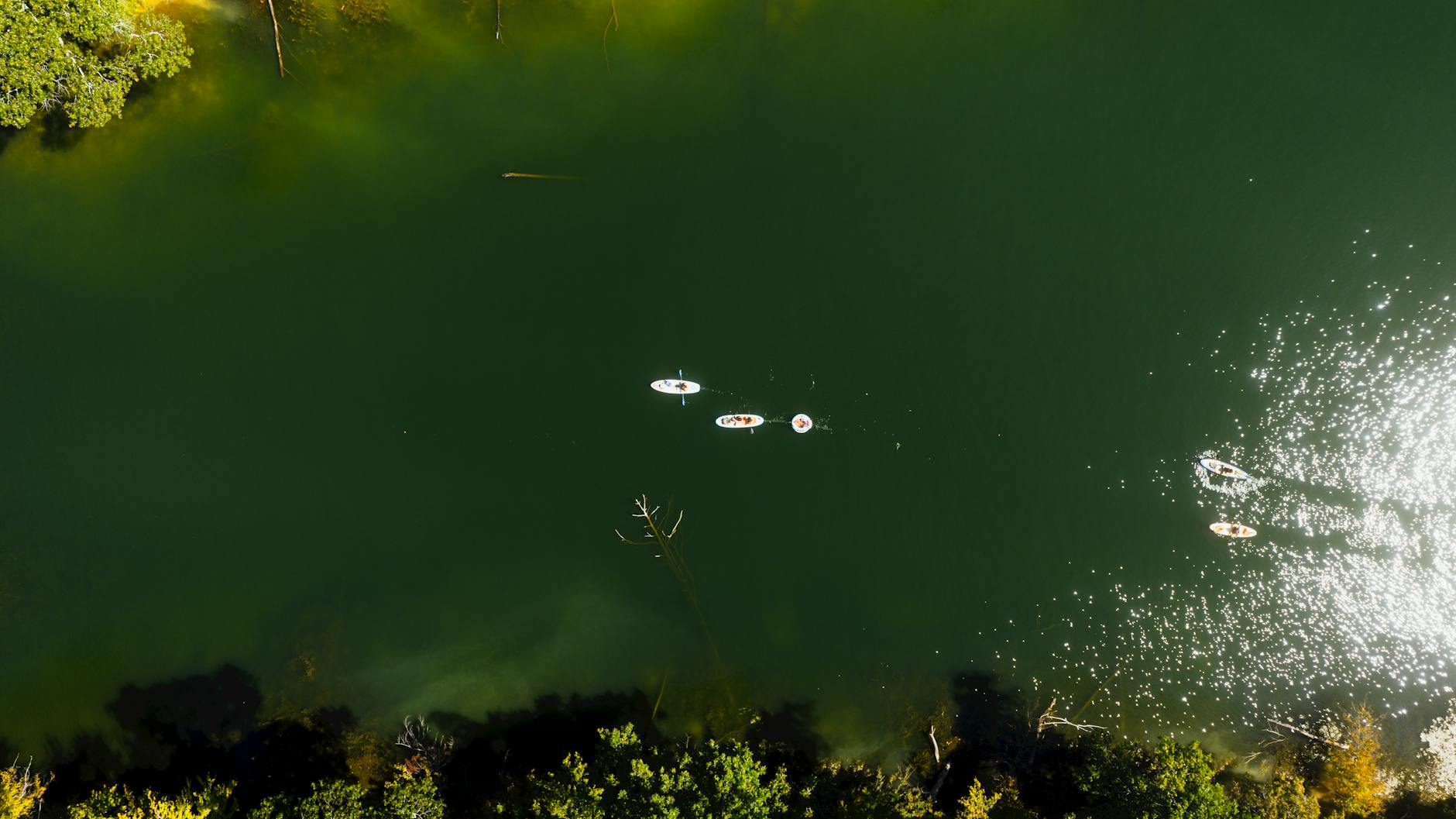
If swimming is not for you, or you want a change, the Cotswold Lakes are also the region’s centre for paddleboarding, kayaking, sailing and wakeboarding, with several centres offering lessons and hire. On the rivers, small canoes and kayaks can use the Thames from Lechlade downstream with the appropriate licence or British Canoeing membership. Our guides to outdoor activities in the Cotswolds and adventure activities cover the options, prices and providers.
Swimming with children
The lidos are the obvious answer, and they are excellent: Chipping Norton has a toddlers’ pool, Cirencester has a children’s pool alongside the main one, and Sandford has the space for a whole day out. For a beach day, the sand at Cotswold Country Park & Beach is the closest the Cotswolds get to the seaside — check what is open for children when you book. Keep river visits to paddling, and remember that even shallow, gentle-looking water can be very cold. For more ideas, see our guide to family holidays in the Cotswolds.
Planning a summer swimming trip
The swimming season runs from late May to early September, with July and August the warmest months for lakes and unheated pools. Hot weekends are busy everywhere — the lidos fill, the lake sessions book up and the roads around Bourton grind to a halt — so swim early in the day and save the honeypot villages for the evening. Cirencester and Cheltenham make good bases, with a lido in each and the Cotswold Lakes a short drive from Cirencester. Our guide to the Cotswolds in summer covers events, crowds and what else to do, and our guide to where to stay in the Cotswolds covers bases across the region.
Frequently asked questions about swimming in the Cotswolds
Where can you go wild swimming in the Cotswolds?
The best legal options are the managed open-water sessions at the Cotswold Lakes, such as Cotswold Country Park & Beach and Cleveland Lakes, and the navigable upper Thames around Lechlade for experienced swimmers. Most other rivers are private.
Is wild swimming legal in the Cotswolds?
There is no general right to swim in English rivers, which are mostly privately owned. Swimming in the navigable Thames is generally allowed away from locks and weirs; canals and private lakes are off-limits unless a venue runs sessions.
Can you swim in the River Windrush at Bourton-on-the-Water?
Children paddle in it on hot days, but it is far too shallow for swimming through the village, and the river has a history of sewage pollution after heavy rain.
Can you swim at the Cotswold Water Park?
Only at managed venues and sessions, such as those at Cotswold Country Park & Beach and Cleveland Lakes. Most of the lakes are private and used for fishing, sailing and wildlife.
Are there outdoor swimming pools in the Cotswolds?
Yes — Sandford Parks Lido in Cheltenham, Cirencester Open Air Swimming Pool, Stratford Park Lido in Stroud and Chipping Norton Lido, all open in summer.
Is it safe to swim in Cotswold rivers?
It can be, with care: avoid swimming for at least 48 hours after heavy rain, check storm overflow data, stay away from weirs and locks, never swim alone and expect the water to be cold.
Swimming is only one way to enjoy the Cotswold rivers and lakes. For the kingfishers, otters and winter ducks that share them, see our guide to Cotswolds wildlife and nature; for walks along the water, our Cotswolds walking guide; and for the rest of a hot-weather trip, our guide to the Cotswolds in summer.
Photo Credits
The Thames winding through water meadows below Lechlade: River Thames at Lechlade (43646416175) by Hugh Llewelyn from Keynsham, UK, CC BY-SA 2.0, via Wikimedia Commons.
Sandford Parks Lido, Cheltenham: Sandford Parks Lido – geograph.org.uk – 2612222 by Rick Crowley, CC BY-SA 2.0, via Wikimedia Commons.
The artificial beach at Cotswold Country Park & Beach: Artificial beach, Cotswold Country Park & Beach – geograph.org.uk – 5043722 by Vieve Forward, CC BY-SA 2.0, via Wikimedia Commons.
The River Thames at Lechlade: River Thames at Lechlade (43646416995) by Hugh Llewelyn from Keynsham, UK, CC BY-SA 2.0, via Wikimedia Commons.
The River Windrush at Widford: River Windrush at Widford – geograph.org.uk – 6622489 by Bill Boaden, CC BY-SA 2.0, via Wikimedia Commons.
Leave a Reply