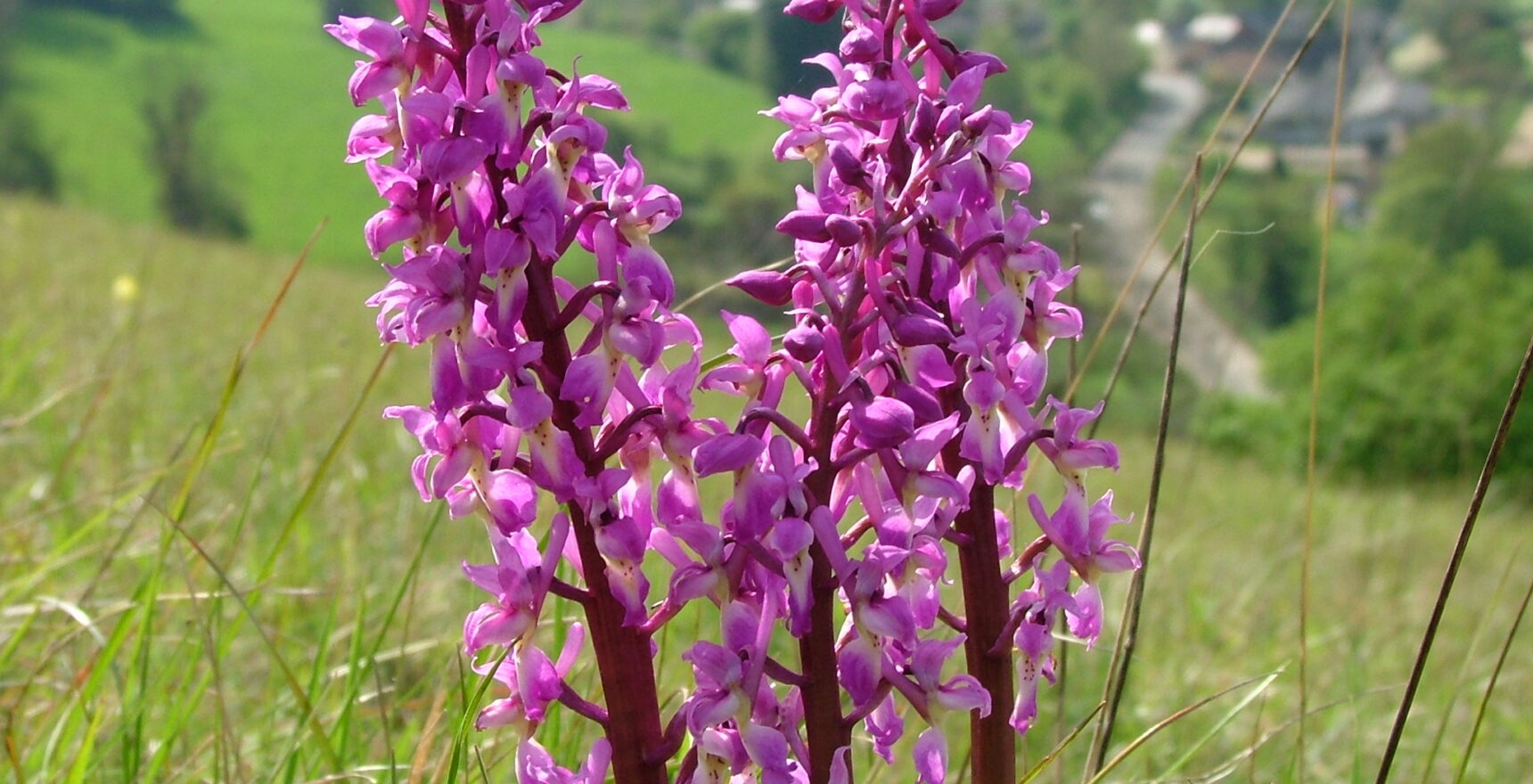
This article contains advertising. My booking links are routed through a partner that adds commission tracking automatically, so if you book through one I earn a commission from the provider, at no extra cost to you. It never affects what I recommend. Affiliate disclosure
Stand still for a minute on the steep bank of Swift’s Hill above Slad on a warm June afternoon and the turf starts to resolve into detail. What looked like rough grass from the lane turns out to be a tapestry: orchids in several shapes and shades of pink, the yellow claws of bird’s-foot trefoil, tiny white flowers of fairy flax, wild thyme just coming into bloom, and over all of it the hum of bees and the flicker of blue butterflies. More than a dozen kinds of orchid grow on this one hillside. It is a good introduction to the Cotswolds wildflower meadows, because most of the best of them are not meadows in the farming sense at all, but steep banks, old commons and forgotten corners that were simply too awkward to plough.
This guide explains what makes Cotswold grassland so special, when the flowers peak, how to recognise the orchids, and where to see them — from limestone banks with rare butterflies to Thames-side hay meadows purple with fritillaries. It also covers the project that is bringing wildflower grassland back across the hills, and a few honest words on the lavender fields and poppies that fill so many summer photographs.
The best wildflower meadows and orchid sites at a glance
| Site | Type | Best for | Peak | Access |
|---|---|---|---|---|
| Swift’s Hill, near Slad | Limestone grassland bank (Gloucestershire Wildlife Trust) | More than 12 orchid species | June | Free; very limited parking |
| Prestbury Hill, above Cheltenham | Limestone grassland (Butterfly Conservation) | Musk and bee orchids, butterflies | June–July | Free |
| Selsley Common, near Stroud | Grazed common | Bee and fly orchids | May–June | Free |
| Cotswold Commons and Beechwoods | National Nature Reserve | 130-plus wildflowers, 15 orchid species | May–July | Free |
| Rodborough Common | National Trust common | Thyme, orchids, blue butterflies | June–August | Free; NT car parks |
| Coaley Peak | Restored meadow (Gloucestershire Wildlife Trust) | Sainfoin, yellow rattle, orchids | June–July | Free car park |
| Clattinger Farm, near the Cotswold Lakes | Ancient hay meadows (Wiltshire Wildlife Trust) | Fritillaries, green-winged and burnt-tip orchids | Late April–June | Free |
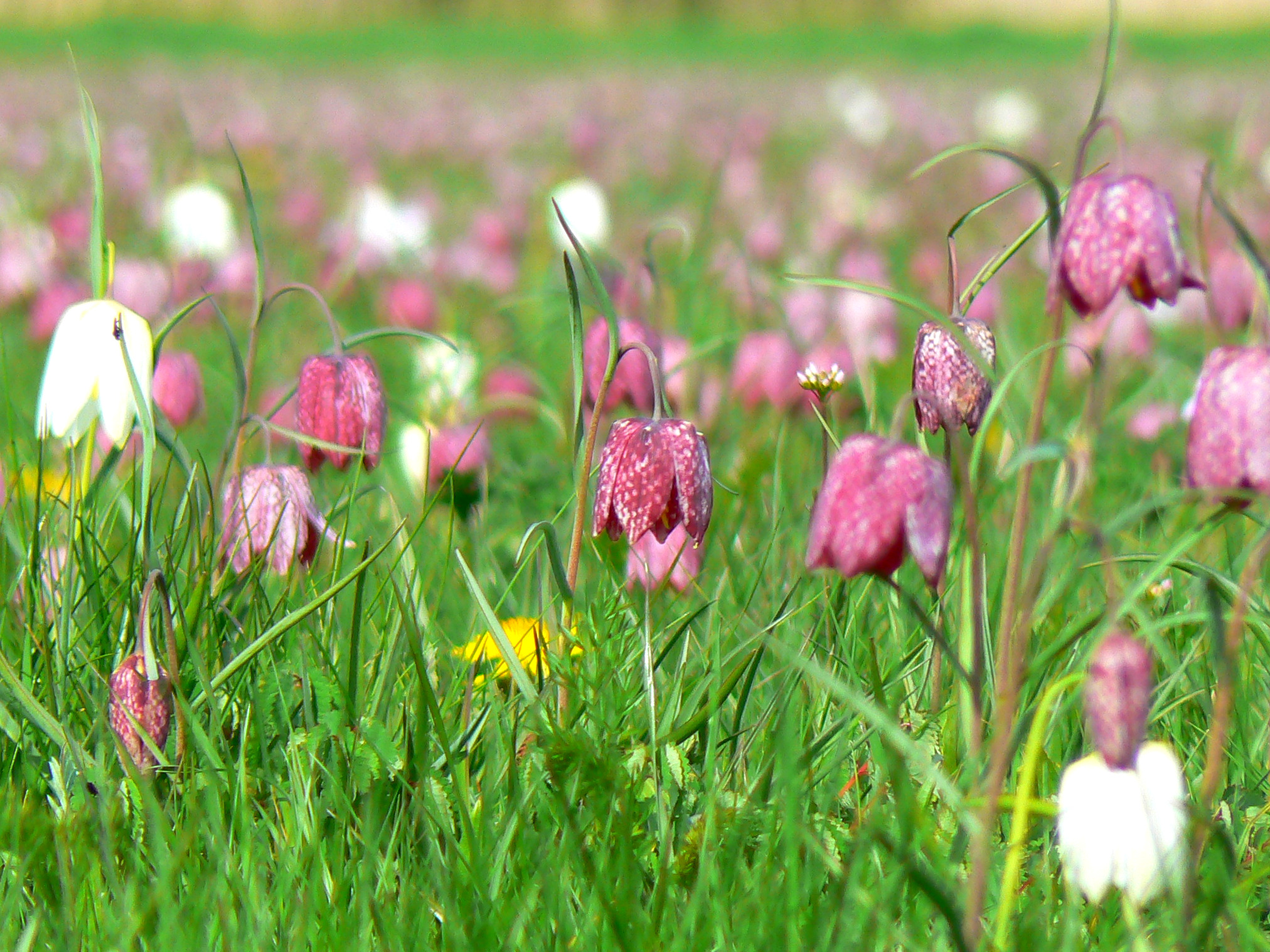
| North Meadow, Cricklade | Thames flood meadow (National Nature Reserve) | Around 80% of Britain’s snake’s-head fritillaries | Mid to late April | Free |
| Ducklington, near Witney | Village fritillary field | Fritillary Sunday, once a year | April | Open day only |
Details checked October 2026. Flowering dates shift by a week or two with the weather — check recent sightings before a long drive.
Why the Cotswolds matter for wildflowers
The Cotswolds hold more than half of the UK’s remaining Jurassic limestone grassland — unimproved turf that has never been ploughed, reseeded or dosed with fertiliser. That matters because limestone grassland is one of the richest plant habitats in northern Europe. The thin, dry, lime-rich soil starves the vigorous grasses that dominate ordinary fields, leaving room for dozens of smaller plants, and a good site can hold more than a hundred species of wildflowers and grasses, sometimes a dozen or more in a single square metre.
For centuries the high wold was open sheepwalk, and this kind of grassland covered much of it. Most was ploughed, particularly during and after the Second World War, and what survived did so for practical reasons: the slopes were too steep for a tractor, the land was common with grazing rights that could not easily be extinguished, or it was a quarry edge, a railway bank or a road verge that nobody needed. That is why the best wildflower sites are so often steep, small and scattered, and why the commons above Stroud and Cheltenham are so important. Rare plants hang on here — the pasque flower, which blooms around Easter on a handful of protected banks, and the Cotswold pennycress, named after the region — alongside the more familiar orchids.
Three kinds of Cotswold meadow
Limestone grassland
The classic Cotswold wildflower habitat: short, springy turf on steep banks, commons and hill forts, grazed by sheep or cattle to keep the scrub and coarse grasses down. Look for orchids, wild thyme, marjoram, rockrose, horseshoe vetch, salad burnet, cowslips in spring and harebells in late summer — and the butterflies that depend on them, from marbled whites to the large blue.
Hay meadows
Traditional hay meadows on deeper soils in the valleys, cut once a year in mid to late summer after the flowers have set seed and grazed afterwards. They are taller and lusher than limestone grassland, with ox-eye daisies, knapweed, meadow buttercups, yellow rattle and great burnet. Very few survive unchanged; Clattinger Farm on the Gloucestershire–Wiltshire border is the outstanding example.
Flood meadows
Along the upper Thames, ancient meadows that flood in winter and are cut for hay in summer hold one of the great spring spectacles in England: the snake’s-head fritillary, with its chequered purple bells. North Meadow at Cricklade is the most famous site in the country for them.
When do the Cotswold meadows flower?
| Month | What is flowering |
|---|---|
| April | Cowslips on the commons, early purple orchids, snake’s-head fritillaries at Cricklade and Clattinger, pasque flowers on a few protected banks |
| May | Green-winged orchids in the hay meadows, horseshoe vetch, milkwort, early fly orchids; Duke of Burgundy butterflies on the grassland |
| June | The peak: bee, pyramidal, fragrant and common spotted orchids, yellow rattle, sainfoin, ox-eye daisies, the first wild thyme |
| July | Musk orchids, marjoram, knapweed, field scabious, thyme at its best, marbled white butterflies everywhere; lavender at Snowshill |
| August | Harebells, carline thistles, autumn gentians, chalkhill blues; hay meadows cut |
| September | The last scabious and harebells; seed heads and grasshoppers |
If you can come only once, aim for the middle two weeks of June, when the orchids and the meadow flowers overlap. For what else is going on that month, see our guide to the Cotswolds in summer.
Cotswolds orchids: a quick field guide
The Cotswold Commons and Beechwoods reserve alone has fifteen species of orchid, and Swift’s Hill more than a dozen. These are the ones you are most likely to meet.
| Orchid | When | What to look for | Where |
|---|---|---|---|
| Early purple | April–May | Purple spikes, often with dark-spotted leaves; smells faintly of tomcats | Woods and grassland across the region |
| Green-winged | May | Purple flowers with green-veined “wings” | Old hay meadows such as Clattinger Farm |
| Common spotted | June–July | Pale pink to white, with spotted leaves | Widespread, including verges |
| Pyramidal | June–July | Deep pink, cone-shaped heads | Banks, commons and verges |
| Fragrant | June | Slender pink spikes with a clove-like scent | Limestone grassland |
| Bee | June | A flower that mimics a bumblebee, with pink “wings” | Selsley, Prestbury Hill, banks and even road verges |
| Fly | May–June | Tiny, dark flowers like insects on a thin stem; easy to miss | Selsley Common and scrubby grassland edges |
| Musk | June–July | Very small, greenish-yellow, honey-scented | Prestbury Hill; two sites in the Cotswold Commons and Beechwoods |
| Burnt-tip | May–June | Small, with a dark “burnt” top to the flower spike | Clattinger Farm; very rare |
A local book, Orchids of the Cotswolds, maps every species in the county for anyone who wants to go further, and Gloucestershire Wildlife Trust runs a “Great Orchid Hunt” for volunteers to record what they find.
Where to see wildflower meadows and orchids in the Cotswolds
Swift’s Hill, near Slad
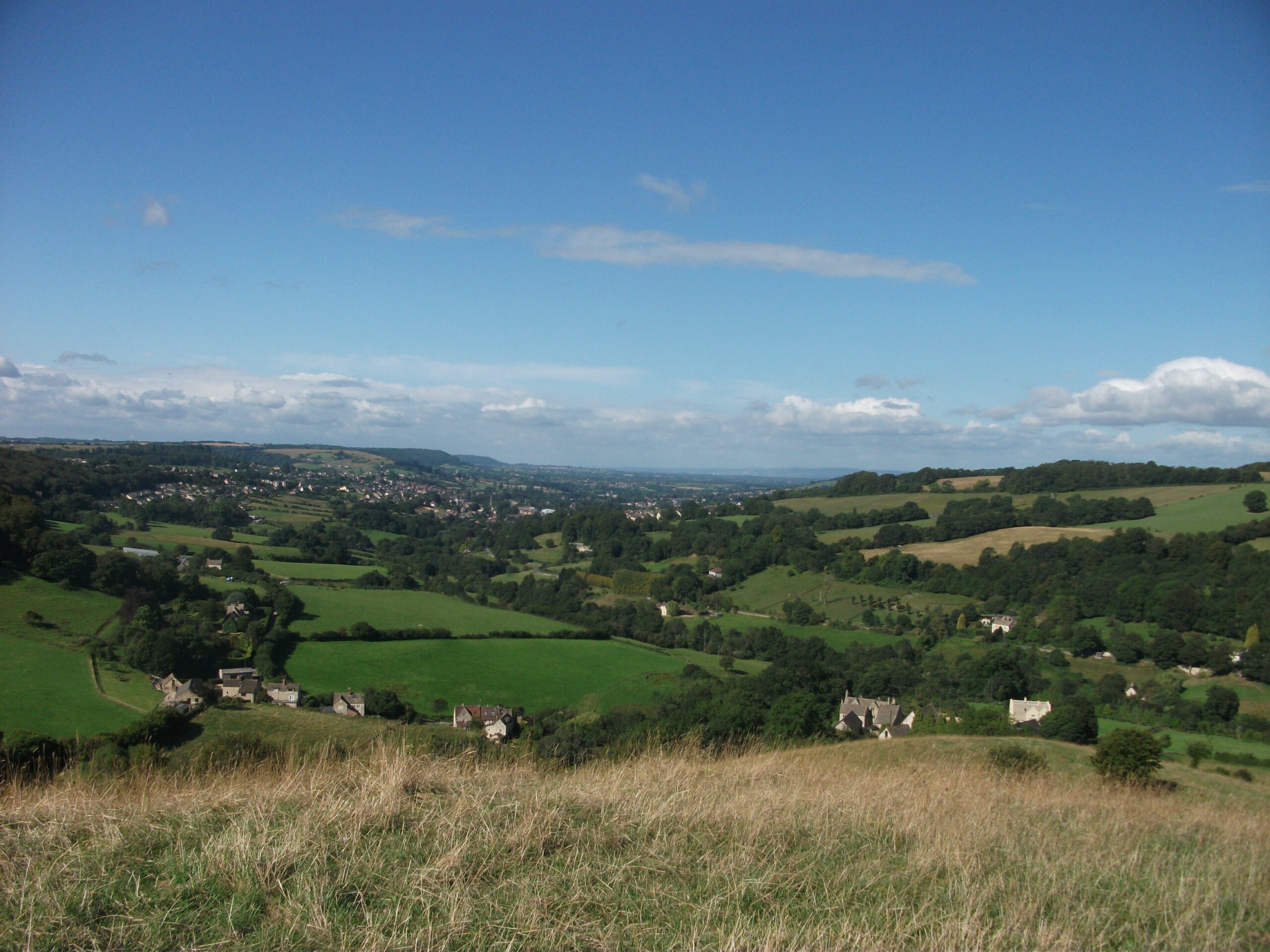
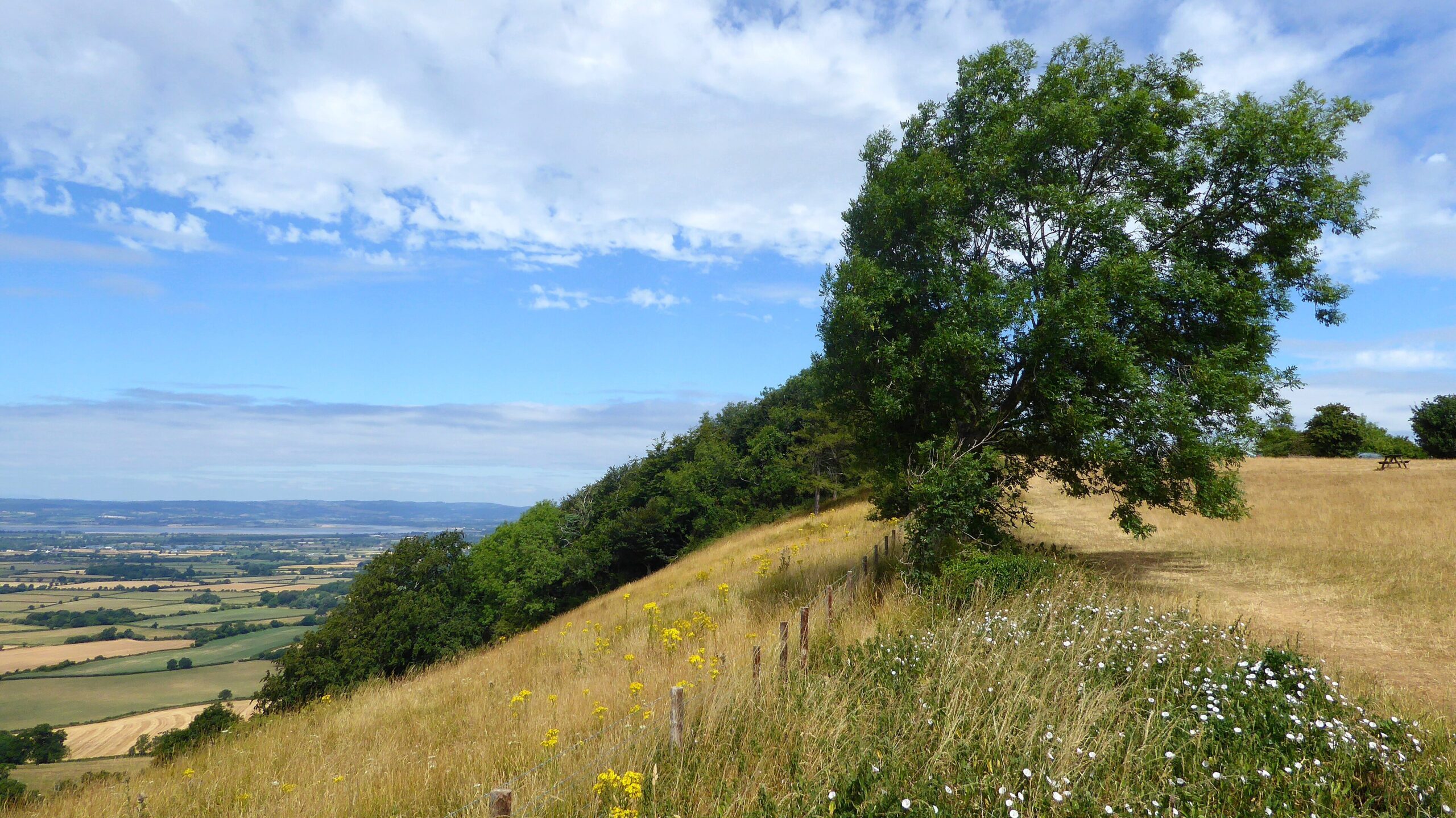
Swift’s Hill is a small, steep Gloucestershire Wildlife Trust reserve above the Slad valley, the landscape of Laurie Lee’s Cider with Rosie, and in June it is one of the finest orchid sites in the county, with more than twelve species recorded. It is steep, so wear grippy shoes, and parking on the narrow lanes is very limited — park in Slad or Stroud and walk up if you can. The view down the valley is a bonus.
Prestbury Hill, above Cheltenham
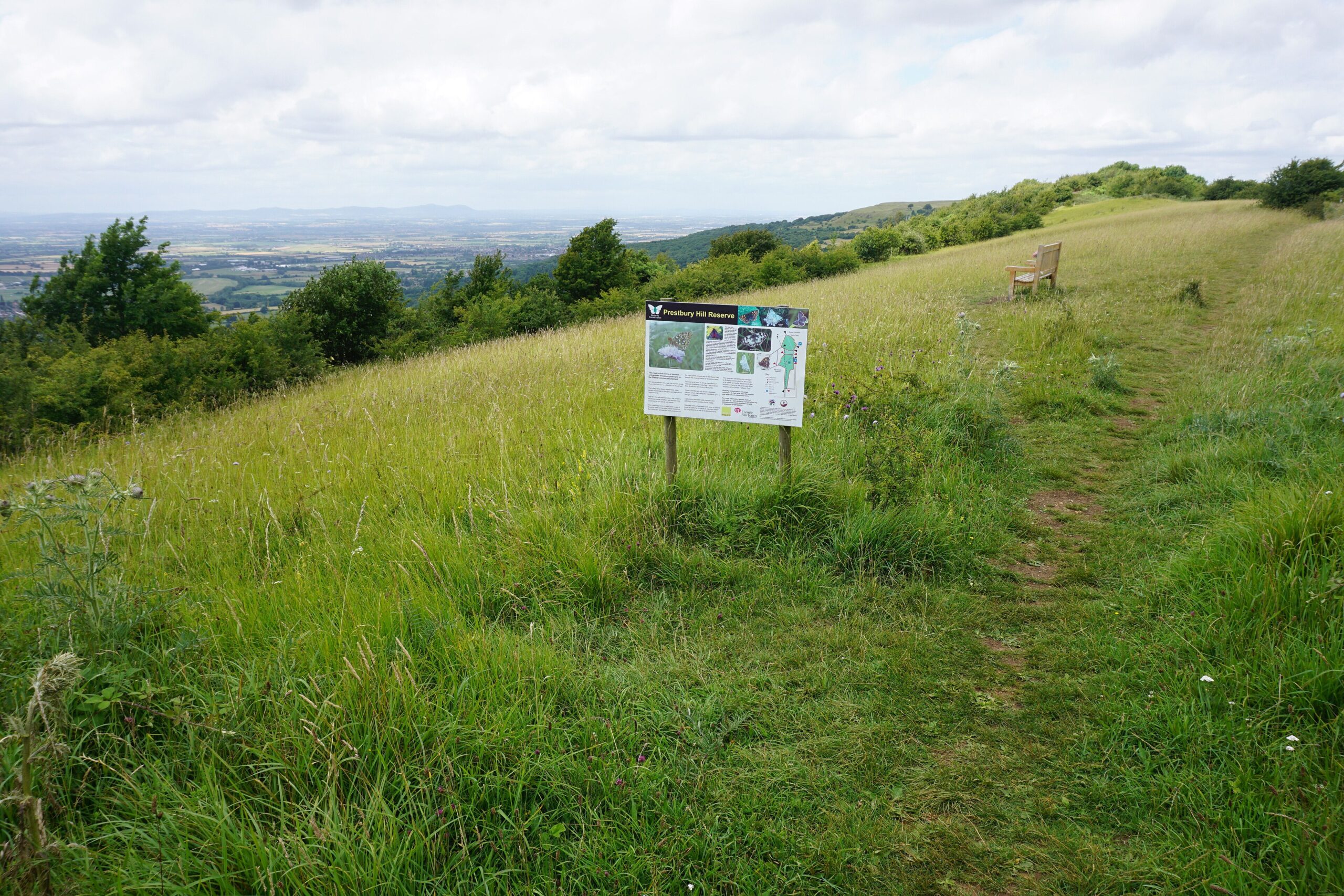
Butterfly Conservation’s Prestbury Hill reserve covers two areas of limestone grassland high on the scarp east of Cheltenham, close to Cleeve Common. It is managed for butterflies, which means flowery, well-grazed turf, and it is one of the best places in the Cotswolds to find musk and bee orchids. Through the summer it is also excellent for butterflies, which is exactly what it is managed for.
Selsley Common, near Stroud
Selsley Common is a big, open, grazed common on the escarpment south-west of Stroud, with long views over the Severn Vale. Among its orchids are bee and fly orchids — the fly orchid is small and dark and very easy to walk past, so go slowly. Selsley’s little church, with its stained glass by William Morris and his circle, is worth a look on the way.
The Cotswold Commons and Beechwoods
The largest National Nature Reserve in the Cotswolds is a chain of beechwoods and limestone grasslands around the upper slopes of the Painswick valley, near Cranham and Sheepscombe. Its grassland commons hold more than 130 species of wildflowers and fifteen species of orchid, including the musk orchid at two locations, and the scarce Duke of Burgundy butterfly flies here in May. The woods add their own orchids, including helleborines in the shade of the beeches.
Rodborough Common and Coaley Peak
The National Trust’s Rodborough Common above Stroud is one of the great limestone commons, carpeted with wild thyme in midsummer and full of orchids and blue butterflies; it was chosen for the reintroduction of the large blue butterfly in 2019. A few miles south, Coaley Peak shows what restoration can do: its twelve acres were arable land until recently, and since Gloucestershire Wildlife Trust adopted the site in 2016 they have filled with sainfoin, yellow rattle, clovers, red campion and orchids. The car park is large and free, which makes it the easiest meadow visit in the region.
Clattinger Farm
Clattinger Farm, part of Wiltshire Wildlife Trust’s Lower Moor Farm reserves near the Cotswold Lakes, is often described as the finest surviving example of enclosed lowland grassland in the UK. Its previous owners farmed traditionally and never used artificial fertilisers — it is said to be the only lowland farm in Britain known never to have received agricultural chemicals at all — and the result is a set of hay meadows of international importance. Snake’s-head fritillaries cover the meadows in late April, green-winged orchids follow, and up to eight species of orchid can be seen in May and June, including the rare burnt-tip orchid.
North Meadow, Cricklade, and Ducklington
North Meadow, beside the Thames Path at Cricklade, is a National Nature Reserve and the most important site in Britain for the snake’s-head fritillary, with around four-fifths of the country’s wild plants. For a week or two in mid to late April it is a sea of chequered purple and white bells, and it is free to walk through on the public paths — stay on them. In Oxfordshire, the village of Ducklington near Witney opens its own fritillary field to visitors on its annual Fritillary Sunday in April, the one day you are allowed to walk among the flowers there.
Greystones Farm, Bourton-on-the-Water
For a meadow walk without leaving the most popular village in the Cotswolds, try Gloucestershire Wildlife Trust’s Greystones Farm on the edge of Bourton-on-the-Water. Its traditional hay meadows by the river are at their best in early summer, and they are a peaceful contrast to the crowded village centre. For more reserves, see our guide to Cotswolds nature reserves.
Bringing the meadows back
The story of Cotswold grassland is no longer only one of loss. In 2019 the Cotswolds National Landscape launched Glorious Cotswold Grasslands, a three-year project funded by the Esmée Fairbairn Foundation to create the largest network of wildflower-rich limestone grassland in the country. It worked so well that it has carried on: more than 200 hectares were restored in the first three years, double the target, and by 2025 restoration had begun on nearly 500 hectares across the National Landscape.
The methods are simple and old-fashioned. Seed-rich hay is cut from the best surviving grasslands and spread on prepared ground nearby; scrub and invasive plants are cleared; landowners get advice on grazing and cutting; and the project works with highway authorities to manage road verges for flowers, linking the meadows into corridors that insects can travel along. Next time you drive through the Cotswolds in June and see a verge full of orchids and knapweed, there is a good chance it is part of the plan.
Lavender, poppies and planted colour
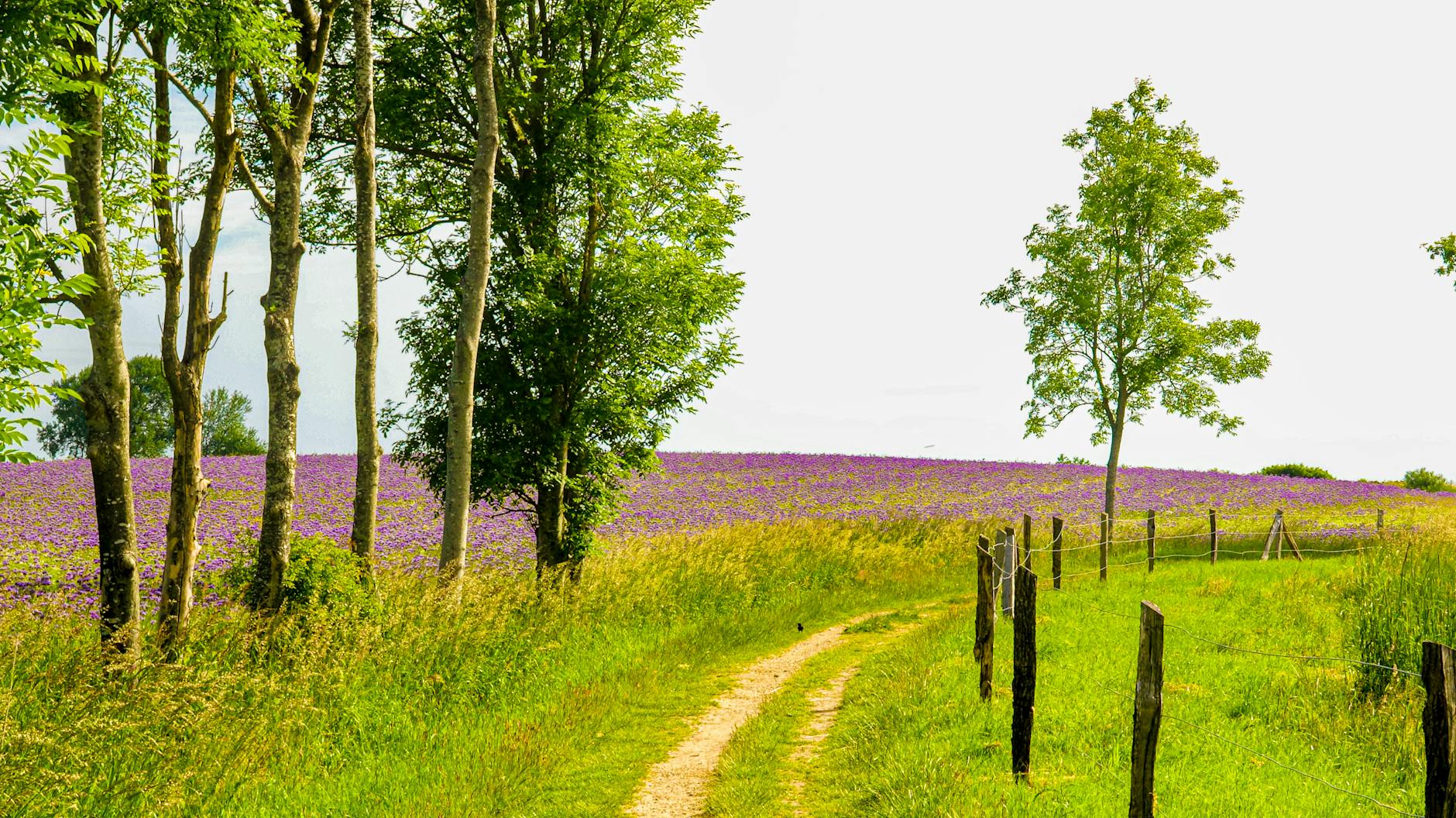
Many of the most photographed “wildflower” scenes in the Cotswolds are nothing of the kind. The purple rows at Cotswold Lavender near Snowshill are a farm crop, open to visitors from mid-June to early August (17 June to 5 August in 2026), and very beautiful for it; our guide to the Cotswolds lavender season covers tickets and timing. The scarlet poppies that light up field margins in June and July are arable weeds that thrive on disturbed ground, and they come and go with the farming year. Enjoy both — but if you want to see what the Cotswold hills looked like before the plough, go to the limestone banks and commons.
Visiting meadows without harming them
- Stay on the paths. Orchids are easily trampled, and a single careless visitor can flatten a patch that took decades to establish.
- Never pick or dig. Uprooting wild plants without permission is illegal, and wild orchids almost never survive being moved.
- Close gates and respect grazing animals. Sheep and cattle are how most grassland reserves are managed.
- Dogs on leads. On open access land they must be on a short lead from 1 March to 31 July to protect ground-nesting birds.
- Do not share exact locations of rare plants. Collectors still dig up rare orchids.
Photographing wildflowers and orchids
Get down to the flower’s level and shoot from the path, using a longer focal length or a macro setting so you do not have to step in. Soft light is best — an overcast day, or the early morning and evening — because harsh sun burns out pale petals. A piece of white card or a small diffuser can soften shadows, and a plain, out-of-focus background makes a single orchid spike stand out. Wind is the enemy: go on a still day, and be patient. Our guide to Cotswolds photography spots has more locations.
Meadow walks to try
Several of the best sites link up with the Cotswold Way, which runs along the escarpment past Selsley Common, Coaley Peak, the Cotswold Commons and Beechwoods and Crickley Hill, so a June walk along almost any stretch of it will take you through flowery grassland. The Slad valley around Swift’s Hill and the commons above Stroud make a superb summer circuit. For routes, see our Cotswolds walking guide and our guide to the Cotswold Way.
Frequently asked questions about Cotswolds wildflower meadows
When are the Cotswold wildflower meadows at their best?
Mid-June, when the orchids and meadow flowers overlap. April brings fritillaries and cowslips, and July the thyme, marjoram and butterflies.
Where can I see wild orchids in the Cotswolds?
Swift’s Hill near Slad, Prestbury Hill above Cheltenham, Selsley Common, the Cotswold Commons and Beechwoods reserve, Rodborough Common and Clattinger Farm are among the best sites.
Where can I see snake’s-head fritillaries near the Cotswolds?
North Meadow at Cricklade, which holds around 80% of Britain’s wild fritillaries, and Clattinger Farm nearby, both best in mid to late April. Ducklington near Witney opens its fritillary field once a year on Fritillary Sunday.
What is limestone grassland?
Unimproved grassland on thin limestone soils, never ploughed or fertilised, and among the richest plant habitats in Europe. More than half of the UK’s Jurassic limestone grassland is in the Cotswolds.
Can I pick wildflowers in the Cotswolds?
No. Uprooting wild plants without the landowner’s permission is illegal, and picking flowers on nature reserves is not allowed. Take photographs instead.
Is the lavender at Snowshill wild?
No — Cotswold Lavender is a working lavender farm, open to visitors in summer. The region’s wild flowers are on the limestone banks and commons.
The meadows are one thread in a bigger story. For the butterflies, birds and mammals that depend on them, see our guide to Cotswolds wildlife and nature; for the spring woods, our guide to bluebell woods in the Cotswolds; and for the reserves that protect the best grassland, our guide to Cotswolds nature reserves.
Photo Credits
Early purple orchids on Selsley Common: FocusedPurpleFlowersOnSelsley by Baryonic Being, CC BY-SA 1.0, via Wikimedia Commons.
The view from the top of Swift’s Hill: On the top of Swifts Hill (14713008938) by Heather from United Kingdom, CC BY 2.0, via Wikimedia Commons.
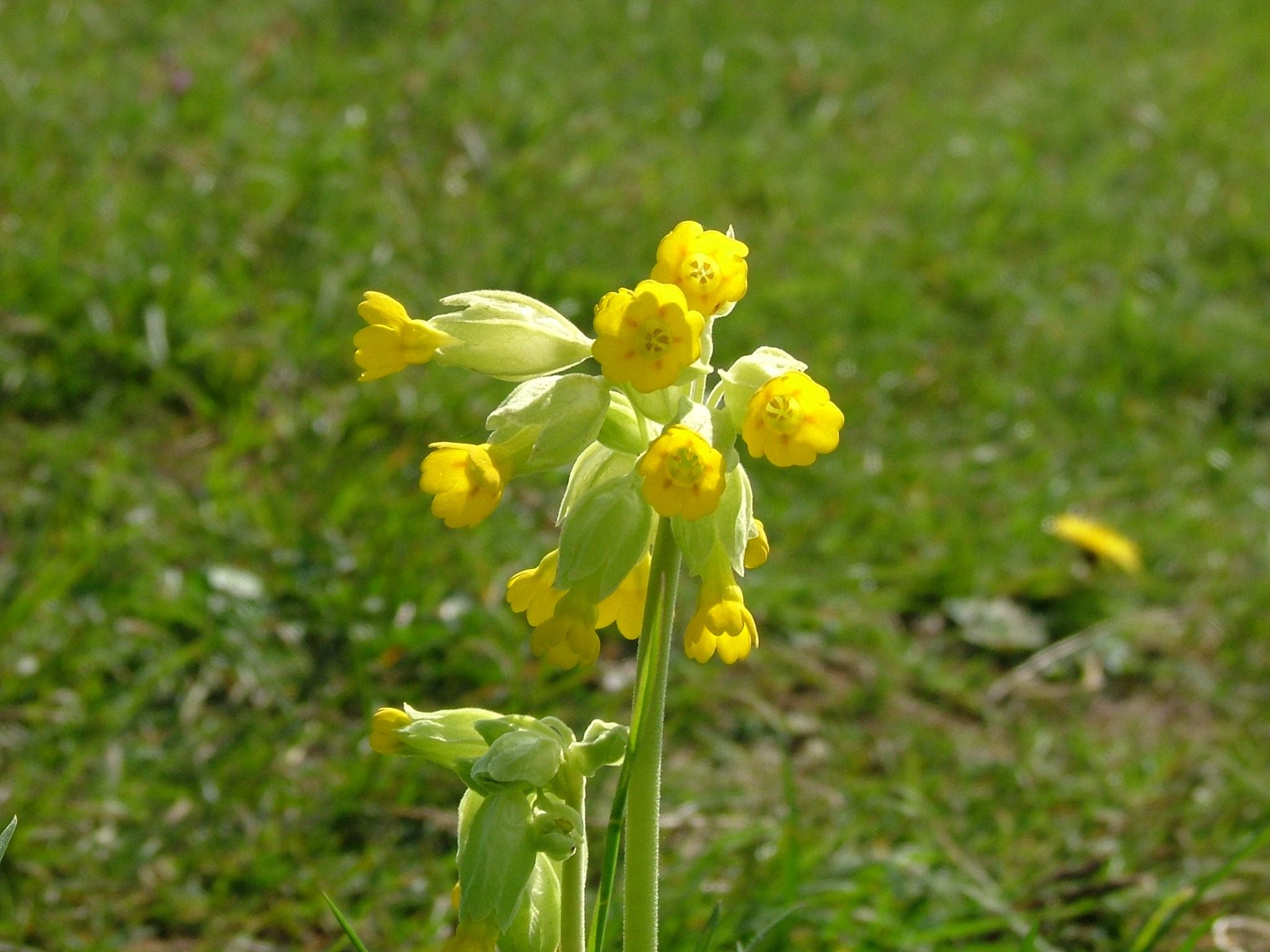
A cowslip on Selsley Common: CowSlipSelsley by Baryonic Being, Public domain, via Wikimedia Commons.
Prestbury Hill nature reserve: Bench and viewpoint in Prestbury Hill Nature Reserve – geograph.org.uk – 4647220 by Bill Boaden, CC BY-SA 2.0, via Wikimedia Commons.
Snake’s-head fritillaries at North Meadow, Cricklade: Flowers in the North Meadow National Nature Reserve, Cricklade – geograph.org.uk – 1820152 by Brian Robert Marshall, CC BY-SA 2.0, via Wikimedia Commons.
Leave a Reply