This article contains advertising. My booking links are routed through a partner that adds commission tracking automatically, so if you book through one I earn a commission from the provider, at no extra cost to you. It never affects what I recommend. Affiliate disclosure
If you can only reach one place in the Cotswolds without a car, make it Moreton-in-Marsh. While most of the region’s honey-stone villages hide down winding lanes far from any railway, Moreton sits right on the mainline, with fast, direct trains from London pulling in just a few minutes’ walk from its broad and handsome High Street. That single fact makes it one of the most useful towns in the whole area: a place you can visit on a day trip from the capital, use as a base for exploring without driving, or simply enjoy for its own considerable charms.
And those charms are real. Moreton-in-Marsh is a proper working market town, not a museum piece, with a famous Tuesday market that is the largest open-air street market in the Cotswolds, a wide main street lined with Georgian and Cotswold-stone buildings, independent shops, excellent pubs, and a clutch of fascinating attractions on its doorstep. This guide pulls together everything you need: how to get here, what to see and do, where to eat and stay, the best nearby days out, and the practical tips that will help you make the most of a town that too many visitors simply pass through.
Where is Moreton-in-Marsh?
Moreton-in-Marsh lies in the northern Cotswolds, in Gloucestershire, close to the borders with Warwickshire, Worcestershire and Oxfordshire. It sits on the A429, which follows the line of the old Roman Fosse Way, and this dead-straight Roman road is the reason for the town’s unusually wide and generous main street. Stow-on-the-Wold is only about four miles to the south, Bourton-on-the-Water around seven, and the market town of Chipping Norton a similar distance to the east, which puts Moreton squarely at the crossroads of the most visited part of the region.
That central position is a big part of Moreton’s appeal. From here you are within easy reach of dozens of the area’s most famous villages and gardens, yet the town itself has a relaxed, lived-in feel that some of the prettier honeypots have lost. It is a place where local life carries on around the visitors rather than being staged for them, and it makes an ideal hub for a longer Cotswold holiday. It sits comfortably among our pick of the best Cotswolds villages and towns precisely because it still works as a real place.
Getting to Moreton-in-Marsh by train
This is where Moreton really comes into its own. It has the only mainline railway station in the heart of the Cotswolds, sitting on the Cotswold Line and served by Great Western Railway. Direct trains run from London Paddington, and the journey takes around an hour and a half, with the fastest services doing it in roughly an hour and twenty-five minutes, which genuinely makes a day trip from London possible. Trains also connect directly to Oxford in around 35 minutes and to Reading in about an hour, so a great swathe of southern England can reach Moreton without ever touching a steering wheel.
The station could hardly be more convenient: it is just a short, level walk from the top of the High Street, and the town is compact enough to explore entirely on foot once you arrive. For anyone keen to see the region the low-stress, low-carbon way, this makes Moreton the natural gateway. You can read more about exploring the area without a car in our guide to getting to and around the Cotswolds, but the short version is simple: arrive in Moreton by train, and the rest of the region opens up. From the station you can also pick up buses to surrounding villages, or simply walk straight into a town that has plenty to fill a day.
A brief history: Roman roads and royal charters
Moreton’s story begins with the Romans, whose Fosse Way marched dead straight across the country and still forms the spine of the modern town. The settlement we see today, however, is essentially a planned medieval new town. In the early thirteenth century the Abbot of Westminster, who held the manor, set about developing a market town on common land beside the Fosse Way, just to the north-west of the older Saxon settlement that survives in the part of town still known as Old Town.
The decisive moment came in 1227, when King Henry III granted the town a charter for a weekly market. A market has been held in Moreton-in-Marsh every Tuesday more or less ever since, close to eight hundred years of continuous trading. That long burgage-plot layout, with narrow shop frontages opening onto the wide street, is the classic shape of a medieval market town, and it is the reason the High Street still works so beautifully as a marketplace today. Incidentally, the “Marsh” in the name has nothing to do with bogland; it most likely derives from an old word for a boundary or march, reflecting the town’s position where several counties meet. For more on how the region was shaped, see our guide to Cotswolds history and heritage.
The Moreton-in-Marsh Tuesday market
If you can possibly time your visit for a Tuesday, do. Every Tuesday the High Street is transformed into the largest open-air street market in the Cotswolds, with around 200 stalls stretching the length of the town. It is a wonderfully unpretentious, properly local affair, a world away from the boutique “artisan” markets you find elsewhere, and all the better for it. This is where Cotswold residents have come to do their shopping for centuries, and it still has that genuine, slightly chaotic energy.
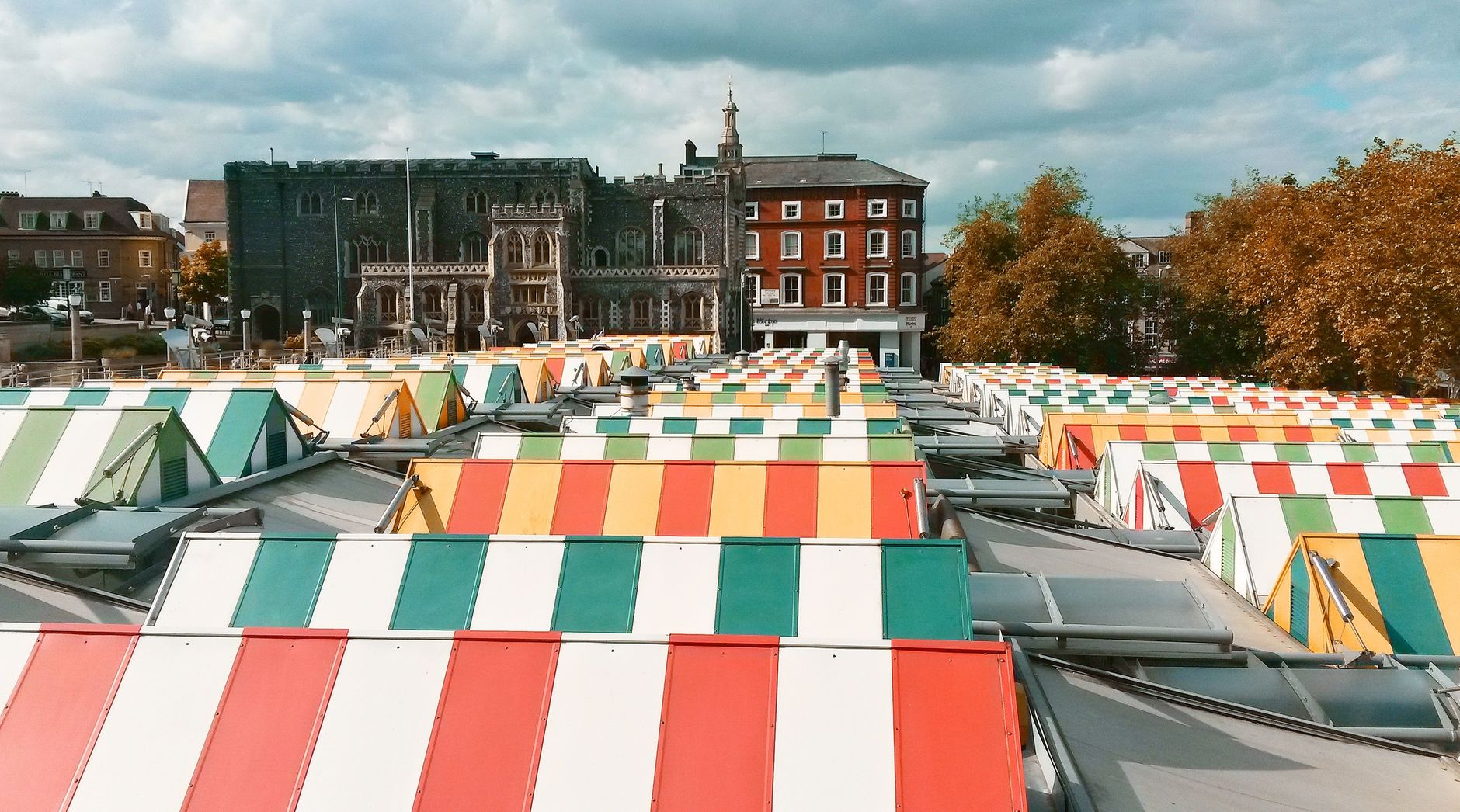
The stalls sell just about everything: fresh fruit and vegetables, fish, cheese, local produce, plants, clothing, fabrics, leather goods, books, household bits, tools and bric-a-brac. You will hear traders calling out their prices, smell street food drifting down the street, and find bargains you would never come across in the smart village shops. It runs through the morning and into the early afternoon, so arrive in good time, bring some cash, and be prepared for the town and its car parks to be busy. The market gets its own deep-dive in our wider guide to Cotswolds shopping, markets and antiques, but experiencing it in person is the only way to really understand why it has endured for eight centuries.
Things to do in Moreton-in-Marsh
Even on a non-market day, Moreton rewards a wander. The town’s history and character are written into its buildings, and there are a handful of specific sights worth seeking out as you stroll the High Street and its side lanes. For ideas beyond the town itself, our guide to things to do in the Cotswolds covers the wider area.
The Curfew Tower
On the corner of Oxford Street stands the Curfew Tower, one of the oldest buildings in the town, dating back to around the sixteenth and early seventeenth centuries. It still houses its old bell, which for centuries was rung each evening as a curfew, telling townspeople to damp down their fires and put out their lights to reduce the risk of fire sweeping through the timber-and-thatch town. The tower also served as the local lock-up for drunks and minor offenders. The bell was reportedly last rung regularly in the 1860s, and the little tower is a charming, easily missed survivor of medieval town life.
The White Hart Royal Hotel
Among the coaching inns that once served travellers on the Fosse Way, the White Hart Royal is the most storied. A former manor house turned coaching inn, it is famous as the place where King Charles I is said to have stayed in 1644, during the English Civil War, after the Battle of Marston Moor. Today it is a comfortable hotel, but its frontage and history are a tangible link to the days when Moreton was an important stop on the road between London and Worcester.
The Wellington Aviation Museum
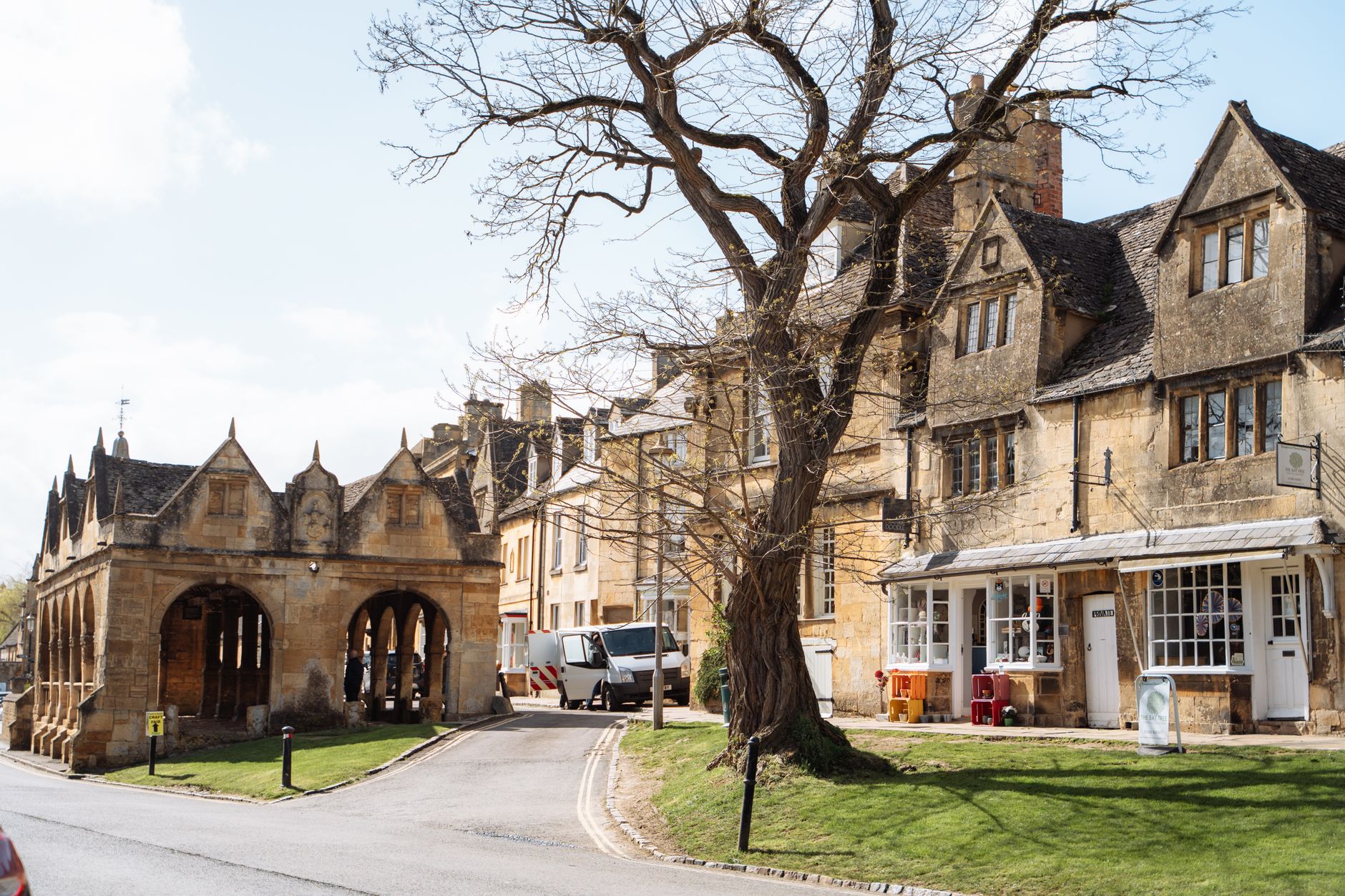
A more unexpected attraction is the Wellington Aviation Museum, a small but characterful private museum packed with Second World War aircraft memorabilia, paintings, models and RAF history. It takes its name from the Wellington bomber and reflects the town’s wartime connection to the nearby RAF airfield. For aviation enthusiasts it is a real treat, and for everyone else it is a reminder of the surprising stories tucked away in even the smallest Cotswold towns. The handsome pillared Redesdale Market Hall, built in the nineteenth century in the middle of the High Street, is another landmark worth noticing as you explore.
The best pubs and places to eat
Moreton is well supplied with good places to eat and drink, from historic coaching inns to characterful cafés. Two pubs in particular stand out. The Bell Inn carries a wonderful literary footnote: it is widely believed to have inspired The Prancing Pony, the inn at Bree in The Lord of the Rings. J.R.R. Tolkien knew this part of the Cotswolds well, and the Four Shire Stone just outside town is often cited as the model for his Three-Farthing Stone. True or not, it is a lovely story to mull over a pint, and the Bell is an excellent pub in its own right, with a smart courtyard and a menu built on local, seasonal produce.
The other essential is the Black Bear Inn, a traditional pub on the High Street and a tied house of the local Donnington Brewery. It is the place to come for honest, well-priced pub food and a pint of properly local ale, with much of the menu sourced from farms just a few miles away. Beyond the pubs, the town has a growing café scene; Grouch Coffee, which famously began life as a coffee stall in a tuk-tuk before finding a permanent home near the station, has a devoted following. There are food shops worth seeking out too, not least the Cotswold Cheese Company for a picnic-perfect selection of local cheeses. For the full regional picture, see our guides to Cotswolds food and drink and the best pubs in the Cotswolds.
Shopping in Moreton-in-Marsh
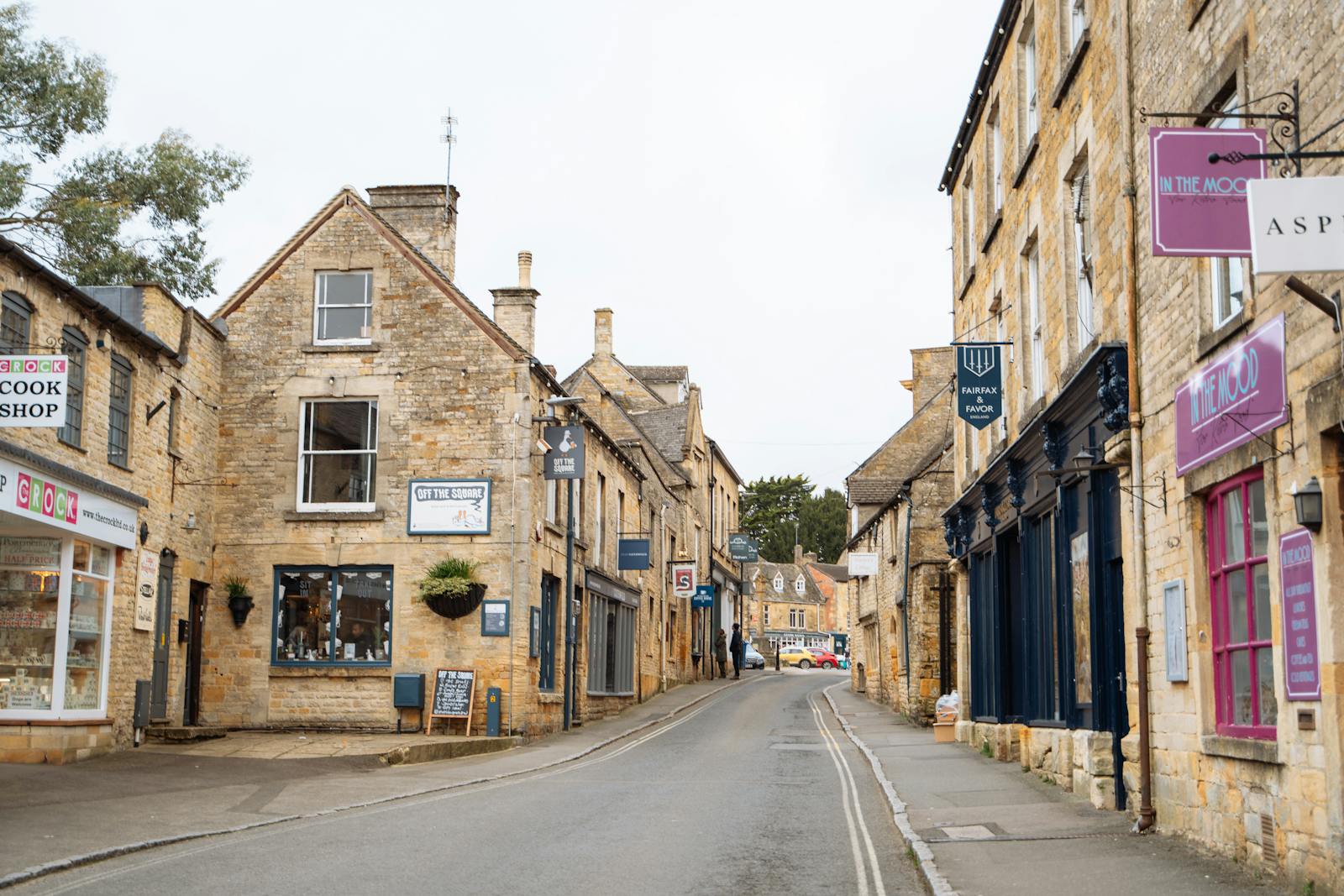
Beyond the Tuesday market, Moreton has one of the better independent shopping streets in the northern Cotswolds. The High Street and its offshoots are dotted with antique shops, galleries, gift shops, delicatessens, bookshops and homeware stores, alongside the practical, everyday shops that keep the town ticking over for residents. It is a town where you can pick up a genuine antique, a local cheese and a good book in the space of an hour, without ever feeling that the place exists purely for tourists.
Because Moreton is a working town rather than a chocolate-box village, prices here tend to be a little more down-to-earth than in the showpiece villages nearby, and there is real variety to the shops. Combine a morning at the market with an afternoon browsing the antique dealers and you have the makings of a thoroughly enjoyable day. If you are watching the pennies, our guide to the Cotswolds on a budget shows how a market town like this can keep costs sensible.
Nearby attractions and day trips
Moreton’s location makes it a superb springboard for some of the finest attractions in the Cotswolds, several of which are within a couple of miles of the town.
Batsford Arboretum, around a mile and a half north-west of town, is home to one of the largest private collections of trees in the country, with thousands of specimens spread across some 56 acres of beautifully landscaped hillside. It is spectacular in autumn, when the Japanese maples blaze red and gold, and lovely in spring for its magnolias and cherry blossom. Right beside it, the Cotswold Falconry Centre is home to around 150 birds of prey, with daily flying demonstrations that are a particular hit with families. A little further afield, Sezincote is an extraordinary surprise: a country house built in the exotic Mughal style of northern India, complete with onion dome, which is said to have inspired the Prince Regent’s Royal Pavilion in Brighton. Batsford features in our roundup of the best gardens in the Cotswolds, and the falconry centre in our guide to Cotswolds family holidays.
History lovers should make for the Four Shire Stone, about two miles east of town, an eighteenth-century pillar that once marked the meeting point of four historic counties (Gloucestershire, Warwickshire, Worcestershire and Oxfordshire) before boundary changes in 1931 left it marking just three. The National Trust’s Jacobean Chastleton House is also within easy reach. And of course Moreton is perfectly placed for the surrounding villages and towns: handsome Stow-on-the-Wold is just down the Fosse Way, the much-photographed Bourton-on-the-Water a little beyond, and the quiet, unspoilt villages of Stanton and Stanway make a wonderful contrast to the busier market town. For more ideas on stringing these together, see our Cotswolds itineraries and day trips.
Where to stay in Moreton-in-Marsh
Moreton makes an outstanding base for a Cotswolds holiday, precisely because of that railway station and central location. The town offers a good range of accommodation, from historic coaching inns like the White Hart Royal on the High Street to comfortable bed-and-breakfasts, guesthouses and self-catering cottages in and around the town. Staying here means you can leave the car behind for days at a time, arriving by train and exploring the surrounding villages by bus, bike or on foot.
Because it is a working town rather than a tourist village, Moreton also tends to offer slightly better value than some of its more famous neighbours, and it has the practical advantages (supermarkets, a railway station, plenty of parking) that make a longer stay easy. For a full rundown of options and areas across the region, browse our guide to where to stay in the Cotswolds.
The best time to visit
The single most important timing decision is the day of the week: come on a Tuesday if you want to experience the famous market, or deliberately avoid Tuesday if you would rather have a quieter, calmer town to explore. Both have their merits. Market day is loud, busy and full of life; the rest of the week, Moreton is a relaxed and pleasant place to stroll and shop.
Seasonally, spring and autumn are particularly rewarding, with Batsford Arboretum at its most beautiful and the surrounding countryside at its best for walking. Summer is busiest and brings the longest days for exploring, while the run-up to Christmas sees the town hold seasonal markets and events. Whenever you come, Moreton’s covered station and indoor options make it a more weatherproof choice than many Cotswold villages. Our month-by-month guide to the best time to visit the Cotswolds can help you fine-tune your plans, and there is good walking straight from the door, covered in our guide to walking and hiking in the Cotswolds.
Practical tips for visiting Moreton-in-Marsh
- Come by train if you can. Moreton’s mainline station, with direct trains from London Paddington in around 90 minutes, makes it the easiest car-free base in the Cotswolds.
- Visit on a Tuesday for the market. The famous Tuesday market runs from the morning into early afternoon. Arrive early, as the town and car parks fill up quickly.
- Bring cash for the market. Many market traders prefer cash, even if the town’s shops and cafés take cards.
- Use it as a hub. Stow, Bourton, Batsford and Chipping Norton are all close by, making Moreton an ideal centre for day trips.
- Don’t skip the side streets. Some of the best shops, the Curfew Tower and the quieter corners of Old Town reward a wander off the main High Street.
- Check opening days for attractions. Smaller sights like the Wellington Aviation Museum and nearby houses such as Sezincote have limited opening hours, so check ahead.
Frequently Asked Questions
Is Moreton-in-Marsh worth visiting?
Yes. Moreton-in-Marsh is one of the most useful and characterful towns in the Cotswolds, with a famous Tuesday market, a handsome historic High Street, good pubs and shops, and excellent attractions nearby. Its mainline railway station also makes it the easiest place in the region to reach without a car, which is a major plus for many visitors.
What day is Moreton-in-Marsh market?
Moreton-in-Marsh market is held every Tuesday and has been for nearly 800 years, since the town was granted a market charter in 1227. With around 200 stalls along the High Street, it is the largest open-air street market in the Cotswolds. It runs through the morning into the early afternoon.
How do you get to Moreton-in-Marsh from London?
Direct Great Western Railway trains run from London Paddington to Moreton-in-Marsh in around an hour and a half, with the fastest services taking about an hour and twenty-five minutes. The station is a short walk from the High Street, making Moreton an easy day trip from London or a convenient car-free base in the Cotswolds.
What is there to do near Moreton-in-Marsh?
Within a couple of miles you will find Batsford Arboretum, the Cotswold Falconry Centre and the exotic Sezincote House, plus the historic Four Shire Stone and the National Trust’s Chastleton House. The town is also a great base for visiting nearby villages and towns such as Stow-on-the-Wold, Bourton-on-the-Water, and the unspoilt villages of Stanton and Stanway.
Is Moreton-in-Marsh a good base for the Cotswolds?
It is one of the best. Thanks to its mainline station, central location on the Fosse Way, good range of accommodation and everyday amenities, Moreton-in-Marsh is ideal for exploring the wider region, particularly if you want to minimise driving. Many visitors use it as a hub for day trips across the northern and central Cotswolds.
What does the “Marsh” in Moreton-in-Marsh mean?
Despite the name, it has nothing to do with marshland. The word most likely comes from an old term for a boundary or march, reflecting the town’s position close to where Gloucestershire, Warwickshire, Worcestershire and Oxfordshire meet. The full name distinguishes it from other places called Moreton.
Related guides
Moreton-in-Marsh is the perfect starting point for a wider Cotswold adventure. From here, head down the Fosse Way to Stow-on-the-Wold, on to Bourton-on-the-Water, or seek out the quiet charm of Stanton and Stanway and nearby Snowshill. To see how it all fits together, start with our complete guide to visiting the Cotswolds and explore our pillar on the prettiest villages in the Cotswolds before planning your trip.