This article contains advertising. My booking links are routed through a partner that adds commission tracking automatically, so if you book through one I earn a commission from the provider, at no extra cost to you. It never affects what I recommend. Affiliate disclosure
If you are driving in from London or Oxford, Burford is very often the first proper taste of the Cotswolds you get, and it makes a strong opening argument. You crest the hill on the old A40 road, turn down into the town, and the High Street falls away in front of you, a broad, handsome slope of golden stone running all the way down to a medieval bridge over the River Windrush. It has earned its nickname as the “gateway to the Cotswolds”, and it is one of those views that makes people pull over and reach for a camera before they have even parked.
Burford is a town with real substance behind the looks. It grew wealthy on medieval wool, it has a great barn of a church with a genuinely dark Civil War story attached, a long tradition of antiques and independent shops, and some excellent pubs in which to round off a day. It sits just over the border on the Oxfordshire side of the Cotswolds, which gives it a slightly different feel from the Gloucestershire villages, and there is a famous wildlife park on its doorstep. Give it a day, or use it as a base for the Windrush valley, and it more than holds its own.
The High Street
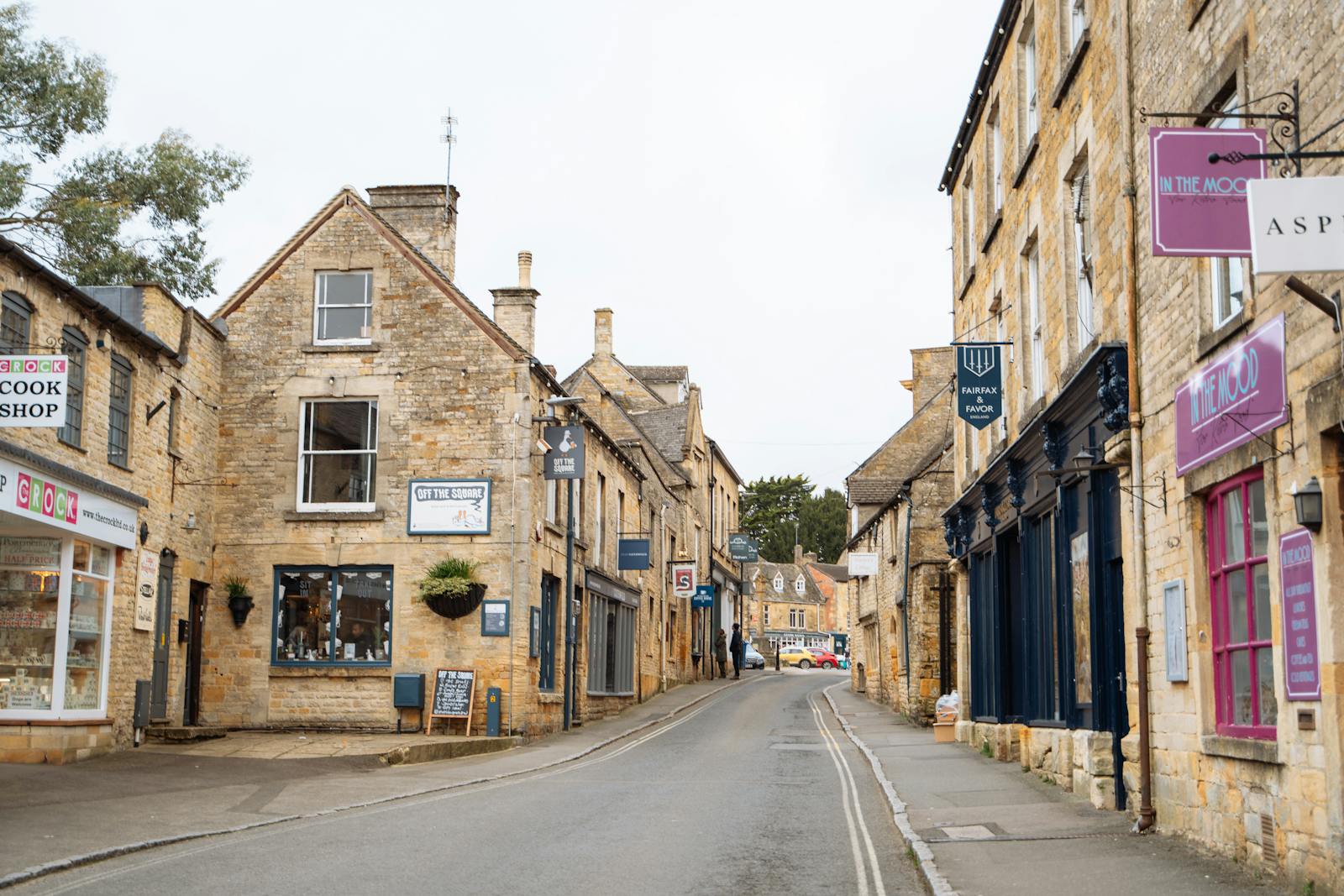
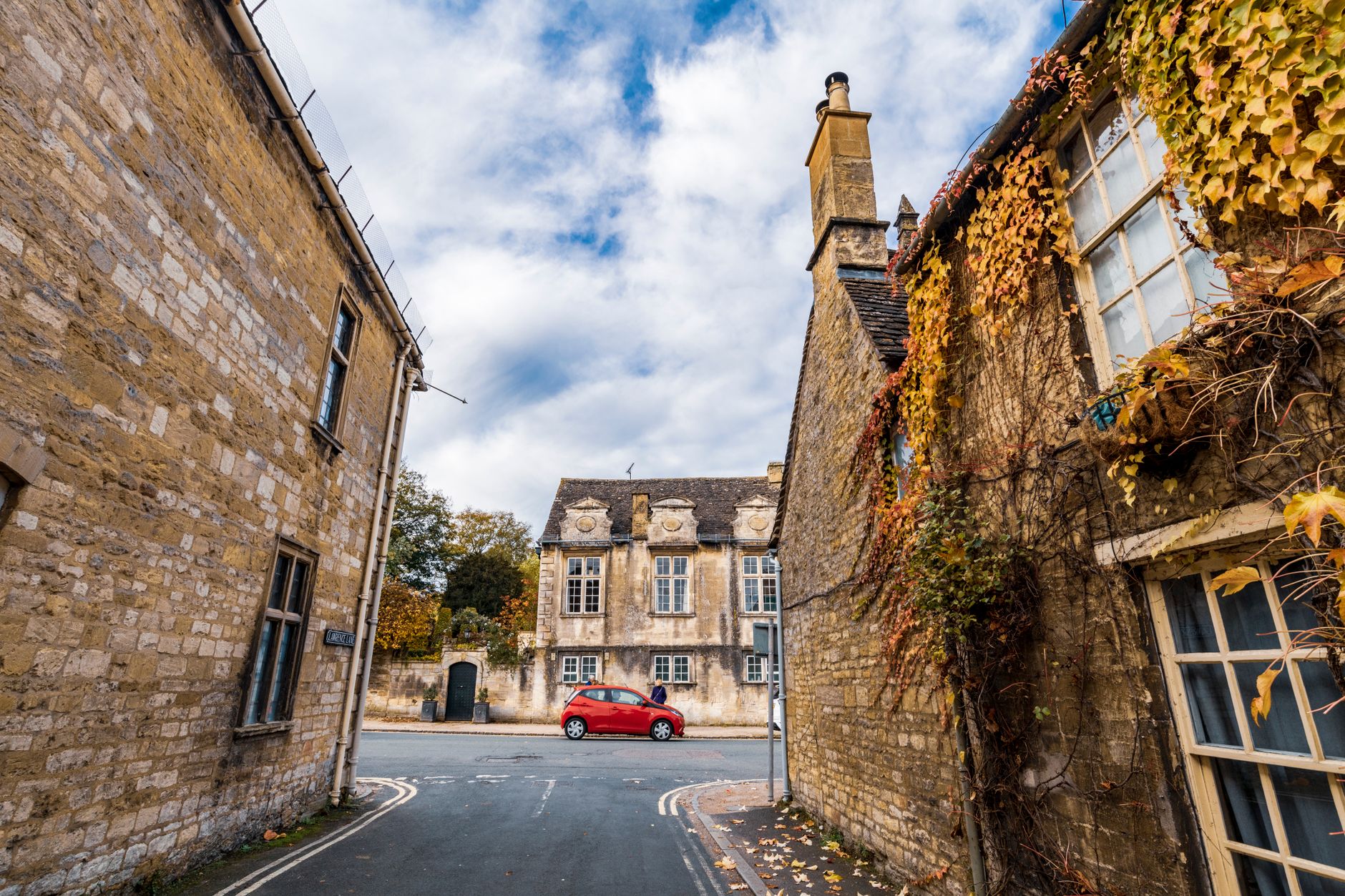
Burford begins and ends with its High Street, and it is no ordinary one. It is a long, curving hill that drops from the top of the town down to the river, lined on both sides with an extraordinary jumble of buildings spanning six centuries, all in the warm local limestone. Grand Georgian townhouses stand cheek by jowl with medieval merchants’ houses, Tudor inns and elegant later shopfronts, the whole lot stepping down the slope in a way that no architect could plan and only time could produce.
The street is unusually wide, and there is a reason for that: this was a serious market and droving town, and the breadth was needed to handle the flocks of sheep and the market stalls that once filled it. Today it is lined with an enjoyable mix of independent shops, antiques dealers, galleries, tearooms and restaurants, with very few chains to break the spell. Walking down towards the river, stone buildings rising on either side and the church tower coming into view ahead, is one of the simple great pleasures of a Cotswold day out.
Do not just march down the middle. The narrow lanes leading off the High Street are where some of the best of Burford hides. Sheep Street, running west, is a quiet, handsome row of stone houses that was once the route along which sheep were driven to market. Witney Street heads east, and Priory Lane drops towards the river; both reward a short detour and get you away from the busiest stretch.
The Church of St John the Baptist
At the foot of the High Street stands the parish church of St John the Baptist, one of the largest and grandest wool churches in the Cotswolds. Building began around 1175 and went on in stages until roughly 1500, which is why it reads as a glorious muddle of Norman, Early English, Decorated and Perpendicular Gothic all in one building, four centuries of church-building written into a single set of walls. The sheer scale of it tells you how much money the wool trade brought to a town of this size.
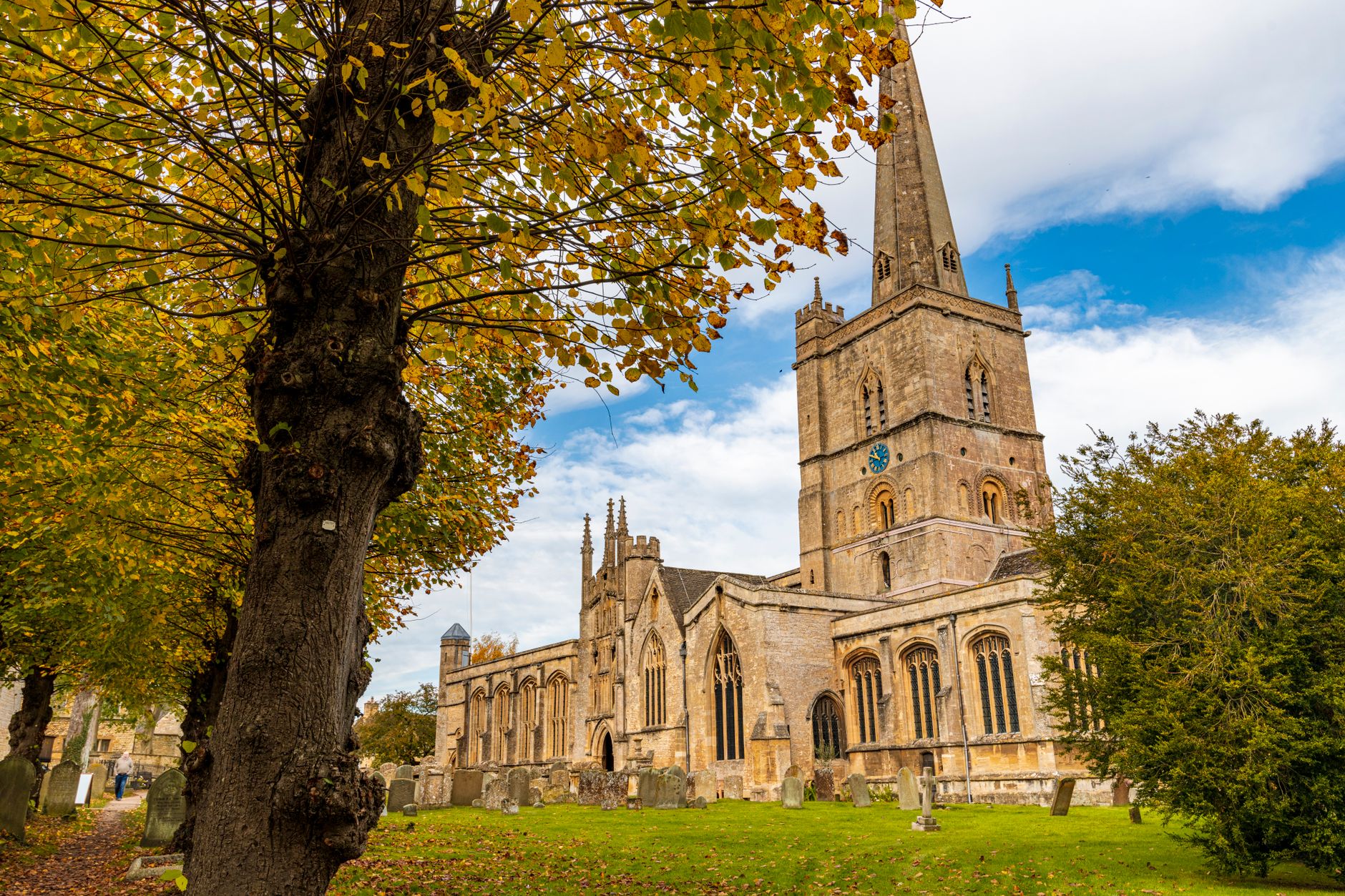
Inside there is plenty to slow you down: a fan-vaulted porch, fine medieval brasses and monuments, carved chapel screens, and tomb effigies of wealthy merchants spanning several centuries. Look in particular at the south chapel, with its fifteenth-century memorials to the wool men who paid for so much of the building. Entry is free. For the wider story of how wool money built churches like this across the region, our guide to Cotswolds history and heritage is a good companion.
The Levellers and a Civil War tragedy
This handsome church holds one of the bleakest stories in Burford’s past. In May 1649, in the aftermath of the Civil War, several hundred soldiers of Parliament’s own New Model Army mutinied. Known as the Levellers, they had refused to be shipped off to fight in Ireland without their back pay and were pressing for a more democratic settlement, ideas well ahead of their time. Oliver Cromwell pursued them, surprised them at Burford by night, and locked around 340 of them up in this church.
They were held here for three days. On 17 May 1649, three of the ringleaders were taken out, stood against the churchyard wall and shot by firing squad while the rest were forced to watch from the church roof. You can still see, scratched into the lead rim of the font, the name of one of the prisoners: “Anthony Sedley 1649 Prisner”. A plaque on the outside wall remembers the three men who died. Every May the town holds Levellers Day, a gathering that commemorates the events and the democratic ideals the Levellers stood for, which is a thoughtful and unusual thing for an English market town to keep alive.
The Tolsey and Burford’s old market life
About halfway down the High Street, raised up on timber posts with an open arcade beneath, stands the Tolsey, a striking sixteenth-century building. The name comes from the tolls once collected here; this was the administrative heart of medieval Burford, where the market business was run, dues were paid and the merchants did their dealing. It is a reminder that the pretty High Street was, for centuries, first and foremost a place of hard commerce.
Today the Tolsey houses a small but genuinely interesting local history museum, run by knowledgeable volunteers, telling the story of the town’s trades and daily life through the centuries, with material on the wool trade, the Civil War and local crafts. Admission is free and its central spot makes it an easy stop. It is exactly the kind of modest, lovingly kept town museum that gives you the texture of a place you would otherwise just walk past.
Antiques and independent shopping
Burford is one of the best antiques towns in the Cotswolds, with a cluster of dealers and showrooms that pulls in collectors from well beyond the county. You will find specialists in period English and Continental furniture, multi-dealer centres mixing vintage jewellery, china and silver, and at least one well-known dealer in sporting antiques and curiosities, the sort of place where you go in for a browse and come out wanting a Victorian fishing reel you have no use for. Prices run the full range, and even window-shopping is a pleasure.
Beyond antiques, the High Street and its side lanes hold a really good crop of independent shops, bookshops, artisan food shops, galleries showing local artists, homeware and clothing, almost all of them in historic buildings that are half the fun to browse in. The near-total absence of chain stores gives Burford a distinct, individual character that many larger market towns have lost. If old and interesting things are your weakness, pair the visit with our wider guide to Cotswolds shopping, markets and antiques.
The Windrush and the medieval bridge
At the bottom of the hill the road crosses the River Windrush on a lovely three-arched medieval bridge, one of the most photographed spots in town. The Windrush is among the best-loved of the Cotswold rivers, a gentle, clear stream that rises up near Cutsdean and winds through some of the prettiest country in England before joining the Thames near Witney. The bridge, with its low stone parapets and arches mirrored in the water, is the natural full stop at the end of a walk down the High Street.
Downstream of the bridge the riverbanks make a pleasant short stroll, with willows trailing in the water and meadows opening out on either side. On a warm day families come down to paddle in the shallows, and in summer the surrounding fields are full of wildflowers. It is a quiet, green counterpoint to the bustle of the street above, and a good spot to let a picnic stretch out.
Cotswold Wildlife Park
A couple of miles south of Burford lies one of the most popular family attractions in this part of the Cotswolds, the Cotswold Wildlife Park and Gardens. Set in around 160 acres of landscaped parkland and gardens around a Victorian manor house, it is home to well over a thousand animals, from rhinos, giraffes and big cats to lemurs, penguins and reptiles, and it consistently ranks among the larger zoological collections in the country. The gardens themselves are a draw, and a narrow-gauge railway runs in the warmer months, which keeps younger visitors happy.
It is open year-round, with longer hours in summer and shorter ones in winter, and last admission is typically an hour or so before closing; in the depths of winter it tends to close on weekdays for a few weeks while staying open at weekends, so it is worth checking ahead and buying tickets online, which usually works out cheaper. It makes an easy half-day on its own or a good rainy-afternoon fallback, and it sits naturally alongside a morning in the town. For more family ideas, our guide to the Cotswold Wildlife Park goes into detail.
Walks from Burford
Burford to Swinbrook and Widford
The finest walk from Burford is a circuit of around six miles through the beautiful Windrush valley, and it strings together some of the most atmospheric corners of the eastern Cotswolds. The route heads out through Fulbrook and across farmland to the enchanting village of Swinbrook, where the church of St Mary holds the remarkable Fettiplace monuments, reclining stone effigies of local squires stacked in tiers like bunk beds, an oddity well worth the look. Swinbrook is also where several of the famous Mitford sisters are buried, in the quiet churchyard.
From Swinbrook the path carries on to the tiny hamlet of Widford, where the lonely little medieval church of St Oswald stands by itself in a field, built on the site of a Roman villa and still with fragments of wall painting and a scrap of Roman mosaic inside. It is one of the most quietly moving spots in the Cotswolds. The walk then follows the Windrush back to Burford. Allow two and a half to three hours. For more routes at every level, see our guide to walking and hiking in the Cotswolds.
A shorter town and river loop
If time or legs are limited, a gentle three-mile loop takes in the High Street, the church, the medieval bridge and the riverside meadows before returning by Priory Lane and the quieter back streets. It is an easy hour to an hour and a half at a stroll, suits all abilities, and is a fine introduction to the town for first-time visitors.
Where to eat and drink
Burford eats and drinks very well for a town of its size, and the historic inns are a big part of the appeal. The Highway Inn, parts of which date back to 1480, has been putting up travellers for well over five hundred years and keeps its original beams, stone fireplaces and a tucked-away courtyard garden. The Lamb Inn is another fifteenth-century favourite, with flagstone floors, log fires and a peaceful walled garden, doing refined but unfussy cooking built on local ingredients. The Angel, an old coaching inn, has a long-standing reputation as one of the better gastropubs in the area.
For something more traditional, there are pubs along and just off the High Street doing proper pies, good ale and a roaring fire in winter, and the Cotswold bakery Huffkins has a tearoom here for cream teas, cakes and a restorative pot of something in the afternoon. As ever, book ahead for dinner at weekends and check opening days off-season, when some kitchens ease back midweek. For more ideas, our roundup of the best pubs in the Cotswolds will point you to plenty more in the area.
Where to stay
Burford makes an excellent and very well-placed base for the eastern Cotswolds, particularly if you are coming from the Oxford or London direction and want to ease yourself into the region. Several of the old coaching inns offer characterful rooms right on the High Street, there are smart small hotels and a good spread of bed and breakfasts, and self-catering cottages can be had in the town and the surrounding lanes. Staying over also lets you enjoy the street in the early morning and evening, once the day visitors have drifted off and the stone glows in the low light.
From here you are well set for the Windrush valley villages, with the Slaughters and Bourton-on-the-Water within easy reach to the west, and the eccentric hilltop village of Snowshill, with its extraordinary manor, a manageable drive north. To compare areas and styles before booking, our guide to where to stay in the Cotswolds breaks the region down by character and budget.
A little history
Burford is an old place. There was a Saxon settlement here, and the town is recorded in the Domesday Book of 1086 with a population of around two hundred. The decisive moment came soon after, around 1090, when Burford was granted a charter by Robert Fitzhamon, one of the earliest borough charters in England, giving the townspeople the right to hold a market and effectively freeing them from much of the feudal grip of the manor. That early independence helped shape the confident, self-reliant town that grew up over the following centuries.
From the fourteenth to the seventeenth century Burford grew rich on wool and the trades that fed off it, spinning, weaving, fulling and tanning, and at one time its saddlers had a reputation that reached well beyond England. The grand stone buildings of the High Street and the great church are the visible legacy of that golden age. South of the town, on the site of the old Saxon village, an Augustinian priory hospital once cared for travellers and the sick until Henry VIII’s dissolution; Burford Priory, a handsome later house incorporating some of the medieval fabric, stands there now.
How to get there and practical tips
Burford sits on the A40 between Oxford, about 20 miles to the east, and Cheltenham, around 30 miles west, which makes it one of the most easily reached towns in the Cotswolds. By car it is roughly an hour and a half from London via the M40, about half an hour from Oxford and around 40 minutes from Cheltenham. The nearest railway station is Charlbury, some ten miles away on the Cotswold Line from London Paddington via Oxford; from Oxford itself there are regular buses, with the Stagecoach service linking the city and Burford. For the full picture, see our guide to getting to and around the Cotswolds.
For parking, there is a pay-and-display car park near the top of the High Street and more space lower down near the church and the river, which spares you the steep walk back up at the end of the day. Spaces fill on summer weekends, so an earlier start helps, and on-street parking along the High Street itself is limited and restricted. The town is easily walkable once you are there, though the gradient is real, so bear that in mind if you have anyone in the party who struggles with hills.
How long to spend, and when to visit
Burford deserves at least half a day to do the High Street, the church and the Tolsey, and to browse the shops. Add the Cotswold Wildlife Park or a walk out to Swinbrook and Widford and you have a full and rewarding day. The town also makes a comfortable base for two or three nights, combining easily with the Slaughters, Bourton and the Windrush valley villages.
Spring and autumn are arguably the loveliest times, with soft light on the stone and fewer crowds; the Swinbrook and Widford walk is especially good when the valley turns in October. Summer is busiest, particularly at weekends, though the broad High Street absorbs people better than tighter villages do. Even in winter the church, the museum and a warm pub will fill a happy few hours. For help planning around the calendar, our guide to the best time to visit the Cotswolds goes month by month.
Frequently Asked Questions
Why is Burford called the gateway to the Cotswolds?
Burford sits on the eastern edge of the Cotswolds, on the Oxfordshire side, right on the A40 from Oxford and London. For many visitors arriving from that direction it is the first classic Cotswold town they reach, with its famous sloping High Street of golden stone, so it has long been thought of as the gateway to the region.
What happened to the Levellers at Burford church?
In May 1649, Oliver Cromwell imprisoned around 340 mutinous New Model Army soldiers, the Levellers, in St John the Baptist Church. After three days, three ringleaders were shot against the churchyard wall on 17 May. A prisoner’s name, Anthony Sedley, is still scratched into the font, and the town holds Levellers Day each May to remember the events.
Is the Cotswold Wildlife Park near Burford worth visiting?
Yes, especially with children. It lies a couple of miles south of the town in around 160 acres of parkland and gardens, with well over a thousand animals and a seasonal narrow-gauge railway. It is open year-round with shorter winter hours, and tends to close on winter weekdays for a few weeks, so check opening times and book online, which is usually cheaper.
How long do you need in Burford?
Allow at least half a day for the High Street, the church, the Tolsey Museum and the shops. Add the wildlife park or the walk to Swinbrook and Widford and you can fill a full day comfortably. Burford also works well as a base for two or three nights exploring the eastern Cotswolds and the Windrush valley.
Is Burford in Oxfordshire or Gloucestershire?
Burford is in Oxfordshire, on the eastern side of the Cotswolds, close to the Gloucestershire border. The River Windrush, which it straddles at the foot of the High Street, flows on eastward to join the Thames near Witney. Its position makes it one of the most accessible Cotswold towns from Oxford and London.
Related guides
Burford is one of many in our roundup of the prettiest villages in the Cotswolds. To plan the wider trip, start with our complete guide to visiting the Cotswolds, then pair Burford with the peaceful Slaughters, riverside Bourton-on-the-Water or the eccentric hilltop village of Snowshill for a fuller day out.