This article contains advertising. My booking links are routed through a partner that adds commission tracking automatically, so if you book through one I earn a commission from the provider, at no extra cost to you. It never affects what I recommend. Affiliate disclosure
There is a long-running local joke in the Cotswolds that you cannot order a flat white in Daylesford or a pint in Burford without standing next to someone off the telly. It is only half a joke. For centuries this gentle, golden landscape has drawn the famous, the powerful and the creative — kings and queens, poets and painters, composers and scientists, and, more recently, a glittering cast of supermodels, rock stars and Hollywood A-listers. The faces change with the times, but the pull of the place never does.
What is it that keeps bringing them? Partly it is the obvious: extraordinary beauty, privacy behind high honey-coloured walls, and a sense of deep, settled England that money cannot manufacture. But there is also a continuity to it that I find genuinely fascinating. The same hills that sheltered a medieval queen and inspired the founder of the Arts and Crafts movement now hide the converted barns of footballers and film stars. This is a guide to the Cotswolds’ most famous residents, past and present — who they were, where they lived, and where you can still walk in their footsteps.
The royal Cotswolds: King Charles and Princess Anne
The Cotswolds’ most famous current resident is, without much competition, the King. Highgrove House, just south-west of Tetbury, has been King Charles III’s beloved country home since the Duchy of Cornwall bought the estate in 1980, and it is here, more than anywhere, that his lifelong passion for organic gardening and the environment has found its fullest expression. When he arrived the gardens were a blank, overgrown canvas; over four decades, working with celebrated gardeners such as Rosemary Verey and the naturalist Miriam Rothschild, he transformed them into one of the most admired private gardens in the country.
The wonderful thing for visitors is that you can actually see them. The gardens at Highgrove have been open to the public since 1996, with guided tours running through the season from roughly April to October and welcoming tens of thousands of visitors a year. Tickets sell out well in advance, so book early, and leave time for the Highgrove shop in Tetbury, whose proceeds support the King’s charitable work. It is a rare and rather lovely thing — the chance to wander the private garden of a reigning monarch.
A few miles away, near Minchinhampton, the King’s sister Princess Anne lives at Gatcombe Park, the working estate where she pursues her well-known love of horses and hosts equestrian events. Between Highgrove and Gatcombe, this quiet stretch of Gloucestershire is about as royal as the modern English countryside gets — though you are far more likely to spot a discreet security detail than an actual royal.
Queens, kings and the long royal history
Royalty in the Cotswolds is nothing new. The most poignant royal story belongs to Sudeley Castle near Winchcombe, which became the home of Katherine Parr, the sixth and last wife of Henry VIII and the only one to outlive him. After the king’s death she married Thomas Seymour and came to live at Sudeley, where she died in 1548 shortly after childbirth. She is buried in the castle’s St Mary’s Church — the only English queen to be buried on a private estate — and her tomb is one of the most moving things to see in the whole region. The young Princess Elizabeth, the future Elizabeth I, spent time here too.
The wider region is thick with royal echoes. Berkeley Castle, on the Cotswold edge towards the Severn, was the scene of the grisly murder of King Edward II in 1327. Woodstock, on the eastern fringe, had a royal hunting palace centuries before Blenheim was built. Time and again, the Cotswolds and their borders have been a stage for the great dramas of the English crown, and the castles and houses where it all happened are, for the most part, open to visit today — explored more fully in our guide to Cotswolds stately homes.
Winston Churchill, born at Blenheim Palace
On the eastern edge of the Cotswolds, in the great baroque pile of Blenheim Palace at Woodstock, one of the most consequential lives of the 20th century began. Sir Winston Churchill was born here on 30 November 1874, in a small ground-floor room, and he retained a deep affection for the palace and its park throughout his life — it was here, he liked to say, that he made the two most important decisions of his life: to be born, and to marry (he proposed to Clementine in the grounds).

Blenheim, the ancestral home of the Dukes of Marlborough and a UNESCO World Heritage Site, now houses a permanent exhibition devoted to its most famous son, and Churchill chose to be buried not in some grand national tomb but in the modest churchyard at nearby Bladon, within sight of the palace where he was born. A visit to Blenheim and Churchill’s simple grave makes for a surprisingly affecting day, and it is one of the unmissable historic sites of the region.
William Morris and the magic of Kelmscott
For lovers of art and design, no Cotswold resident matters more than William Morris, the writer, designer and socialist visionary who became the guiding spirit of the Arts and Crafts movement. In 1871 Morris took on Kelmscott Manor, a beautiful grey-gold Elizabethan house near Lechlade on the southern edge of the Cotswolds, and he loved it with an intensity that shaped his entire philosophy of beauty, nature and honest craftsmanship. He kept the house until his death in 1896 and is buried in the quiet churchyard of St George’s in the village.
Kelmscott Manor is open to visitors on selected days, and to step inside is to understand the roots of a movement that changed the look of the modern world. Morris’s belief that the Cotswolds embodied a truer, handmade way of life drew a whole generation of craftsmen to the region — a story so important that we have given it its own guide to the Arts and Crafts movement in the Cotswolds. If you only read one companion piece to this one, make it that.
Writers who found their voice in these hills
The Cotswolds have an extraordinary literary pedigree, and the most beloved local writer of all is surely Laurie Lee. Born and raised in the steep little village of Slad, near Painswick, Lee immortalised his Cotswold childhood in Cider with Rosie, one of the best-loved memoirs in the English language. He returned to Slad in later life, drank in the village pub — the Woolpack, which still trades happily on the connection — and is buried in the churchyard there, reputedly positioned so he lies between the pub and the church, with a fine view of the valley he made famous.
He is in good company. The novelist Jilly Cooper made the Cotswolds and its horsey, gossipy social whirl the setting for her hugely popular “Rutshire Chronicles,” writing from her home near Bisley for decades. The poet Pam Ayres hails from the Oxfordshire Cotswolds, and writers from J.B. Priestley to countless others have sought peace and inspiration in these valleys. There is something about the landscape — intimate, green, deeply English — that seems to loosen the pen.
Composers, scientists and pioneers
The Cotswolds’ contribution to the wider world is not all wool and words. Gustav Holst, composer of The Planets, was born in Cheltenham in 1874, and the handsome Regency house where he came into the world is now the Holst Victorian House museum, a lovely small museum that brings both the composer and the daily life of the period to life. Cheltenham, with its music and literature festivals, still wears its cultural heritage proudly.
Perhaps the most globally significant Cotswold figure of all, though, was a country doctor. Edward Jenner, working in the small town of Berkeley on the western edge of the hills, developed the world’s first successful vaccine, against smallpox, in the 1790s — a breakthrough that has since saved more human lives than almost any other. His home, now Dr Jenner’s House museum, tells the story of the man who effectively founded the science of immunology from a Gloucestershire garden. And in Cheltenham, the Antarctic explorer Edward Wilson, who died alongside Captain Scott returning from the South Pole, is commemorated with a fine statue. For such a rural region, the Cotswolds have shaped the world to a remarkable degree.
It is worth remembering, too, how much of this creative energy still pulses through the region today. Cheltenham alone hosts internationally renowned festivals of music, literature, science and jazz, drawing leading writers, performers and thinkers every year and keeping the town’s cultural reputation very much alive. The result is a place where heritage is not a museum piece but a living tradition — where the descendants of wool merchants, the ghosts of poets and the cameras of modern television crews all share the same honey-coloured streets. Few rural areas anywhere can claim such an unbroken line of remarkable people, and fewer still wear it so lightly.
The modern celebrity set and the “Golden Triangle”
Which brings us, inevitably, to the present day. Over the last couple of decades the Cotswolds have become one of the most fashionable rural boltholes in Britain, and a swathe of countryside roughly bounded by Burford, Stow-on-the-Wold and Chipping Norton has been dubbed the “Cotswolds Golden Triangle” for its sheer concentration of star power. Members’ clubs like Soho Farmhouse, near Great Tew, have turbocharged the trend, giving the London creative set a luxurious country base.
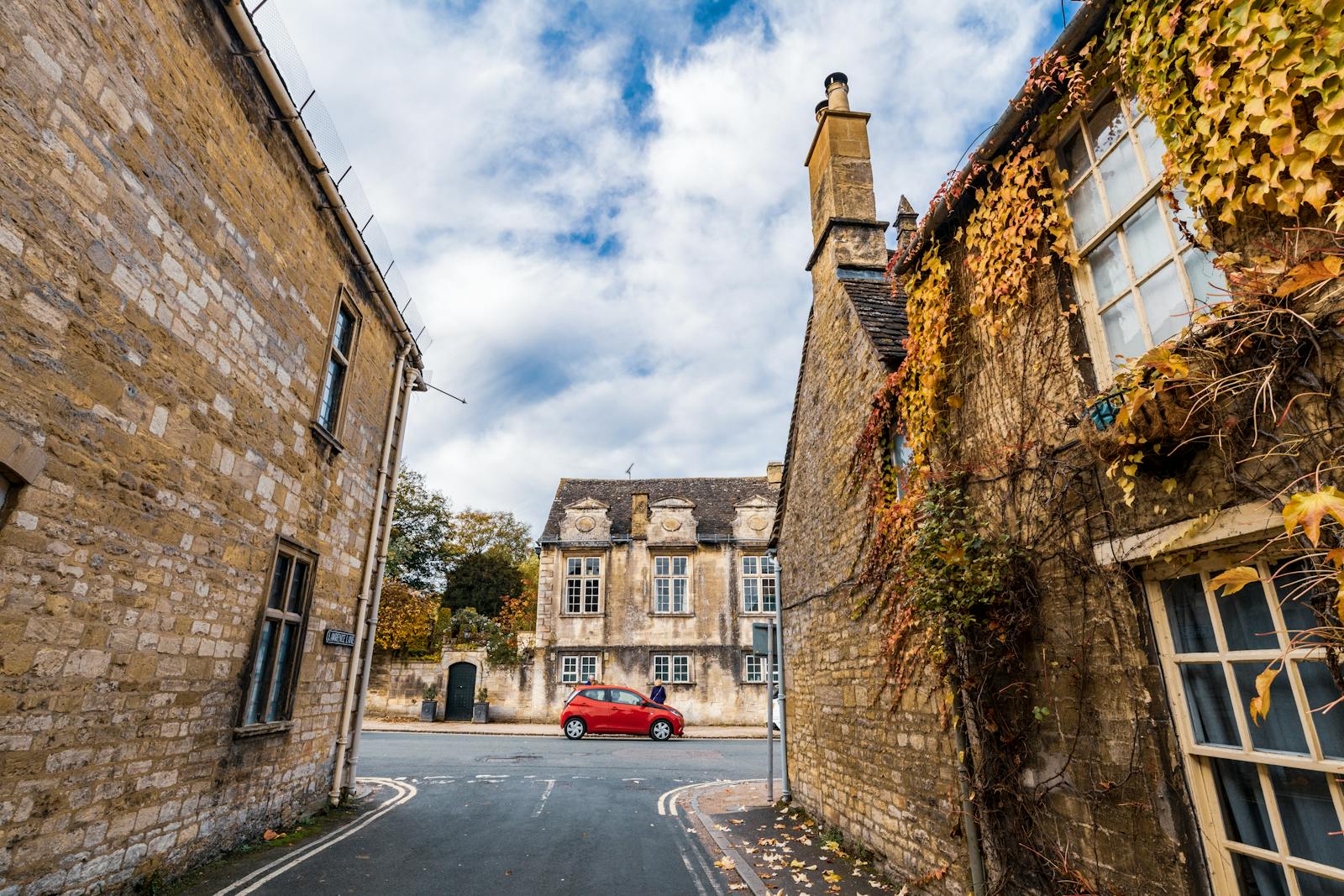
The most visible modern resident is Jeremy Clarkson, whose Diddly Squat Farm near Chadlington, and the wildly popular television series filmed there, have turned a corner of the Oxfordshire Cotswolds into a genuine tourist attraction. His pub, The Farmer’s Dog, near Burford, draws long queues of fans. Nearby, David and Victoria Beckham have a much-photographed converted barn near Great Tew, while supermodel Kate Moss has long had a home near Little Faringdon and is a familiar face in local pubs. Add a rotating cast of musicians, actors and broadcasters, and you have a modern social scene that the gossip columns adore.
A word to the wise, though: these are people’s homes, and the Cotswolds is not a celebrity safari park. Locals are wonderfully unfazed by it all, and the kindest — and frankly the most rewarding — way to enjoy the area is to take it as the famous do, at a gentle pace, in good pubs and beautiful villages, without going hunting for anyone’s front gate.
The Mitford sisters and aristocratic scandal
No account of famous Cotswold residents would be complete without the Mitford sisters, surely the most talked-about siblings of 20th-century England. The six daughters of Lord Redesdale — Nancy, Pamela, Diana, Unity, Jessica and Deborah — grew up between the wars at Asthall Manor and then at Swinbrook House, just outside Burford, and their later lives read like a novel that no editor would have dared believe. Nancy became a celebrated comic novelist; Jessica a committed communist and campaigning writer in America; Diana married the British fascist leader Oswald Mosley; Unity became notoriously infatuated with Hitler; and Deborah ended up as Duchess of Devonshire, chatelaine of Chatsworth.
That one quiet Cotswold family could span almost the entire political and cultural spectrum of the century is part of the enduring fascination. Several of the sisters are buried in the peaceful churchyard of St Mary’s at Swinbrook, beneath the green hills they grew up in, and a visit to the village — with a pause at the riverside Swan Inn — is a gently atmospheric way to feel the long reach of their story. Nancy’s affectionate, waspish novels, drawing on this very landscape and milieu, remain the best introduction of all.
Part of what binds all these residents, old and new, is simple geography. The Cotswolds sit within easy reach of London — little more than ninety minutes by train or car from the centre — yet feel a world away the moment you arrive. That combination of accessibility and seclusion has always been irresistible to people whose work keeps them tethered to the capital but whose hearts crave green hills and high stone walls. Add a thriving scene of celebrated farm shops, gastropubs and members’ clubs — the Daylesford organic empire near Kingham chief among them — and the modern Cotswolds offer the famous everything they could possibly want, without ever having to leave the countryside.
Where to follow in their footsteps
The best of this heritage is genuinely open to visitors, which makes for some marvellous days out. You can tour King Charles’s gardens at Highgrove, stand at Katherine Parr’s tomb at Sudeley, see Churchill’s birth room and grave around Blenheim and Bladon, explore William Morris’s Kelmscott Manor, and visit the small museums dedicated to Holst in Cheltenham and Jenner in Berkeley. Round it off with a pint at the Woolpack in Slad, raising a glass to Laurie Lee with the same valley view he loved. For more on the great houses behind many of these stories, our guide to Cotswolds stately homes is the natural next step.
Frequently asked questions about famous Cotswolds residents
Which royals live in the Cotswolds?
King Charles III has his private country home at Highgrove, near Tetbury, where his celebrated organic gardens are open to the public on guided tours from spring to autumn. His sister, Princess Anne, lives a few miles away at Gatcombe Park, near Minchinhampton, a working estate known for its equestrian events.
Which celebrities live in the Cotswolds?
Among the best-known modern residents are Jeremy Clarkson, whose Diddly Squat Farm and pub are near Chipping Norton and Burford; David and Victoria Beckham, with a barn conversion near Great Tew; and Kate Moss, near Little Faringdon. The fashionable “Golden Triangle” around Burford, Stow-on-the-Wold and Chipping Norton, anchored by clubs like Soho Farmhouse, attracts many more.
Was Winston Churchill born in the Cotswolds?
Yes. Sir Winston Churchill was born at Blenheim Palace in Woodstock, on the eastern edge of the Cotswolds, on 30 November 1874. He is buried in the nearby churchyard at Bladon, within sight of the palace, and Blenheim houses an exhibition devoted to his life.
Where did William Morris live in the Cotswolds?
William Morris, founder of the Arts and Crafts movement, lived at Kelmscott Manor, a 16th-century house near Lechlade, from 1871 until his death in 1896. He is buried in the village churchyard, and the manor is open to visitors on selected days. His love of the region helped make the Cotswolds the heartland of the Arts and Crafts movement.
From medieval queens to modern supermodels, the Cotswolds have always been a place people of consequence chose to call home — and, happily, much of that heritage is open for the rest of us to enjoy. To dig deeper into the creative legacy of William Morris and those who followed him, read our guide to the Arts and Crafts Cotswolds, or return to the pillar guide on Cotswolds history and heritage.
One town has absorbed more of this than the rest of the region put together, and it did not ask to. Our Chipping Norton guide is straight about the Diddly Squat queue four miles down the road — when to go, when not to bother, and what else the town has that is worth your morning.
No resident has done more for Cotswold visitor numbers in recent years than Jeremy Clarkson, whose farm between Chipping Norton and Chadlington now draws queues that would not disgrace a theme park. If you want to see the shop, the pub and the beer for yourself, our Diddly Squat and Farmer’s Dog guide tells you when to go and what is genuinely worth the wait.