This article contains advertising. My booking links are routed through a partner that adds commission tracking automatically, so if you book through one I earn a commission from the provider, at no extra cost to you. It never affects what I recommend. Affiliate disclosure
On a raw afternoon in early February, the car park at Colesbourne Park fills with people in waxed jackets, a surprising number of them carrying hand lenses. They are not there for the view. They have come to crouch on damp grass and peer into flowers the size of a thumbnail, comparing the green markings on the inner petals the way other people compare wines. This is snowdrops Cotswolds-style: part country walk, part quiet obsession, played out in a handful of great gardens and on banks, woodland edges and churchyards across the hills from late January until the daffodils take over.
You do not need a hand lens, or any interest in the difference between ‘S. Arnott’ and ‘Atkinsii’, to enjoy it. The great drifts of common snowdrops at Painswick Rococo Garden are one of the loveliest sights of the English winter, and the season arrives exactly when the Cotswolds need it most — when the villages are quiet, the pubs have their fires lit and room rates are at their lowest. This guide covers the four gardens worth planning around, what each costs and when it opens, where to find snowdrops for free, the walks that go with them, and a beginner’s guide to the varieties so you know what the people with the hand lenses are looking at.
Where to see snowdrops in the Cotswolds at a glance
| Garden | Where | Snowdrop season | Opening | Admission | Best for |
|---|---|---|---|---|---|
| Painswick Rococo Garden | Painswick, near Stroud | Mid-January to 1 March (17 January–1 March in 2026) | Daily, 10:00–17:00 | Paid; group rate was £10.95–£11.50 a head in 2026 | Huge naturalised drifts; the Painswick snowdrop ‘Atkinsii’ |
| Colesbourne Park | Between Cheltenham and Cirencester | Last weekend of January and every weekend in February | Saturday and Sunday afternoons, roughly 13:00–16:00 | Around £10 for adults; under-16s free | More than 300 varieties; serious galanthophiles |
| Cerney House Gardens | North Cerney, near Cirencester | January–February; open daily from early February | Daily; no booking needed | Paid | Quiet woodland walks and a walled garden |
| Rodmarton Manor | Between Cirencester and Tetbury | February | Selected afternoons — Wednesdays and Saturdays from 13:30 in 2026 | Paid | 150-plus varieties in an Arts and Crafts garden |
| Churchyards, banks and woods | Across the region | Late January to early March | Any time | Free | A quiet walk with no ticket |
Dates, hours and prices checked October 2026 against the 2026 season. The gardens publish their 2027 dates over the winter, and prices usually rise slightly each year — confirm before you travel, especially for Colesbourne and Rodmarton, which open on set days only.
When do snowdrops flower in the Cotswolds?
The first snowdrops show in sheltered gardens in early January, the main display builds through the second half of the month, and the peak usually falls in the first three weeks of February. By early March the common snowdrops are going over, although some of the later named varieties carry on, and the crocuses, aconites and early daffodils are taking their place. A mild winter brings everything forward by a week or two; a long freeze holds it back, but snowdrops are tough, and a fall of snow simply pauses them.
Time of day matters too. Snowdrops close up tight in the cold and open their outer petals wide when the sun warms them, so a bright afternoon after a frosty morning shows them at their best — and on the mildest days you will see early bumblebees working the flowers. That is one reason the gardens open in the middle of the day. Go too early on a freezing morning and you will be looking at a field of closed white buds.
Painswick Rococo Garden
If you see only one snowdrop display in the Cotswolds, make it this one. Painswick Rococo Garden is an eighteenth-century pleasure garden hidden in a combe behind Painswick House, with Gothic follies, winding woodland paths, a kitchen garden and a maze, restored from the 1980s using a painting of the garden made by Thomas Robins in 1748. It is the only complete surviving garden of its kind in England, and it would be worth a visit at any time of year. In late winter, though, it is famous for something else: around five million snowdrops, naturalised in sheets through the woodland and down the banks.
Most are the common snowdrop, but there are fifteen known varieties in the garden, including its own. Galanthus ‘Atkinsii’ — tall, early and elegant, with long outer petals — was first found in Painswick in the nineteenth century and named after James Atkins, who grew it here. It is still one of the best snowdrops for a garden, and seeing it in its home valley is a small pilgrimage for snowdrop lovers.
The garden opens daily for the snowdrop season, from 10:00 to 17:00. In 2026 the season ran from Saturday 17 January to Sunday 1 March, and you can expect a similar window in 2027. Group rates in 2026 were £10.95 a head for parties of twenty or more and £11.50 for groups of ten to nineteen, so expect to pay a little more as an individual; check the garden’s website for the current price. The paths run up and down the sides of the valley and are muddy after rain, so wear boots. Sunny weekends in mid-February are busy — a weekday, or a weekend morning soon after opening, is far more peaceful.
Painswick itself is one of the most beautiful small towns in the Cotswolds, built of pale silvery stone, with a churchyard full of clipped yews. Walk up from the garden into the town for lunch, then out along the Cotswold Way to Painswick Beacon if you have the light. Our Painswick guide covers the town, its pubs and its cafés.

Colesbourne Park
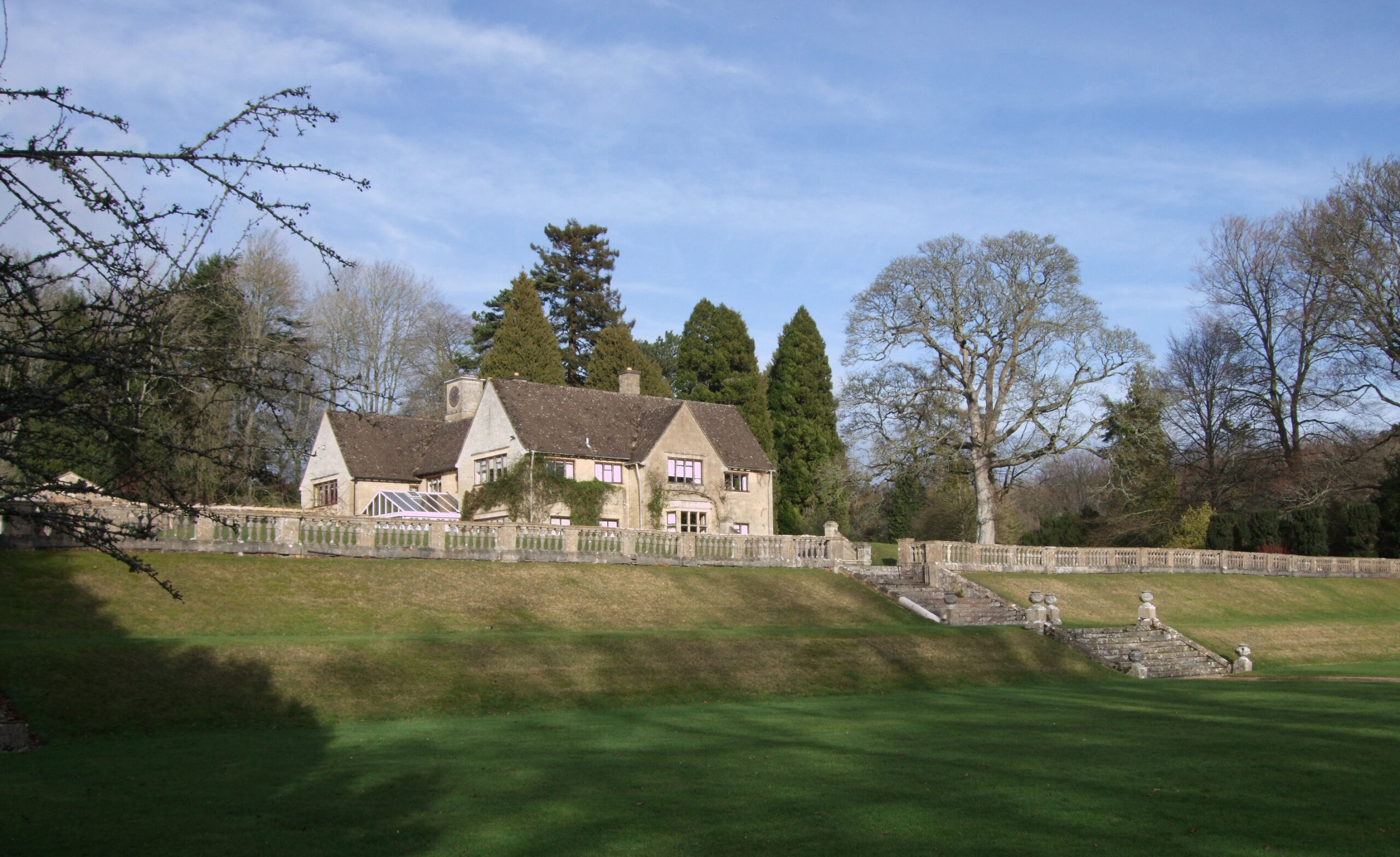
Colesbourne is the garden the experts talk about. The estate, in the Churn valley on the road between Cheltenham and Cirencester, has belonged to the Elwes family for generations, and its snowdrop story goes back to Henry John Elwes, the Victorian plant collector and naturalist whose name lives on in Galanthus elwesii, the big, broad-leaved giant snowdrop he brought back from Turkey. Today the garden grows more than 300 varieties of snowdrop across over ten acres of garden and woodland walks, alongside hellebores, cyclamen and early-flowering shrubs, under the trees of an arboretum collected over more than a century.
It opens on weekend afternoons only, from the last weekend of January and through every weekend in February, roughly from 13:00 to 16:00. Admission has been around £10 for adults, with children under 16 free — check the current dates and price on the Colesbourne Gardens website before you go. The estate also runs snowdrop study days and guided tours for people who want to go deeper.
Is it worth it if you are not a collector? Yes, but go with the right expectations. Colesbourne’s drifts are lovely, but its real fascination is variety — the labelled clumps, the subtle differences in markings, the rarities you will not see anywhere else in the region. If all you want is a breathtaking sweep of white, Painswick gives you more of it; if you want to understand why people pay hundreds of pounds for a single bulb, come here. Doing both on the same weekend is easy: they are about twenty-five minutes apart by car.
Cerney House Gardens
Cerney House, in the hamlet of North Cerney just north of Cirencester, is the gentle, no-fuss option. The house sits in a fold of the Churn valley with a romantic walled garden, Victorian features and woodland walks that are carpeted with snowdrops in January and February. In 2026 the garden opened every day from the start of February, with no need to book, which makes it the easiest of the four to fit around the weather. It is smaller and quieter than Painswick and less specialist than Colesbourne — a good choice for an unhurried hour with tired children or an elderly relative.
North Cerney’s little church of All Saints is worth five minutes on the way past. Cirencester, a few minutes’ drive south, has everything else you need for lunch; our Cirencester guide covers the town.
Rodmarton Manor
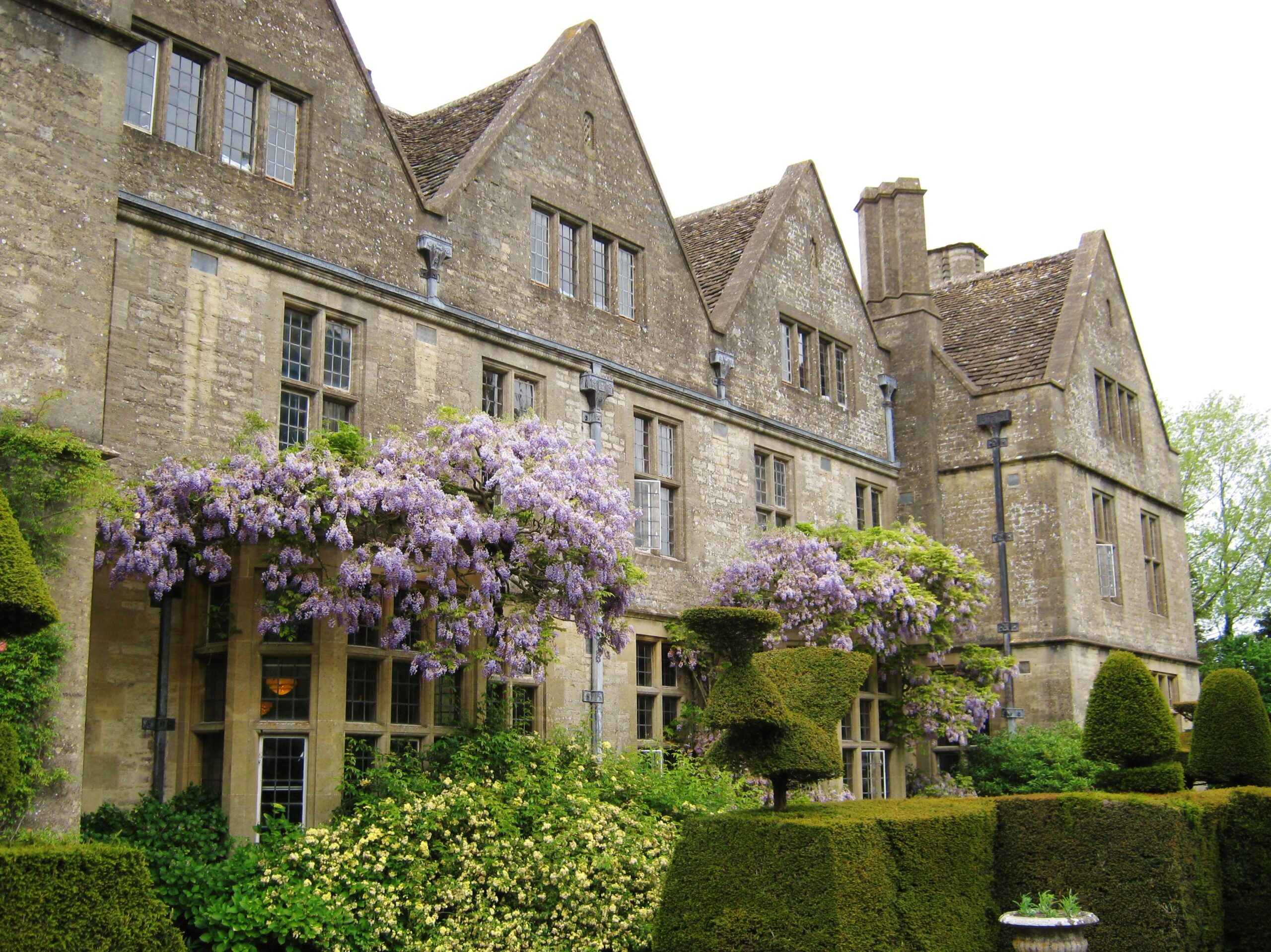
Rodmarton Manor, between Cirencester and Tetbury, is one of the finest Arts and Crafts houses in England — built over two decades in the early twentieth century by local craftsmen, using local stone and timber, for the Biddulph family who still live there. Its eight acres of gardens are a sequence of hedged “rooms”, and in February they hold more than 150 different snowdrops, many of them planted out in the borders where you can see them up close. It opens for snowdrop afternoons on selected days — in 2026, Wednesdays and Saturdays in February from 13:30 — so check the dates before you set out. For more on the movement behind houses like Rodmarton, see our guide to Arts and Crafts in the Cotswolds.
Snowdrops for free: churchyards, banks and woods
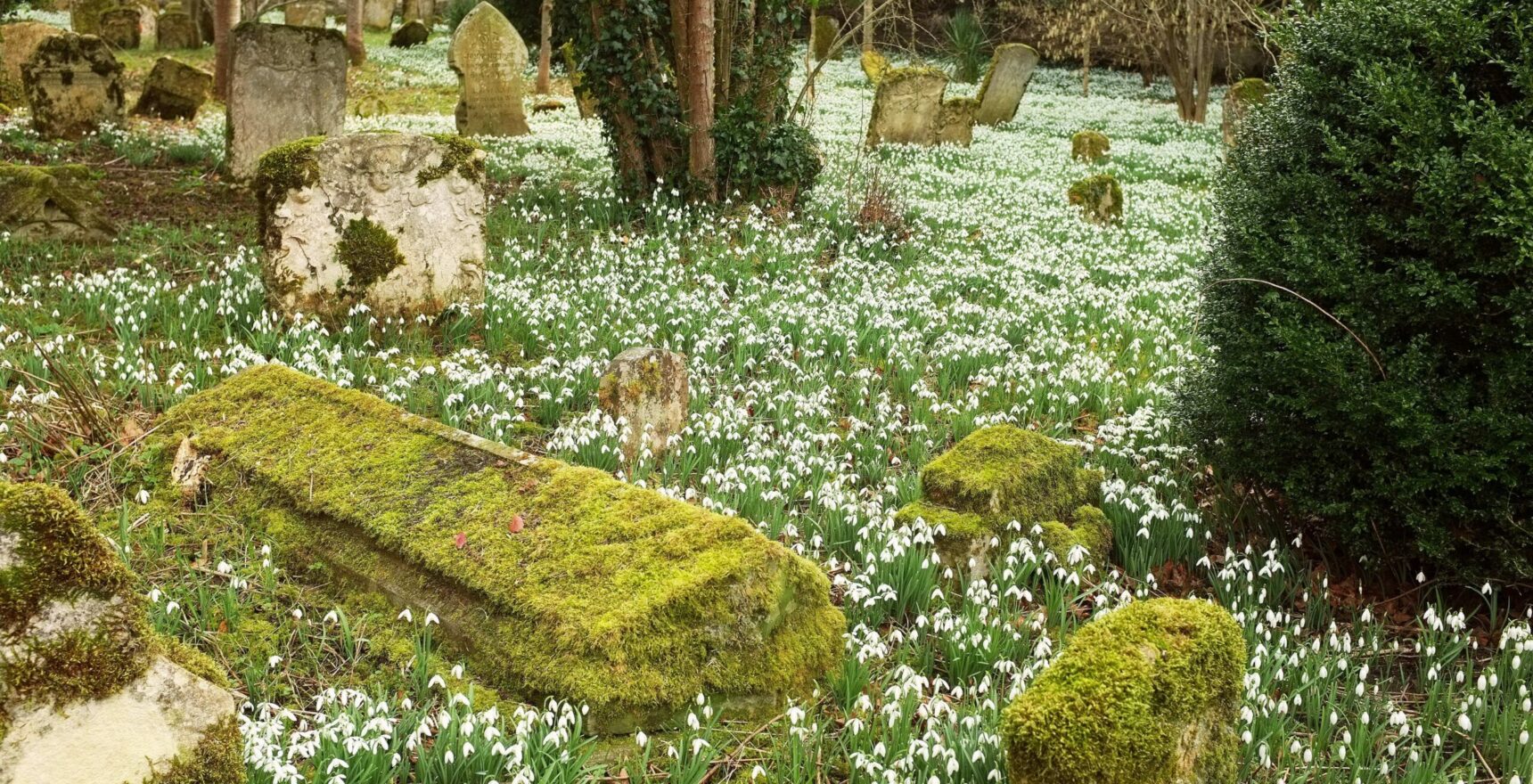
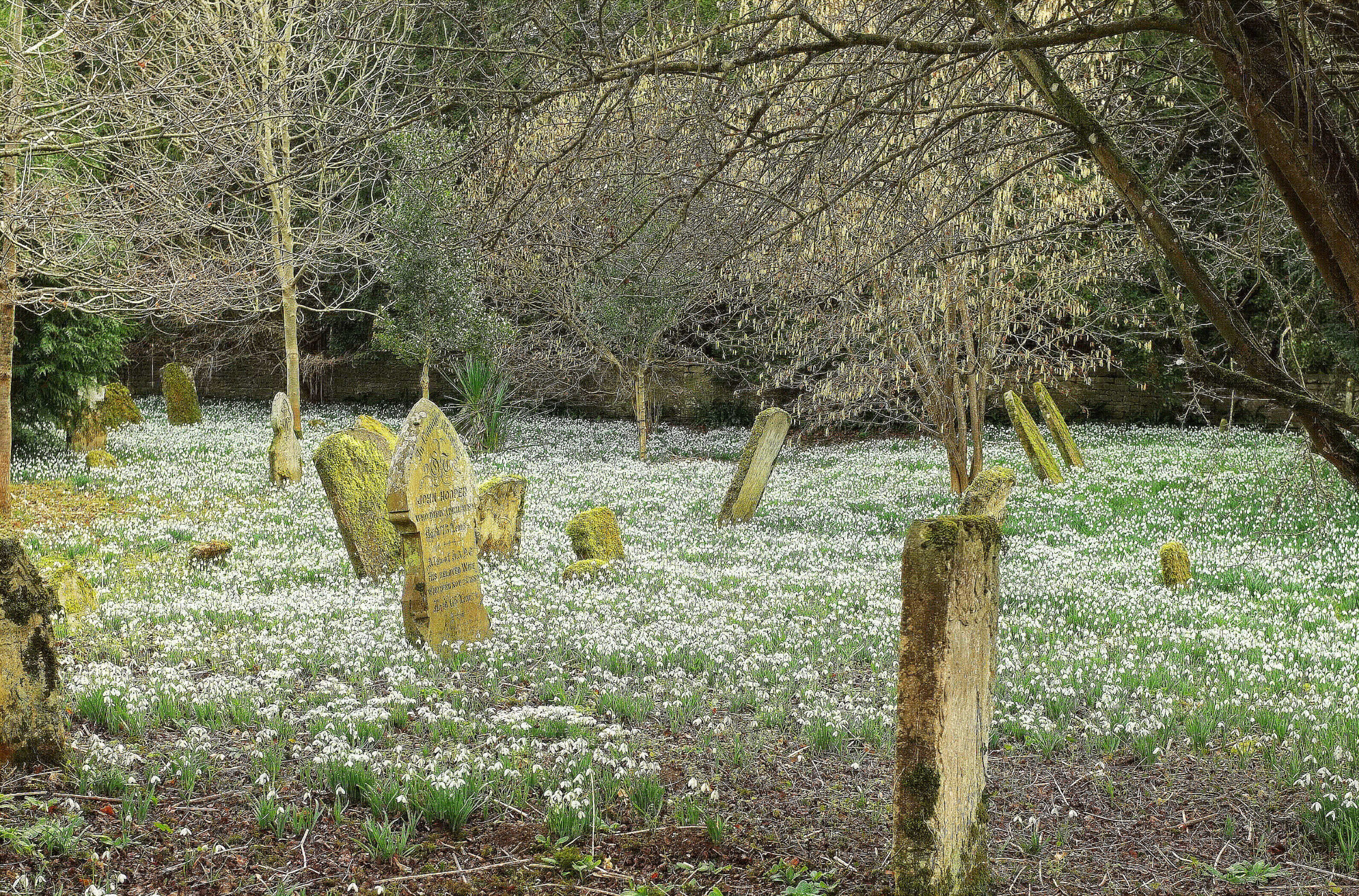
Snowdrops are probably not native to Britain — they seem to have arrived as garden plants several centuries ago — but they have been here long enough to make themselves completely at home. In the Cotswolds they grow wild along stream banks, in the edges of old estate woods, under hedges and, above all, in churchyards, where generations of planting have built up drifts that rival the gardens. Almost any old village church with big trees around it will reward a February detour, and the churchyards of the great wool churches are worth checking too. Great Barrington, in the Windrush valley near Burford, is a good example: in February the ground between its old headstones turns white.
The best way to find them is simply to walk. A February circuit almost anywhere along the river valleys — the Coln, the Windrush, the Churn or the Evenlode — will turn up white patches under the trees, and the lanes around the estate villages are often lined with them. Respect private land, stay on public footpaths and leave every bulb where it is. Our guide to the great Cotswold wool churches is a good place to start planning a church-and-snowdrop drive.
Three snowdrop days out, with a walk and a pub
Painswick: the classic
Arrive at the Rococo Garden soon after it opens at 10:00, spend an hour and a half on the snowdrops and the follies, then walk up into Painswick for lunch. In the afternoon, follow the Cotswold Way north out of town through the woods and onto Painswick Beacon, an Iron Age hill fort with views over Gloucester to the Malverns and the Welsh hills. It is a steady climb of a couple of miles; turn round when the light starts to go, because February dusk comes early on the escarpment.
Colesbourne and Cirencester: the connoisseur’s day
Make it a Saturday. Spend the morning in Cirencester — the Corinium Museum is open 10:00 to 16:00 every day of the week and holds some of the finest Roman mosaics in Britain — then drive north up the Churn valley for Colesbourne’s afternoon opening. Cerney House is a few minutes away along the same valley if you have the time and the legs for both.
A church-and-snowdrop drive in the Coln valley
On a bright February day, follow the Coln downstream from the Fosse Way through Coln St Dennis, Coln Rogers and Ablington to Bibury, stopping wherever the churchyards and riverbanks are white. Finish in Bibury, quiet at this time of year, with Arlington Row free of the summer crowds, or carry on to Fairford to see the medieval stained glass in St Mary’s. Our guide to pub walks in the Cotswolds has routes that end at a fire.
A beginner’s guide to snowdrop varieties
There are around twenty wild species of snowdrop and thousands of named garden varieties, and collectors — galanthophiles — will happily discuss the differences for hours. Single bulbs of rare varieties have sold for more than £1,000. You do not need to know any of this to enjoy a snowdrop garden, but a few names will help you read the labels at Colesbourne and Rodmarton.
| Snowdrop | What to look for |
|---|---|
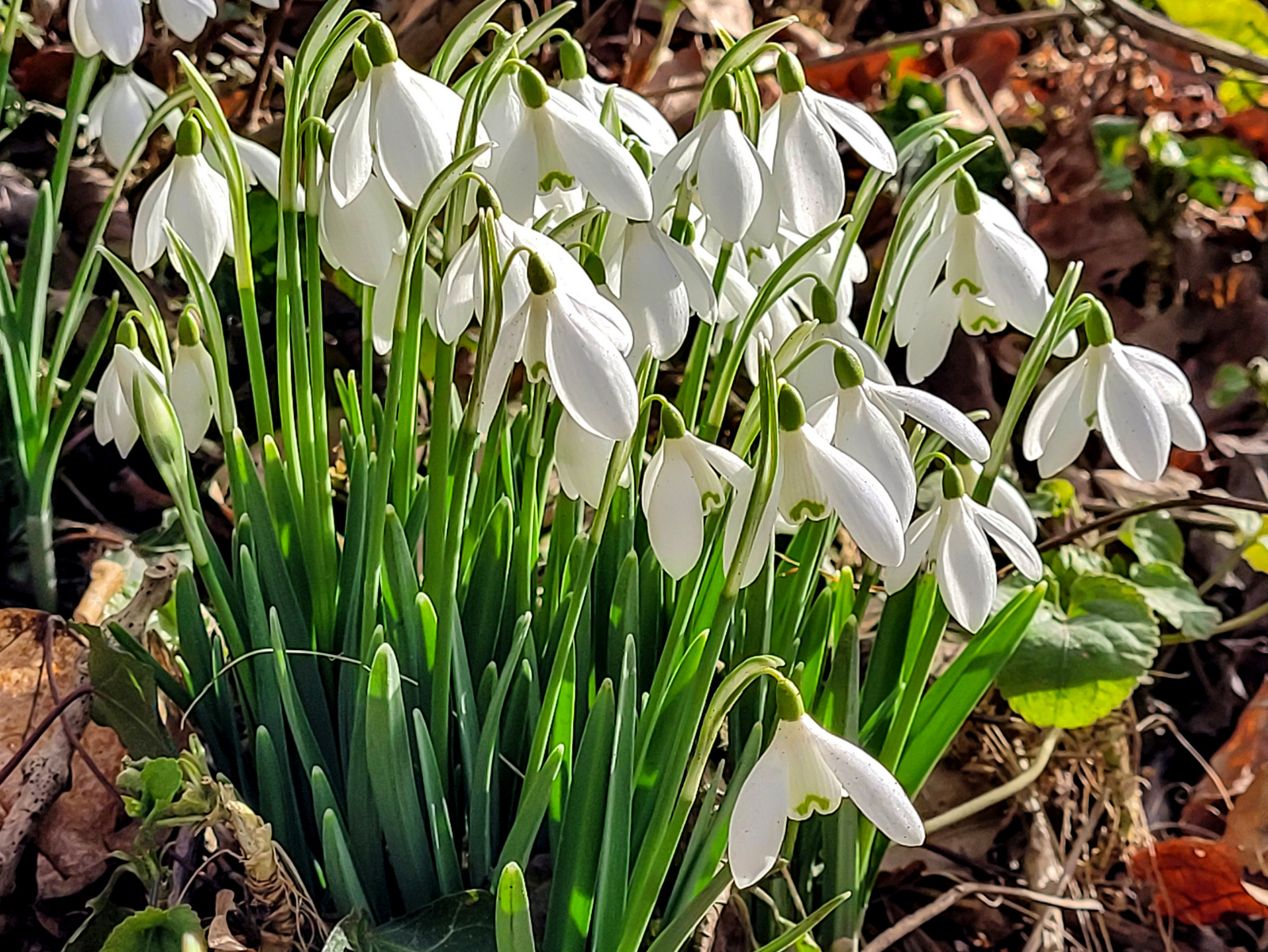
| Galanthus nivalis (common snowdrop) | The one in the big drifts: narrow grey-green leaves, a single green mark on each inner petal. |
| G. nivalis ‘Flore Pleno’ | The double snowdrop, with a frilly ruff of inner petals; spreads fast and is common in churchyards. |
| G. elwesii (giant snowdrop) | Bigger flowers and broad, grey leaves; often two green marks on the inner petals. Named after Henry John Elwes of Colesbourne. |
| G. plicatus | Leaves with folded-back, pleated edges. Brought home from the Crimea by soldiers in the 1850s. |
| ‘Atkinsii’ | Tall, early and elegant, with long outer petals; the Painswick snowdrop. |
| ‘S. Arnott’ | Large, rounded, honey-scented flowers on tall stems; one of the best for gardens. |
| Yellow snowdrops | Varieties such as ‘Wendy’s Gold’ and ‘Primrose Warburg’ have yellow markings instead of green — always a crowd around them. |
Want some for your own garden? Buy from a nursery or a garden that grows its own, never bulbs of unknown origin, and plant them “in the green” — just after flowering, while the leaves are still up — which is when they establish best.
Snowdrop etiquette
- Do not pick or dig. Uprooting wild plants without the landowner’s permission is illegal, and in gardens it is simply theft — some of these clumps are irreplaceable.
- Stay on the paths. The ground around snowdrops is soft in February, and the leaves are easily crushed. Kneel on the path for your photograph, not in the drift.
- Check the dog policy. It varies from garden to garden. Churchyards and public footpaths are fine with a dog on a lead.
- Dress for the weather. Gardens on north-facing slopes stay frozen until midday, and the paths are often muddy. Waterproof boots make a bigger difference to your visit than anything else.
How to photograph snowdrops
Snowdrops are small, white and grow close to the ground, which makes them one of the trickiest flowers to photograph well. Get down to their level — a folded bin bag or a kneeling mat keeps your knees dry — and shoot along the ground rather than down on them. Low winter sun from behind makes the petals glow, and a dark background of leaf litter or a shaded bank makes them stand out. Cameras tend to underexpose a mass of white flowers, turning them grey; dial in a little positive exposure compensation, or tap to brighten on a phone. For close-ups, focus on the inner petals and their green markings: that is the detail the collectors care about. Our guide to Cotswolds photography spots has more ideas for winter light.
What else to do in the Cotswolds in snowdrop season
Late January and February are the quietest weeks of the Cotswold year, and that is a large part of their appeal. The famous villages are almost empty on weekdays, the pubs light their fires at lunchtime, and you can walk into most restaurants without a booking. The flip side is that some attractions close for the winter and others open shorter hours, so check before you make a long drive. February half term brings families back for a week, and Valentine’s weekend fills the romantic hotels; outside those, this is the cheapest time of year to stay. Days are short — sunset is still before 17:30 in mid-February — so plan the garden for the middle of the day and keep the mornings and evenings for walking and eating.
Our guide to the Cotswolds in winter covers what is open, what to pack and the best winter walks, and our guide to rainy-day activities has plenty for the days when the weather wins. For a weekend away, see our ideas for Valentine’s Day in the Cotswolds, which falls right in the middle of snowdrop season.
Where to stay for the snowdrops
Painswick, Stroud and the villages of the Stroud valleys put you within a few minutes of the Rococo Garden and a short drive from Colesbourne. Cirencester is the best base for Colesbourne, Cerney House and Rodmarton, all of which are within about twenty minutes, and it has the widest choice of places to eat. Cheltenham works well too, with Colesbourne half an hour south and plenty to do on a wet day. Winter rates are the lowest of the year, and many places with roaring fires and good kitchens run midweek deals. Our guide to where to stay in the Cotswolds covers every area.
Frequently asked questions about snowdrops in the Cotswolds
When is the best time to see snowdrops in the Cotswolds?
The peak is usually the first three weeks of February, with displays building from late January and fading in early March. A bright afternoon after a frost is the best time of day, when the flowers open in the sun.
Where is the best place to see snowdrops in the Cotswolds?
Painswick Rococo Garden for sheer numbers — around five million — and Colesbourne Park for variety, with more than 300 kinds. Cerney House Gardens and Rodmarton Manor are quieter alternatives near Cirencester.
How much does it cost to see the snowdrops at Painswick?
The Rococo Garden charges admission during the snowdrop season. In 2026 group rates were £10.95–£11.50 per person, with individual tickets a little more; check the garden’s website for the current price.
Do you need to book for Colesbourne?
Colesbourne opens to the public on weekend afternoons in late January and February. Check its website for the current season’s dates, prices and any booking requirements before you go, especially for study days and guided tours.
Can I see snowdrops in the Cotswolds for free?
Yes. Many village churchyards, stream banks and woodland edges have large drifts, especially in the river valleys. Walk the public footpaths in February and you will find them almost everywhere.
Are snowdrops native to Britain?
Probably not. They are thought to have been introduced as garden plants several centuries ago, but they have naturalised so widely that they now feel as much a part of the English winter as robins and frost.
Snowdrops open the Cotswold year; the bluebells follow in late April. For when and where to see those, read our guide to bluebell woods in the Cotswolds, and for every season in between — orchids, butterflies, otters and winter ducks — our guide to Cotswolds wildlife and nature. For gardens that are worth a visit in the rest of the year, see our round-up of the best gardens in the Cotswolds.
Planning a January visit? Painswick’s snowdrops usually open in mid-January and Colesbourne’s on the last weekend of the month, and both pair well with a frosty walk and a pub lunch. Our guide to the Cotswolds in January covers the rest of the month, from race days at Cheltenham to what is open.
Photo Credits
Snowdrops round the old tombs in Great Barrington churchyard: Snowdrops, Great Barrington – geograph.org.uk – 7095302 by Derek Harper, CC BY-SA 2.0, via Wikimedia Commons.
Snowdrops among the headstones at Great Barrington: Snowdrops, Great Barrington – geograph.org.uk – 7095306 by Derek Harper, CC BY-SA 2.0, via Wikimedia Commons.
Colesbourne Park house and lawns: Colesbourne Park – geograph.org.uk – 2776442 by Vieve Forward, CC BY-SA 2.0, via Wikimedia Commons.
Rodmarton Manor and its topiary: Rodmarton Manor. – panoramio by Robert Powell, CC BY-SA 3.0, via Wikimedia Commons.
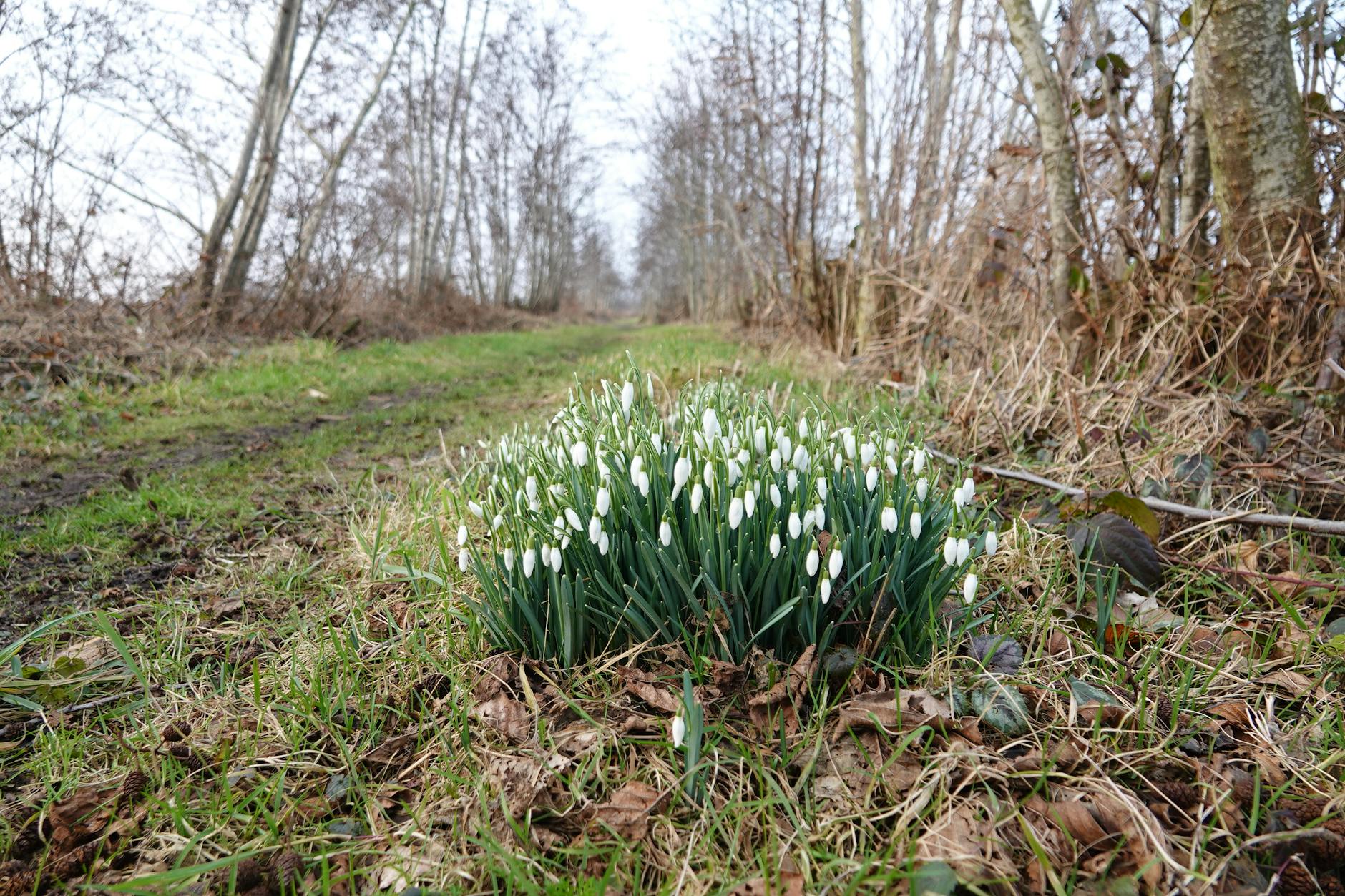
Common snowdrops open in the sun: Snowdrops in sunshine – geograph.org.uk – 7397503 by Jonathan Billinger, CC BY-SA 2.0, via Wikimedia Commons.
Leave a Reply