This article contains advertising. My booking links are routed through a partner that adds commission tracking automatically, so if you book through one I earn a commission from the provider, at no extra cost to you. It never affects what I recommend. Affiliate disclosure
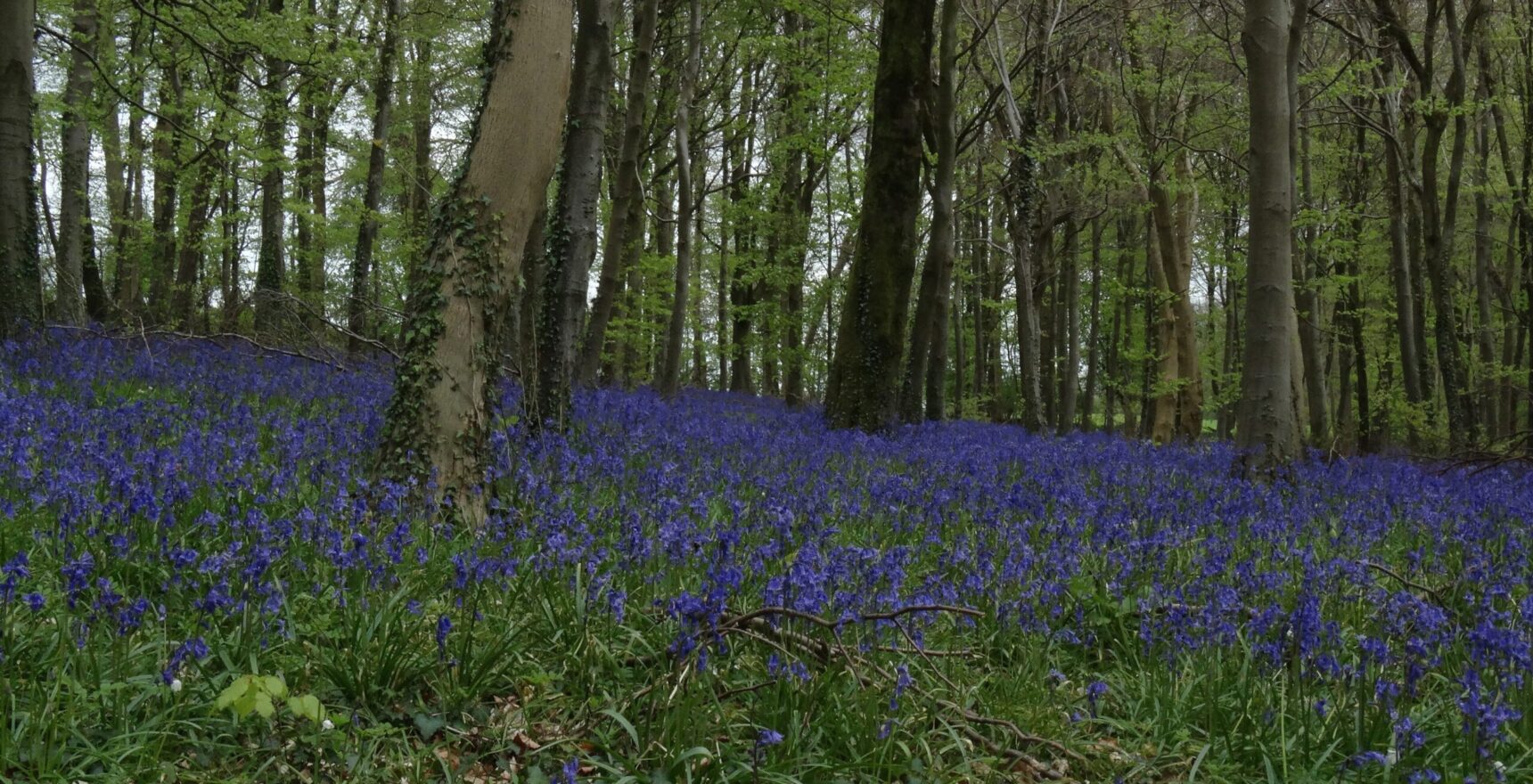
For about three weeks each spring, the beech hangers above Stroud look from the valley road as though someone has let blue smoke drift in under the trees. Walk up into them and the smoke resolves into millions of nodding flowers, with a scent like hyacinth and damp leaf-mould that hangs in the still air beneath the canopy. Type bluebells Cotswolds into a phone in April and you will be sent to the same handful of woods as everyone else — which is fine, because several of them really are among the best in England. But the difference between a good bluebell walk and an unforgettable one is mostly timing, light and getting there before the car park fills, and that is what this guide is for.
Below are the eight woods worth planning a spring morning around, from Woodchester Park and Siccaridge in the Stroud valleys to Foxholes in the Evenlode valley of Oxfordshire, with when each usually peaks, where to park, how long the walks are and what else is nearby. There is also a short guide to telling a native bluebell from the Spanish interloper, some honest advice on crowds, and a few tips for photographing a flower that cameras almost always get wrong.
The best bluebell woods in the Cotswolds at a glance
| Wood | Nearest town | Usual peak | Walk | Parking and cost |
|---|---|---|---|---|
| Woodchester Park (National Trust) | Stroud / Nailsworth | Last week of April to first week of May | Waymarked valley trails past five lakes; hilly | NT car parks at Tinkley Gate and Buckholt, £4 for non-members; entry free |
| Siccaridge Wood (Gloucestershire Wildlife Trust) | Sapperton / Chalford | Late April to early May | 1.5-mile stile-free loop on a ridgetop path | Lay-by by the Daneway bridge; free |
| Standish Wood (National Trust) | Stroud / Haresfield | Late April to early May | On the Cotswold Way, easily combined with Haresfield Beacon | Limited parking — arrive early; free |
| Frith Wood (Gloucestershire Wildlife Trust) | Slad / Stroud | Late April to early May | Steep beech hanger above the Slad valley | Roadside, very limited; free |
| Cranham and Buckholt woods | Painswick | Late April to early May | Network of paths and the Cotswold Way | Small lay-bys and roadside spaces; free |
| Leckhampton Hill | Cheltenham | Late April | Woodland paths below the escarpment top | Small car parks on the hill; free |
| Silk Wood, Westonbirt Arboretum | Tetbury | Late April to early May | Waymarked Silk Wood trail; easy and buggy-friendly in parts | Arboretum car park; paid entry |
| Foxholes (Berks, Bucks and Oxon Wildlife Trust) | Kingham / Chipping Norton | Early to mid May | 1.75-mile Wildlife Walk; 1.7 miles in from Kingham station | Lay-by just past Bruern; free |
Parking charges and reserve details checked October 2026 — confirm before you travel, and remember that peak dates move by a week or more with the weather.
When do bluebells flower in the Cotswolds?
In an average year the first flowers open in mid-April, the woods are at their deepest blue from roughly the last week of April to the end of the first week of May, and by the middle of May the colour is fading as the seed heads swell. A warm March can pull everything forward by a week or more; a cold, late spring pushes it back. Within the Cotswolds, the woods on the high escarpment tend to run a few days behind the sheltered valley woods, and Foxholes, on the colder eastern side in Oxfordshire, is usually at its best a little later than the Stroud woods — often into the second week of May.
There is a second clock running at the same time. In beechwoods, the best moment of all comes when the bluebells are fully open and the beech leaves have just unfurled overhead, a translucent lime green that filters the light onto the blue below. That combination usually lasts only a week or so before the canopy thickens and the wood darkens, and it is the reason photographers get so particular about dates. If you can only go once, aim for the end of April and check recent photos from the wood you have in mind before you set out — local walkers and the reserve owners post updates every spring.

Bluebells also tell you something about the wood itself. They spread very slowly, mostly by seed, and a dense carpet usually means the ground has been woodland for centuries; ecologists use them as one of the indicators of ancient woodland. Britain holds around half of the world’s bluebells, which is why a spring wood here is a sight that visitors from almost anywhere else in the world have never seen.
Where to see bluebells in the Cotswolds: the eight best woods
1. Woodchester Park, near Stroud
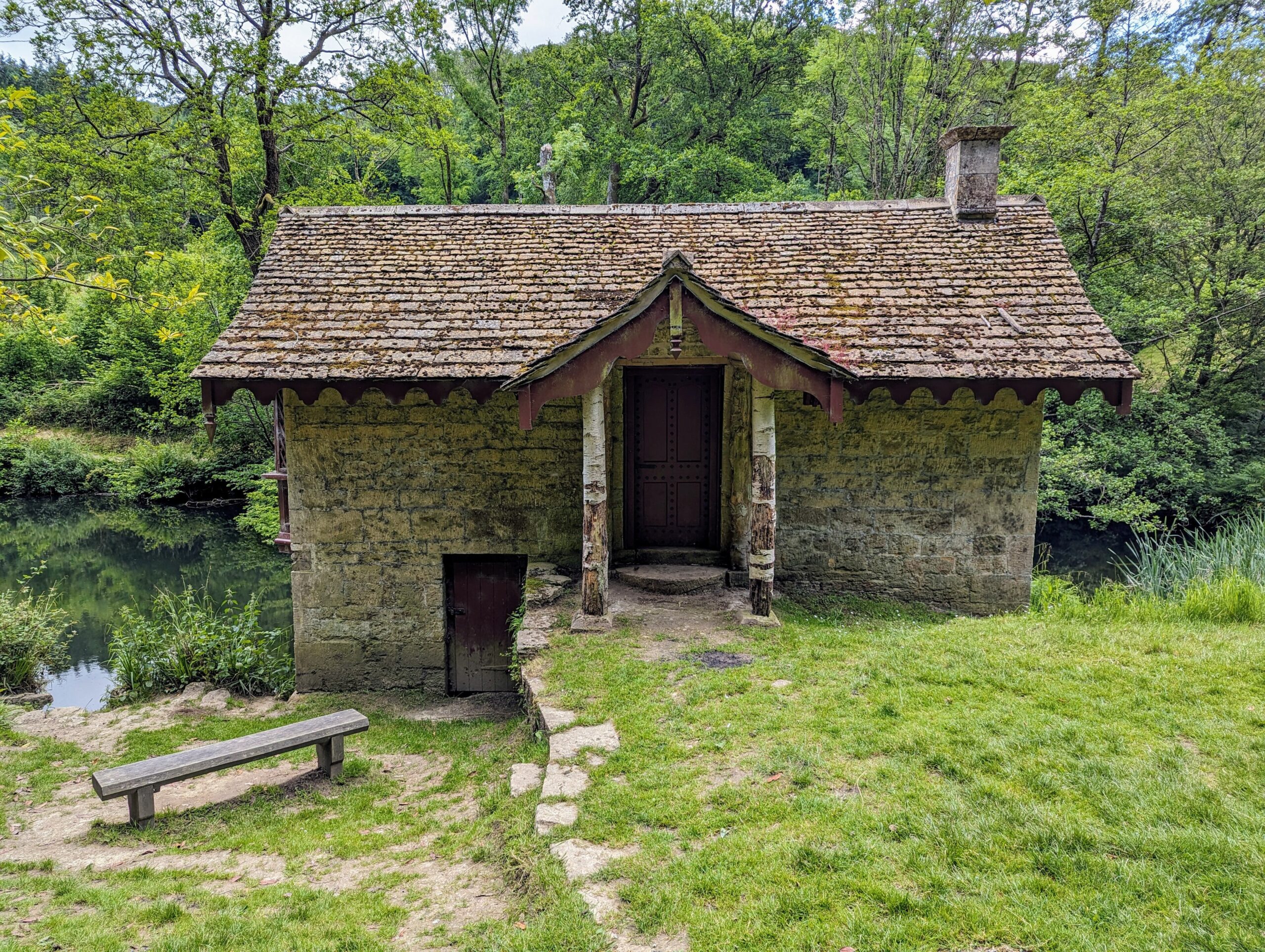
Woodchester is the one most people have heard of, and it earns its reputation. The National Trust owns a long, secluded wooded valley south of Stroud: once the landscaped park of a country house, now a “lost landscape” of five lakes, a nineteenth-century boathouse, an old quarry and pasture, with Woodchester Mansion — a Victorian house abandoned before it was finished — at the bottom. The bluebells are spread through the beech and oak woods on the valley sides, and in late April the combination of blue flowers, new leaves and the glint of the lakes below is hard to beat.
Park at Tinkley Gate, off Tinkley Lane near Nympsfield, or at the Buckholt car park on the Nympsfield road; both are pay and display at £4 for non-members and free for National Trust members. Waymarked trails of different lengths run down the valley and round the lakes. Two warnings. First, everything you walk down you will have to walk back up, and the climb out is steep enough to slow most people down. Second, sunny bluebell Sundays fill both car parks by mid-morning — come on a weekday, or arrive before 9:30 at the weekend. If you are there on one of the mansion’s open days, a free minibus runs from the Buckholt car park, and the mansion’s colony of rare horseshoe bats can be watched on camera inside.
2. Siccaridge Wood and Daneway, near Sapperton
Siccaridge is our pick for the best small bluebell walk in the Cotswolds. It is a semi-natural ancient wood of beech, ash and silver birch in the Golden Valley between Sapperton and Oakridge, looked after by Gloucestershire Wildlife Trust, and the ridgetop path runs through dense drifts of bluebells in late April and early May. The loop is about 1.5 miles, fairly easy and free of stiles, which makes it a good choice for older walkers and children who will not manage Woodchester’s hills.
Park in the lay-by on the far side of the bridge from the Daneway Inn, or in the space for a couple of cars at the start of the ridgetop path, opposite the entrance to Daneway Banks. Both fill quickly on spring weekends, and the lanes are narrow, so do not be tempted to squeeze in across a gateway. The old Thames and Severn Canal runs along the valley floor below the wood, and the stone portal of the Sapperton canal tunnel is a short stroll away. In June, come back for Daneway Banks across the lane, one of the best places in Britain to see the large blue butterfly.
3. Standish Wood and Haresfield Beacon
Standish Wood clings to the escarpment north-west of Stroud near Haresfield, owned by the National Trust and threaded by the Cotswold Way. It is one of the best combinations in the region of bluebells and a view: walk through the wood in late April, then out onto Haresfield Beacon, where the whole Severn Vale opens up beneath you and the river shines in the distance on a clear day. The paths are steep in places and can be muddy after rain. Parking around the Beacon is limited, so this is another wood to reach early.
4. Frith Wood and the Slad valley
Frith Wood is a tall beech hanger on the ridge above Slad, the valley Laurie Lee made famous in Cider with Rosie. Gloucestershire Wildlife Trust manages it as a nature reserve, and in late April the bluebells run in sheets beneath the smooth grey trunks — classic ancient-woodland bluebells, and one of the most atmospheric spots in the Stroud valleys. It is steep and the parking is roadside and limited, but it is usually quieter than Woodchester. Combine it with a walk down into Slad itself, where the Laurie Lee Wildlife Way, a trail of posts carrying lines from his poems, winds through the valley.
5. Cranham, Buckholt and the Cotswold Commons and Beechwoods
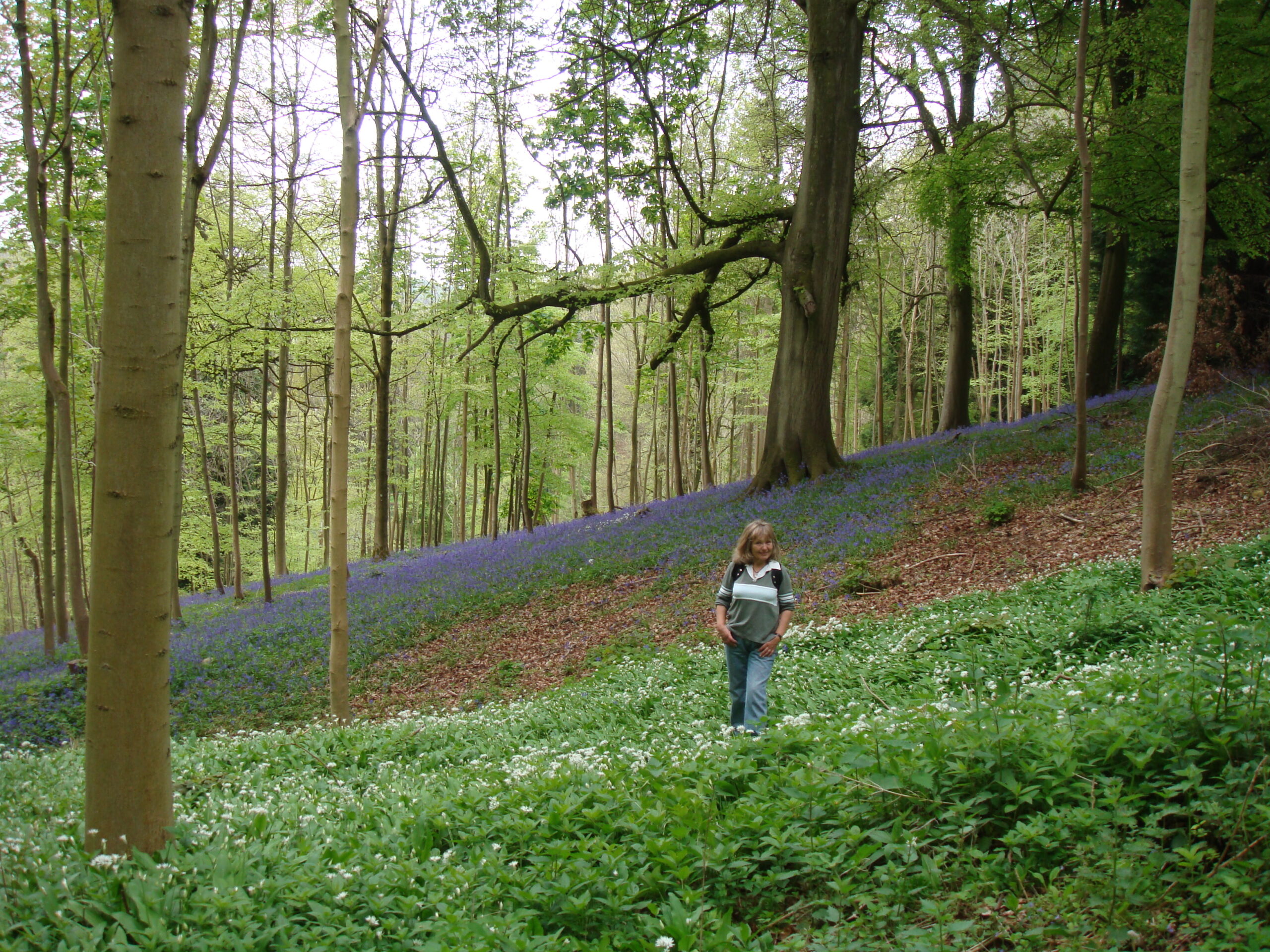
The cluster of beechwoods between Painswick, Cranham and Cooper’s Hill forms part of a National Nature Reserve, and in spring the woods are patched with bluebells and wild garlic — you will smell the garlic in the damp hollows long before you see it. There is no single honeypot here, which is the point: pick a path from Cranham village or a lay-by on the Painswick road and wander. Rough Park, the steep wood above Prinknash Abbey at the northern end, has one of the densest carpets in the area, and the quieter woods around Miserden, a few miles east, mix bluebells with sheets of white wild garlic. The Cotswold Way runs through the middle, and Painswick, with its churchyard of clipped yews, is a short drive away for lunch. Our Painswick guide has the cafés and pubs.
6. Leckhampton Hill, Cheltenham
Leckhampton Hill rises straight out of the southern edge of Cheltenham, and the woods on its flanks put on a good show of bluebells in late April, often a little earlier than the higher woods further south. It is the obvious choice if you are staying in Cheltenham without a car to spare for the day: walk up through the woods, out onto the open top for the view across the town to the Malverns, and on to the Devil’s Chimney, a pillar of limestone left behind by the quarrymen. Our Cheltenham guide covers the town itself.
7. Silk Wood at Westonbirt
Westonbirt, the National Arboretum near Tetbury, is better known for autumn colour, but its Silk Wood holds a large and reliable carpet of bluebells in spring, and the waymarked Silk Wood trail is the easiest bluebell walk on this list — wide, well-signed and good with small children. You pay to get in, so it is not the choice for a quick free walk, but there are toilets, a café and room to park, which is more than can be said for most of the woods above. Our Westonbirt Arboretum guide has tickets and opening times.
8. Foxholes, near Bruern
On the eastern side of the Cotswolds, Foxholes is an ancient wood in the Evenlode valley, a surviving fragment of the old royal forest of Wychwood, managed by the Berks, Bucks and Oxon Wildlife Trust. It is one of the best bluebell woods in Oxfordshire, and because it tends to peak in May rather than late April, it is a good back-up if you miss the Gloucestershire woods. Primroses, violets and early purple orchids come before the bluebells, and tall foxgloves follow in summer.
There is a 1.75-mile Wildlife Walk, waymarked with badger signs. Limited free parking is in a lay-by just past Bruern; the track to the reserve itself is badly potholed and best avoided in an ordinary car. Better still, come without one: Foxholes is 1.7 miles from Kingham station along the Oxfordshire Way, and Kingham has direct trains from London Paddington and Oxford, which makes this the most car-free bluebell walk in the Cotswolds. A longer circuit of around seven miles starts from Shipton-under-Wychwood station. Dogs are allowed on leads, and entry is free.
A few more worth knowing
- Ebworth, near Sheepscombe — National Trust beechwoods in the valleys north of Painswick, with a waymarked walk from the Ebworth Centre and a scattering of bluebells in spring.
- Woods along the Cotswold Way — almost any stretch of the trail through the escarpment beechwoods between Cheltenham and Wotton-under-Edge will give you bluebells in late April. Our Cotswold Way walking guide breaks the route into sections.
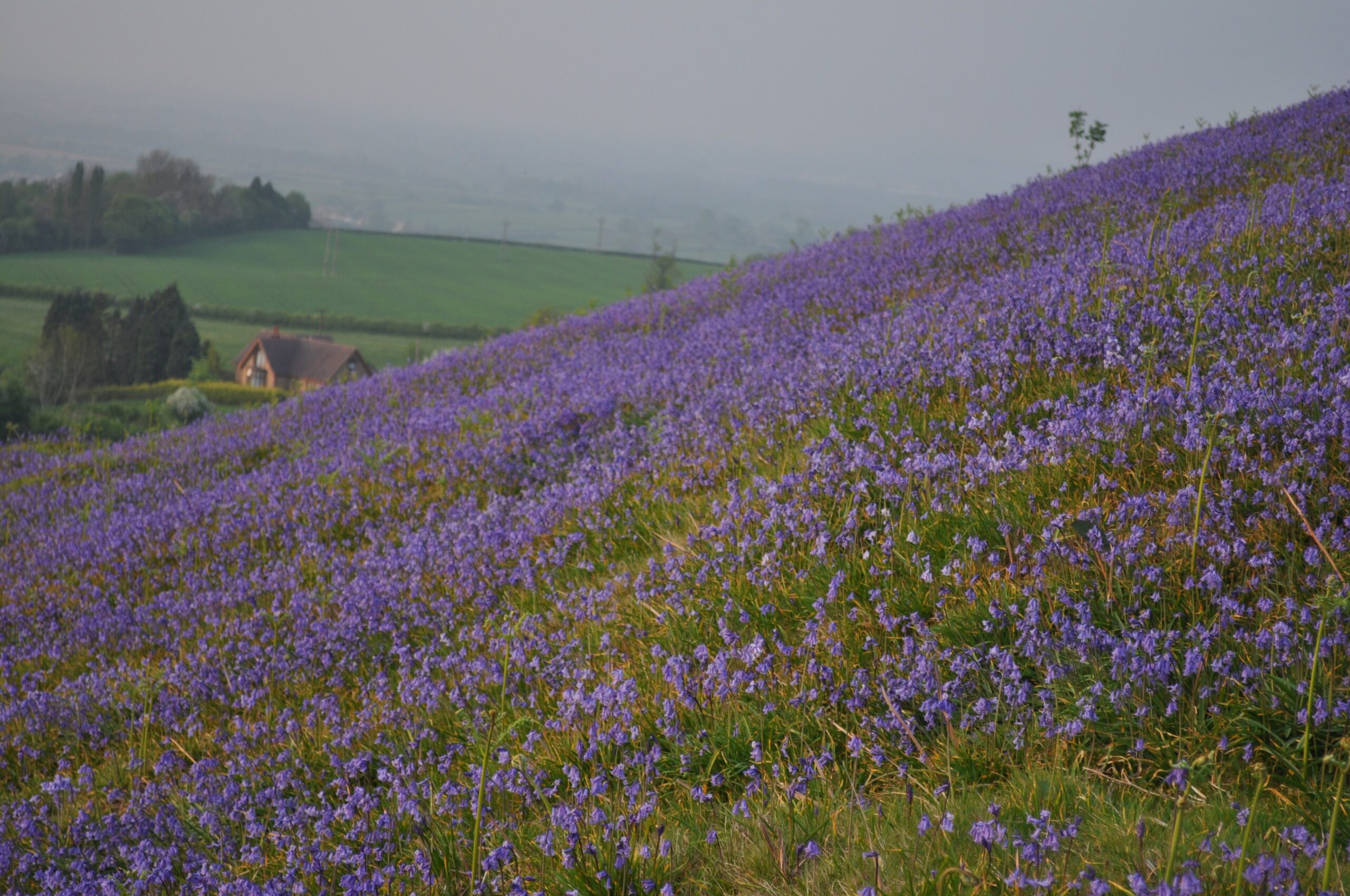
- Cam Peak, near Dursley — on this small, steep outlier of the escarpment, the bluebells spill out of the trees and across the open hillside, which is unusual and very photogenic. Combine it with Cam Long Down on the Cotswold Way.
- Estate and village woods — small copses around villages often hold bluebells too, but these are more likely to be mixed with garden escapes. Look closely before you rave about them.
Three Cotswolds bluebell walks to plan a morning around
The Siccaridge and Daneway loop (1.5 miles, easy)
From the lay-by by the Daneway bridge, follow the ridgetop path into Siccaridge Wood through the thickest of the bluebells, then loop back along the lower path towards the canal. It takes under an hour at a gentle pace, longer with a camera. Add the stroll along the towpath to the tunnel portal for another twenty minutes, or climb up to Sapperton church for the view across the valley.
Woodchester’s lakes and woods (allow two hours, hilly)
Start at Tinkley Gate and follow the waymarked trails down through the bluebell woods to the chain of lakes and the boathouse, then on to the mansion if it is an open day. Come back up the other side of the valley for a different set of woods. Wear proper shoes: the paths are rooty, and after a wet April the lower trails turn to clay.
Kingham station to Foxholes (about 5 miles, car-free)
Walk the 1.7 miles from Kingham station along the Oxfordshire Way into the Evenlode valley, follow the 1.75-mile Wildlife Walk round Foxholes, and return the same way — around five miles in all, flat apart from a few short slopes. Check train times back before you set out, and bring lunch: there is nothing at the reserve itself.
For more routes through the region’s woods, including walks that are at their best in autumn, see our round-up of Cotswold woodland walks, and for gentler options our guide to short walks in the Cotswolds.
Native or Spanish? How to tell a real English bluebell
The native bluebell is under quiet pressure from the Spanish bluebell, a garden plant that has escaped into the wild and hybridises freely with it. In the old woods above you will almost always be looking at the real thing; near villages, gardens and roadsides, it is worth a second glance.
| Feature | Native English bluebell | Spanish bluebell |
|---|---|---|
| Stem | Droops or nods at the tip | Stands upright |
| Flowers | Hang mostly on one side of the stem | Arranged all round the stem |
| Bell shape | Narrow tube with petal tips curled right back | Wider, open, conical bell |
| Colour | Deep violet-blue (occasionally white) | Paler blue, often pink or white |
| Pollen | Creamy white | Blue or pale blue |
| Scent | Strong and sweet | Little or none |
Hybrids sit somewhere in between, which is why the pollen is the most useful single test: tilt a flower and look inside.
Bluebell etiquette (and the law)
- Stay on the paths. A bluebell’s leaves feed the bulb for next year, and once they are crushed the plant can take years to recover. Every spring, popular woods are scarred by new desire lines where people have walked in for a photograph.
- Do not lie or sit in them for photos. The flattened patch you leave behind will still be visible next spring.
- Do not pick or dig. Native bluebells are protected: digging up the bulbs is illegal, as is uprooting any wild plant without the landowner’s permission.
- Dogs on leads. Keep dogs on the paths too, and pick up after them — these are nature reserves as well as walks.
- Park considerately. Lanes around Sapperton, Slad and Bruern are narrow and used by farm traffic. If the lay-by is full, go somewhere else and come back another day.
How to photograph bluebells
Bluebells are notoriously difficult to photograph well, for one simple reason: most cameras and phones render that particular blue as purple. Set a slightly cooler white balance, or shoot on an overcast day or in open shade, and you will get much closer to what your eyes see. Bright midday sun is the enemy — it creates harsh contrast under the trees and washes the colour out.
- Go early. The first two hours after sunrise give you soft side-light, mist in the hollows and, crucially, no other people in your frame.
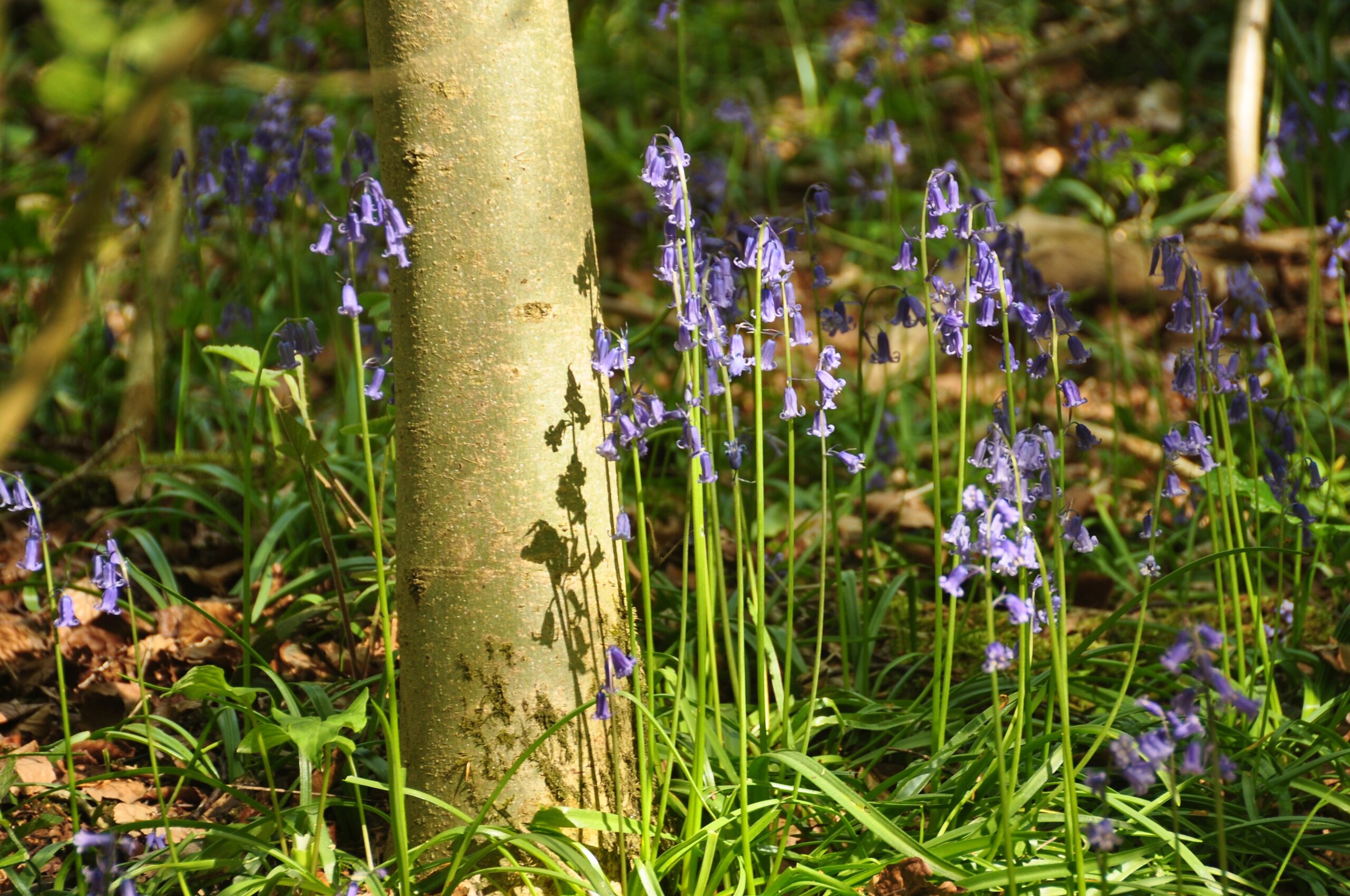
- Get low. Shooting from knee height, from the path, makes the carpet look denser and pulls the eye into the wood.
- Use the paths. A curving path through the flowers is the classic composition for a reason — and it keeps you off the plants.
- Look up as well as down. The lime-green of new beech leaves against blue is what makes a Cotswold bluebell wood different from an oak wood elsewhere.
- Try a close-up. A single stem with the carpet blurred behind it often says more than a wide shot.
Our guide to Cotswolds photography spots has more locations and the best times of day for each.
Making a day of it
Most of the best woods are in the Stroud valleys, which is good news, because that corner of the Cotswolds is excellent for a spring day out. Combine Woodchester with lunch in Nailsworth and a walk on Minchinhampton Common, where cowslips cover the turf in late April; our Nailsworth and Minchinhampton guide has the details. Siccaridge pairs naturally with Sapperton and Cirencester. Frith Wood and Standish Wood are both a few minutes from Stroud, where the Saturday farmers’ market runs from 9am to 2pm — our Stroud guide covers the town. On the eastern side, Foxholes sits close to Kingham, Chipping Norton and Stow-on-the-Wold.
Late April and early May is also lambing and blossom season, with wild garlic in the valley bottoms and the first swallows over the fields. Our guide to the Cotswolds in spring covers what else is on and what is open, and if you are building a whole trip around the season, our guide to the best time to visit the Cotswolds weighs spring against the rest of the year.
Getting there without a car
Foxholes is the easiest: 1.7 miles on foot from Kingham station. Stroud station puts you within a taxi ride or a steep walk of Frith Wood, Standish Wood and Woodchester, and Cheltenham Spa station is a bus or taxi from the foot of Leckhampton Hill. Rural bus services in the Stroud valleys do exist, but they are thin on Sundays — check the current timetable before relying on one. Our guide to the Cotswolds without a car has the wider picture.
Frequently asked questions about bluebells in the Cotswolds
When is the best time to see bluebells in the Cotswolds?
Usually from the last week of April to the end of the first week of May, with Foxholes in Oxfordshire often a little later. Warm springs bring the peak forward; cold ones delay it.
Where are the best bluebell woods in the Cotswolds?
Woodchester Park, Siccaridge Wood, Standish Wood and Frith Wood near Stroud; the Cranham beechwoods near Painswick; Leckhampton Hill above Cheltenham; Silk Wood at Westonbirt; and Foxholes near Bruern in Oxfordshire.
Are the Cotswold bluebell woods free to visit?
Most are. Siccaridge, Frith Wood, Standish Wood, Foxholes and Leckhampton Hill are free; Woodchester is free to enter but charges £4 for parking to non-members of the National Trust; Westonbirt charges admission.
Can I take my dog to see the bluebells?
Yes, in most of the woods listed here, on a lead and on the paths. Check signs at each entrance, as some reserves have seasonal restrictions near livestock.
Are there bluebells near Bourton-on-the-Water?
Not in the village itself. The nearest outstanding bluebell wood is Foxholes near Bruern, a short drive east towards Kingham.
Can I see bluebells in the Cotswolds without a car?
Yes. Foxholes is a 1.7-mile walk from Kingham station along the Oxfordshire Way, and Leckhampton Hill is reachable from Cheltenham on foot.
Is it illegal to pick bluebells?
Digging up bluebell bulbs is illegal, and uprooting any wild plant without permission is an offence. Picking flowers on a nature reserve is against the rules everywhere — leave them for the next visitor and for the bees.
Bluebells are only one chapter of the Cotswold year. For the rest — orchids on the commons, rare butterflies, otters on the rivers and winter ducks on the lakes — see our guide to Cotswolds wildlife and nature. For gardens that are at their best in spring, see our round-up of the best gardens in the Cotswolds, and for somewhere to stay within reach of the woods, our guide to where to stay in the Cotswolds.
Photo Credits
Bluebells under the beeches at Rough Park above Prinknash: Bluebells at Rough Park above Prinknash – geograph.org.uk – 5609093 by Colin Park, CC BY-SA 2.0, via Wikimedia Commons.
The boathouse at Woodchester Park: Boat House entrance, Woodchester Park by DIaNyf8q, CC0, via Wikimedia Commons.
Bluebells and wild garlic in a wood near Miserden: Bluebell wood near Miserden – geograph.org.uk – 2272897 by Sally, CC BY-SA 2.0, via Wikimedia Commons.
Bluebells on the open slopes of Cam Peak: Bluebells on Cam Peak – geograph.org.uk – 2785911 by kay kenyon, CC BY-SA 2.0, via Wikimedia Commons.
Bluebell close-up at Crickley Hill Country Park: Bluebells in Crickley Hill Country Park (3903) by Nilfanion, CC BY-SA 4.0, via Wikimedia Commons.
Leave a Reply