This article contains advertising. My booking links are routed through a partner that adds commission tracking automatically, so if you book through one I earn a commission from the provider, at no extra cost to you. It never affects what I recommend. Affiliate disclosure
There is a particular half-hour, on a clear evening in the Cotswolds, when the whole landscape seems to switch on from within. The low sun catches the stone of the cottages and the churches and the field walls, and everything turns the colour of warm honey, or melted butter, or — on the richest evenings — something close to molten gold. Photographers chase it. Visitors stop mid-sentence to stare at it. And almost everyone, sooner or later, asks the same question: why is everything here that extraordinary colour?
The answer is one of those lovely cases where geology, history and human craft all line up into a single, satisfying story. The Cotswolds are not honey-coloured by accident or by planning committee; they are honey-coloured because the entire region is built out of the rock it sits on, a stone laid down beneath a tropical sea well over a hundred million years ago. Once you understand the stone, you understand the buildings, the walls, the roofs and even the planning rules — and you will never look at a Cotswold village quite the same way again.
A whole region carved from a single rock
The Cotswolds sit on a great tilted sheet of Jurassic limestone, formed between roughly 150 and 200 million years ago when this part of England lay under a warm, shallow tropical sea. Layer upon layer of shell fragments, coral debris and the remains of tiny marine creatures settled on the seabed and slowly compacted into rock. That rock is what geologists call oolitic limestone, and it is the single material from which almost the entire visible Cotswolds — cottages, manor houses, churches, barns, bridges and field walls — has been built.
This is the crucial thing to grasp. In most parts of England, building materials were brought in, and styles were imported. In the Cotswolds, for most of its history, you built with whatever you could dig out of the ground a field or two away. The stone was quite literally local, which is why a village can feel so completely of a piece with the hills around it. The buildings look as though they grew there because, in a sense, they did.
So why is it honey-coloured? The geology behind the glow
The word “oolitic” comes from the Greek for “egg stone,” and it describes the structure beautifully. If you look at a freshly cut piece of Cotswold limestone under a hand lens, you will see that it is made of countless tiny spheres, called ooids or ooliths, each one a microscopic ball of calcium carbonate built up in concentric layers around a speck of shell or sand, like a pearl. Those little egg-like grains give the stone its even texture and its wonderful workability — it cuts cleanly and carves well, which is exactly what medieval masons wanted.
The colour, though, comes from a different ingredient: iron. The stone contains varying amounts of iron oxide, and it is this that tints it anywhere from creamy white through soft grey to deep golden ochre. The more iron, the warmer and richer the colour. There is also a satisfying quirk of weathering at play. Freshly quarried Cotswold stone is often pale, almost white, and it deepens to its characteristic honey tone only after a few years of exposure to the air and weather. So the glow you admire is, in part, the patina of age — the buildings have literally ripened.
Fifty shades of honey: how the colour changes across the region
One of the quiet pleasures of travelling through the Cotswolds is noticing how the stone changes colour as you go. It is not a single uniform shade at all; the iron content varies from quarry to quarry, and the result is a slow gradient across the whole region. Once someone points it out to you, you cannot stop seeing it.
Broadly speaking, the stone runs warmer and browner in the north, around the Oxfordshire fringe, and there is a greyer cast to parts of north Gloucestershire. The classic deep honey colour — the one everyone pictures — is at its most glorious in the northern showpiece villages such as Stanton and Broadway. Move into the central and southern Cotswolds, around Cirencester and Dursley, and the stone takes on a more golden tone. Keep going south towards Bath and it pales again into a creamy, almost pearly white. A drive across the region is, in effect, a slow journey along a colour chart.

The famous quarries: stone that built more than villages
Cotswold stone was so good that it did not stay in the Cotswolds. Some of the most prestigious buildings in England are made from it, hauled out of quarries whose names mean little to most visitors but a great deal to anyone who loves architecture.
The quarries at Taynton, near Burford, produced a fine creamy stone that was carted to Oxford for its colleges, and later used in the building of Eton College, Windsor Castle and the colossal Blenheim Palace. Stone from Corsham helped build the great Georgian crescents of Bath. Minchinhampton stone went into the Houses of Parliament, and Leckhampton stone built much of Regency Cheltenham. The honey-coloured block known as Guiting stone, with its slightly darker golden tone and medium grain, is the very stuff of so many classic Cotswold villages. When you admire a great country house, there is a fair chance you are admiring a Cotswold hillside that was quarried, dressed and moved.
The roof over your head: Cotswold stone “slates”
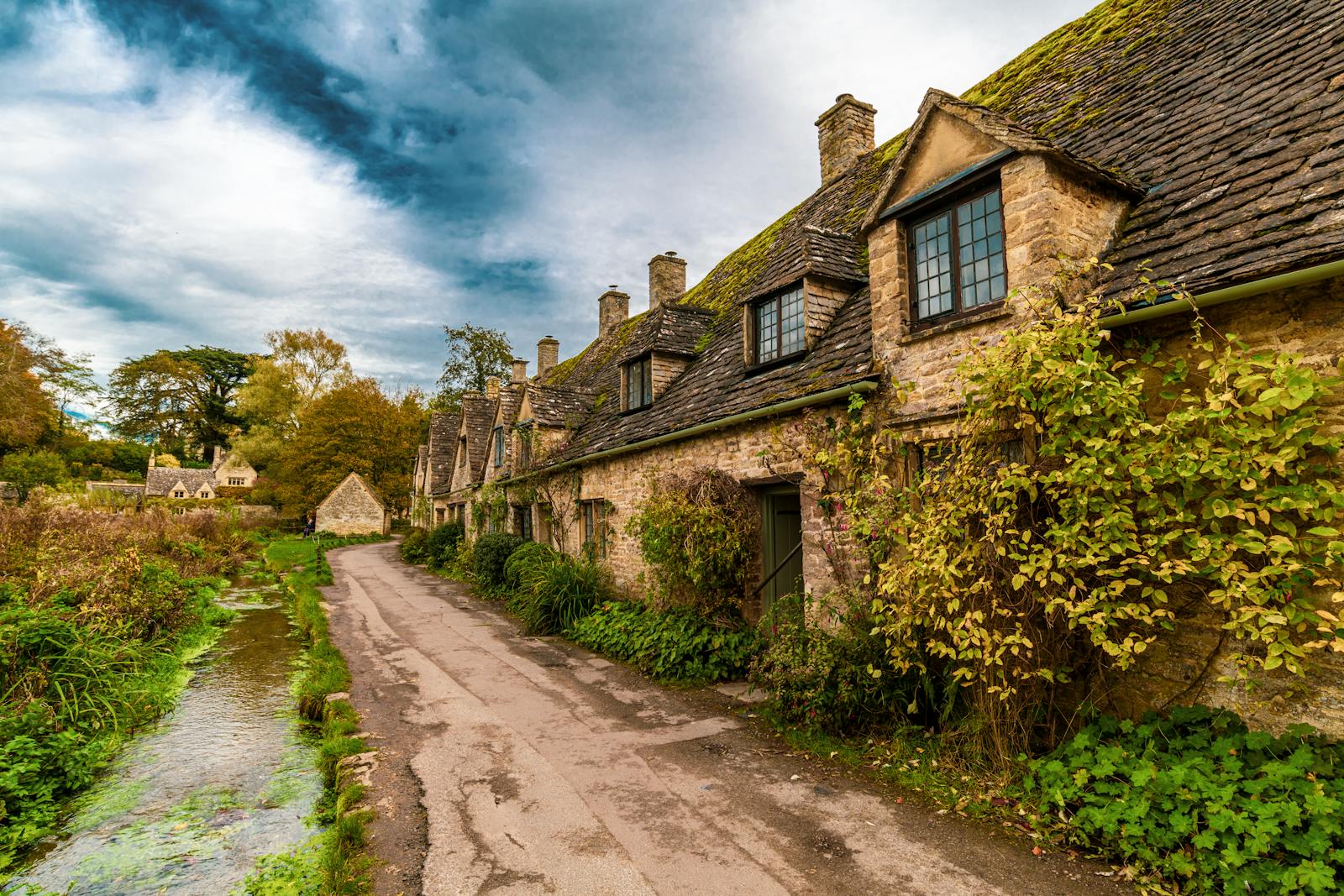
Look up at a traditional Cotswold roof and you are looking at one of the most distinctive — and most labour-intensive — features of the whole regional style. The roofs are covered not in true slate but in thin slabs of the local limestone, which everybody nonetheless calls “slates.” The craft of making them is astonishingly old: archaeologists have found Cotswold stone roof tiles on Roman villa sites, which means the method has barely changed in close to two thousand years.
The technique is wonderfully ingenious. The roofing stone, called “pendle,” was quarried in autumn and left out through the winter, still wet from the ground. As the trapped moisture froze, it expanded and split the stone along its natural layers into thin, roof-sized sheets — the weather doing the work that would otherwise take endless hammering. The finished slates are then laid in courses that diminish as they climb, the largest and heaviest at the eaves and the smallest at the ridge. It is this graduation, more than anything, that gives Cotswold roofs their soft, textured, almost living quality. The catch is weight: these roofs are heavy, which is precisely why the walls of old Cotswold houses are built so reassuringly thick.
Drystone walls: the craft that stitches the landscape together
Step out of the villages and the same stone reappears as the field walls that lace across the hills. Cotswold drystone walls are built, as the name says, without any mortar at all — just carefully chosen and skilfully fitted stones, locked together by gravity and the waller’s eye. A good wall is wider at the base than the top, threaded through with longer “through stones” for stability and finished with a row of upright coping stones along the crest.
They are slow to build — a skilled waller might complete only a few metres a day — but when made well they last for generations, flexing gently with the ground and providing homes for wrens, lizards and wildflowers. Maintaining them is now considered an important part of conserving the Cotswold landscape, and the craft of drystone walling is treasured and taught precisely because there is no shortcut to it. To my eye they are every bit as much a part of the region’s heritage as the grand churches; they are just made by anonymous hands.
The details that make a building unmistakably Cotswold
Beyond the colour and the roofs, there is a whole vocabulary of small details that, together, add up to “the Cotswold look.” Once you learn to spot them, you start reading the buildings like a face.

The most characteristic is the stone mullioned window — tall windows divided by upright stone bars, or mullions, often with a dripstone or “hood mould” carried over the top to throw rainwater clear of the glass. Add to that steeply pitched gables, gabled dormer windows poking out of those heavy roofs, sturdy stone door surrounds and the occasional carved finial, and you have the classic Cotswold cottage or manor. Many larger houses feature a prominent central “king mullion” window over the porch. None of this was about showing off, originally; it was practical building in a damp climate with a generous, workable local stone. But the cumulative effect is one of the most harmonious vernacular styles in Europe.
Why it all still looks the same: conservation and planning
Here is a fair question for the sceptic: surely some of this consistency is enforced rather than natural? And the honest answer is yes — today it is carefully protected. Much of the region falls within the Cotswolds National Landscape (the protected area formerly known as the Cotswolds Area of Outstanding Natural Beauty), and a great many individual buildings are formally listed for their historic interest. Planning policies across the Cotswold districts strongly encourage new development to use natural or reconstituted Cotswold stone and to respect the traditional scale, roof pitch and detailing of their surroundings.
That is why a brand-new house in a Cotswold village will usually still wear the honey-coloured uniform, and why you rarely see a jarring modern intrusion in the historic cores. It is a deliberate act of stewardship, building on the lucky historical accident I mention in our guide to the Cotswolds wool trade: when the wool wealth drained away, the region became too poor to modernise, and so the old stone towns survived intact. Conservation today simply protects what poverty once accidentally preserved.
Where to see the finest Cotswold stone
If you want to feast your eyes on the stone at its very best, these are the places I would steer you towards — and the times of day worth planning around.
- Bibury — Arlington Row, a terrace of 17th-century weavers’ cottages, is perhaps the single most photographed row of stone buildings in England, and rightly so.
- Castle Combe — Often called the prettiest village in England, a tight huddle of golden cottages with almost nothing modern in sight.
- Stanton and Snowshill — Two of the most perfectly preserved honey-stone villages in the north Cotswolds, with barely a building out of place.
- Chipping Campden — The gently curving High Street is a master class in the full range of Cotswold building, from humble cottages to the grand wool-merchant houses.
- The Slaughters — Lower and Upper Slaughter, where the stone is reflected in the little River Eye, are the quintessential unspoilt Cotswold idyll.
For the very best of the colour, go in the “golden hours” just after sunrise or before sunset, when low light rakes across the stone and sets it glowing. Overcast days flatten it; bright, low sun ignites it. If photography is your thing, our guide to the best Cotswolds photography spots pairs perfectly with a stone-spotting tour.
Reclaimed, reconstituted and the art of looking after old stone
Because genuine Cotswold stone is now expensive and many of the historic quarries have long since closed, modern builders work with a mix of materials. Reclaimed stone, salvaged from demolished walls and barns, is highly prized for repairs and extensions because it already carries that weathered patina and blends seamlessly with old work. For larger or budget-conscious projects, “reconstituted” Cotswold stone — cast from crushed local limestone bound together — is widely used and approved in many planning situations, since from a distance it reads convincingly as the real thing.
There is also a quiet craft to keeping old Cotswold buildings healthy, and it is one many newcomers learn the hard way. Traditional stone walls were built with soft lime mortar, which lets the wall “breathe” and move gently with the seasons. When well-meaning owners repoint with hard modern cement, moisture gets trapped in the stone, and the stone — rather than the mortar — begins to crumble and spall. Conservation specialists across the region now spend a great deal of time undoing exactly this sort of damage. The lesson, if you ever come to own a piece of this honey-coloured heritage, is simple: respect the lime, and the stone will outlast you by centuries.
It is worth remembering, too, that the stone is a living surface. Lichens speckle it gold and grey, moss softens the north-facing walls, and the colour shifts with the weather and the seasons — warmer and more saturated after rain, paler under a flat winter sky. Part of the magic of the Cotswolds is that no two buildings, and no two days, look quite alike. The stone is the constant; the light and the lichen do the rest.
Frequently asked questions about Cotswold stone
Why is Cotswold stone yellow or honey-coloured?
The colour comes from iron oxide within the local oolitic limestone. Depending on how much iron the stone contains, it ranges from creamy white through grey to a deep golden ochre. The honey tone also deepens with age: freshly quarried stone is often pale and only ripens to its rich colour after a few years of weathering.
What kind of stone is Cotswold stone?
It is oolitic Jurassic limestone, formed between roughly 150 and 200 million years ago from the compacted remains of marine life on a warm sea floor. “Oolitic” refers to the tiny egg-shaped grains, or ooids, that make up the rock and give it its even texture and easy workability.
Are Cotswold roofs made of slate?
Not true slate, no. The roof tiles are thin slabs of local limestone, traditionally split by winter frost and laid in courses that get smaller towards the ridge. They are called “slates” locally, but they are limestone, and the craft of making them dates back to Roman times.
Why do all the buildings in the Cotswolds look the same?
Historically, builders used the local limestone because it was abundant and close to hand, giving every village a natural unity. Today that consistency is protected: much of the area is a National Landscape, many buildings are listed, and planning rules encourage new development to use Cotswold stone and traditional detailing so the historic character is preserved.
Where can I see the best examples of Cotswold stone architecture?
Bibury’s Arlington Row, Castle Combe, Stanton, Snowshill, Chipping Campden and the Slaughters are among the finest. For grand uses of the stone, visit Blenheim Palace and the colleges of Oxford. Our pillar guide to Cotswolds history and heritage places the architecture in its wider historical context.
The next time you stand in a Cotswold village at golden hour and feel that quiet glow of contentment, you will know it is not sentiment alone — it is a tropical sea, a hundred million years of pressure, a little iron, a great deal of skilled human hands and a region that, by luck and by law, kept its old stone clothes. For the bigger picture of how this landscape came to be, carry on to our guide on the Cotswolds National Landscape and what its protected status really means. The grandest expression of that stone is ecclesiastical — see our guide to the Cotswolds wool churches.
The best proof of how little Cotswold villages have changed is how often film crews use them. A street in Blockley becomes 1950s Kembleford for Father Brown, Chastleton’s courtyard becomes Tudor Putney for Wolf Hall, and Lacock plays Georgian Meryton, all with a load of gravel and a few period props. Our guide to Cotswold period drama locations shows where to see them.