This article contains advertising. My booking links are routed through a partner that adds commission tracking automatically, so if you book through one I earn a commission from the provider, at no extra cost to you. It never affects what I recommend. Affiliate disclosure
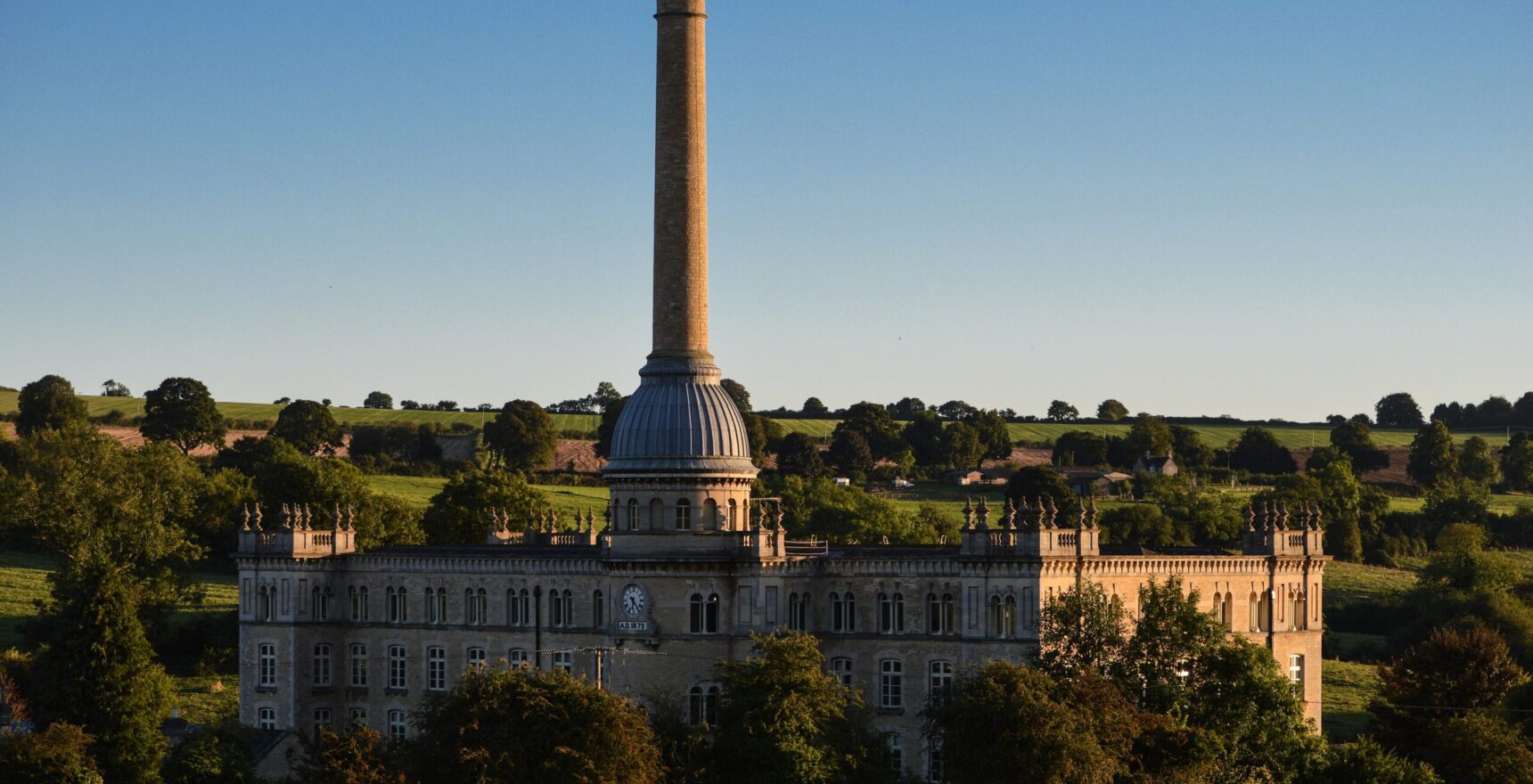
Coming in from the west on the A44, you crest a hill and see a chimney. It is a hundred and sixty-five feet of honey limestone rising out of a domed base, standing over a building with battlements, pinnacles and a clock, and it looks like an Italian campanile that has been dropped into an Oxfordshire field by mistake. It is a tweed mill. It was built in 1872 by a Lancashire architect for a family who wanted their factory to look like a country house, and it is the best introduction to this town that exists.
Because the point about Chipping Norton Cotswolds is that it is not a pretty village pretending to be a town. It is the highest town in Oxfordshire, at around seven hundred feet, and it has a mill, a theatre, a lido, a Wednesday market, a Neolithic stone circle four miles up the road and a working population who were doing all of this long before anyone arrived to look at it.
Locals call it Chippy. Among the Cotswold towns it is the one that most resembles somewhere people actually live — and, currently, the one with the strangest traffic problem in the region.
Chipping Norton at a glance
| Detail | |
|---|---|
| Population | About 6,300 |
| Altitude | Around 700 ft — the highest town in Oxfordshire |
| Market day | Wednesday, Market Place |
| Farmers’ market | Third Saturday of the month, 08:30–13:30 |
| Free to see | St Mary’s church, the castle earthworks, Bliss Mill from the footpath, the almshouses |
| Nearest station | Kingham, 4 miles — about 1h30 from London Paddington |
| Typical double room | £85–£130 — the cheapest of the good northern bases |
| Time needed | Half a day for the town; a full day with the Rollrights |
Prices and times checked September 2026 — confirm before you travel.
Bliss Tweed Mill
The mill is the town’s signature and the reason to arrive from the west. William Bliss’s family had been making cloth here since the eighteenth century; after a fire in 1872 they commissioned George Woodhouse, a Lancashire mill architect, to rebuild — and rather than the plain brick shed that would have gone up in Rochdale, they got a classical stone block with a mansard roof, corner turrets and a chimney disguised as a Tuscan bell tower rising from a domed drum.
It made tweed until 1980, which is late for an English woollen mill, and it is now flats. You cannot go in, but there is a public footpath along the valley below it and the view from the A44 lay-by is the one everybody photographs. Go in the last hour of light, when the stone turns the colour the whole region is named for.
The Rollright Stones
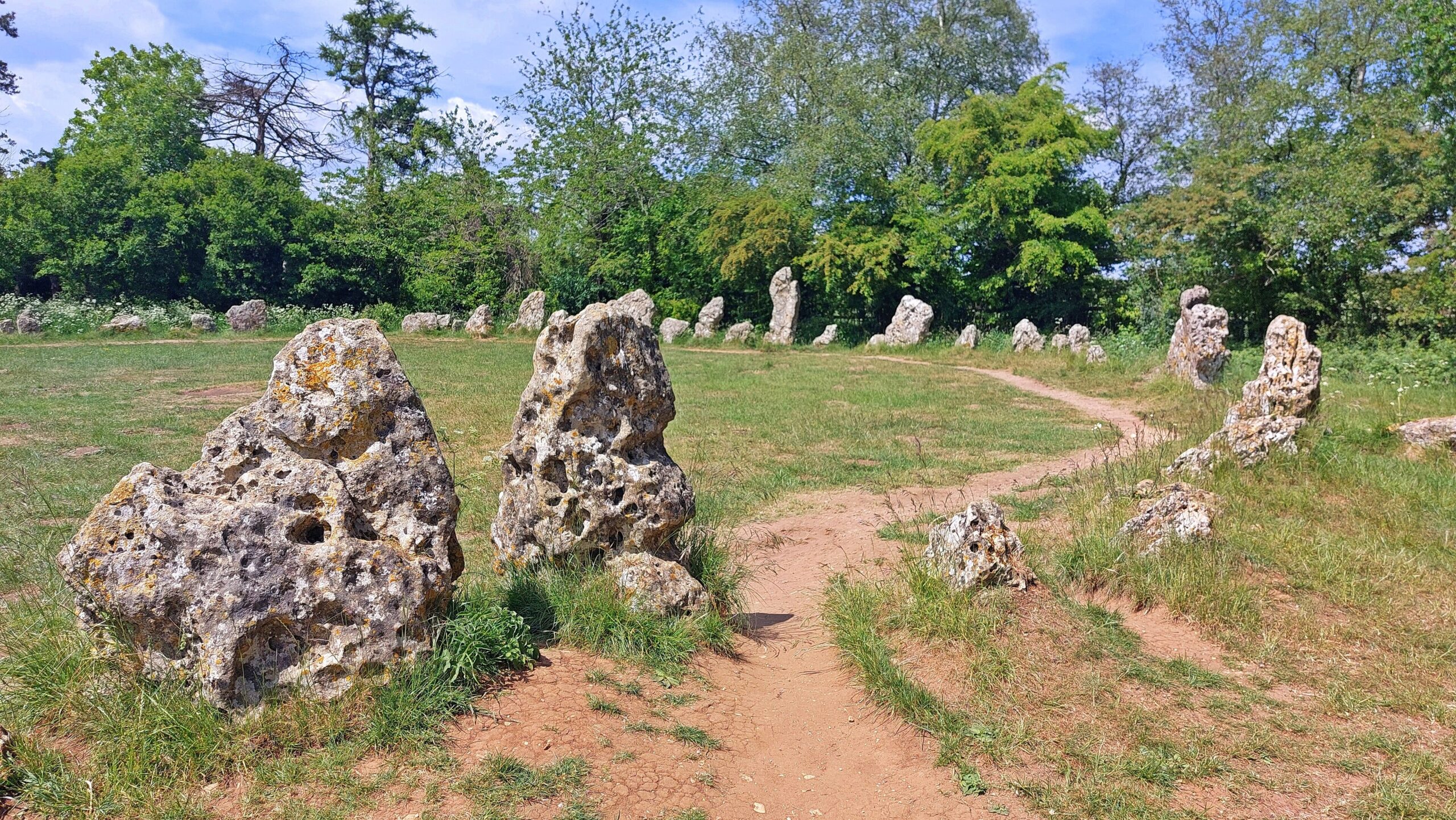
Four miles north on the ridge that carries the Oxfordshire–Warwickshire border, and the most atmospheric prehistoric site in the Cotswolds. There are three separate monuments, built roughly a thousand years apart, which is unusual in itself:
- The King’s Men — a circle of around seventy-seven stones, perhaps 2500 BC, weathered into extraordinary pitted and holed shapes by four and a half thousand years of rain. The circle is about a hundred feet across and you can walk into it.
- The Whispering Knights — the oldest of the three by a long way, a portal dolmen of around 3800–3500 BC standing in a field a few hundred yards east: four uprights leaning together with a fallen capstone, the remains of a burial chamber.
- The King Stone — a single twisted monolith across the road to the north, in Warwickshire, probably a Bronze Age grave marker. Its shape is partly the work of drovers who chipped bits off for luck.
The legend is worth knowing because the stones are named for it: a king marching to conquer England met a witch who told him that if he could see Long Compton in seven strides the kingdom was his. He strode, a mound rose in front of him, and she turned him, his men and his muttering knights to stone.
The site is privately owned and run by a trust, with a small honesty-box charge for the King’s Men — bring a couple of pound coins. It is open in daylight hours, it is never crowded, and in low winter sun it is genuinely extraordinary. Our history and heritage guide puts it alongside Belas Knap and the region’s other prehistoric sites.
The town centre
St Mary the Virgin
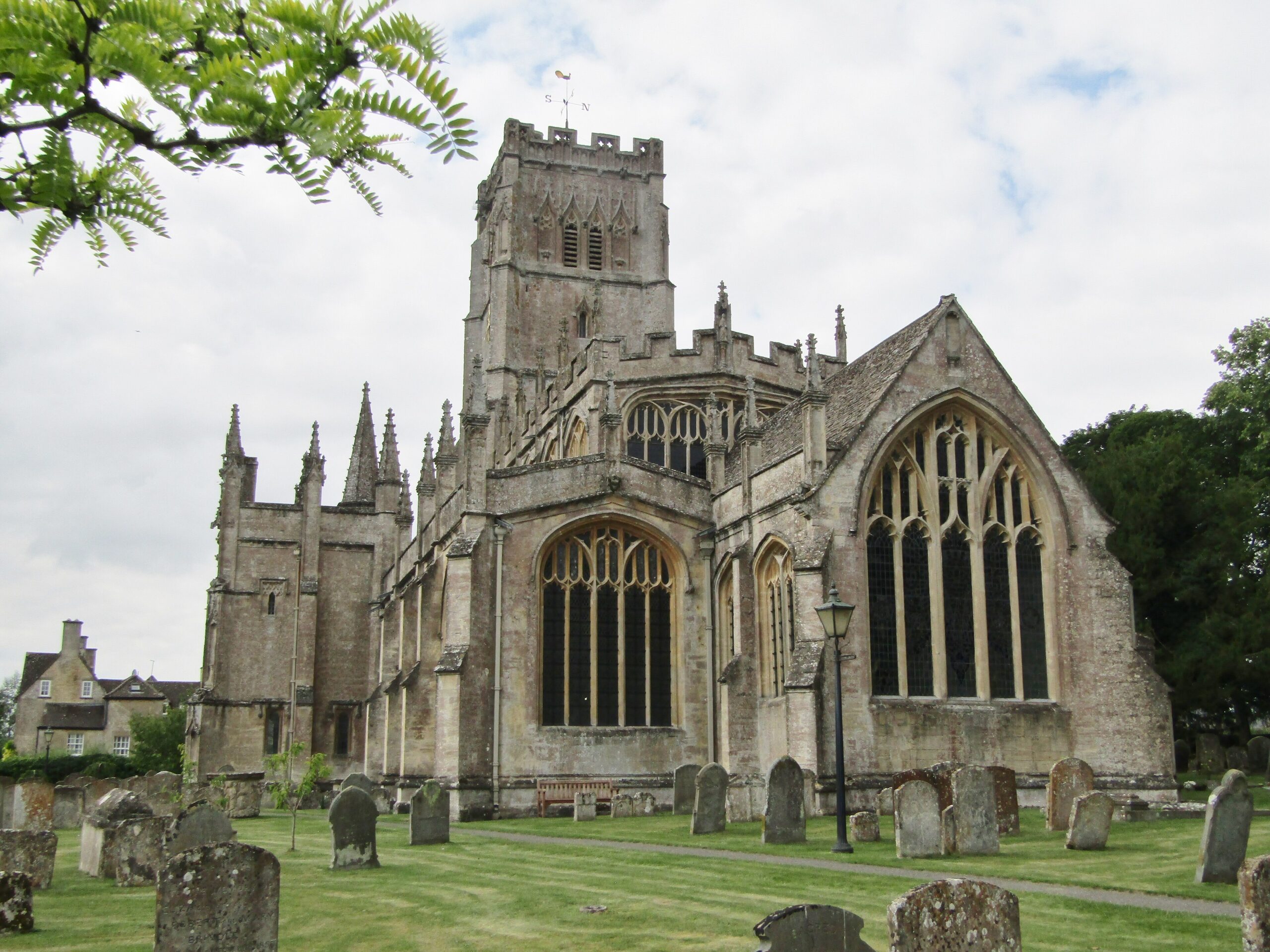
A wool church of the fifteenth century, and the unusual feature is the porch: hexagonal, two-storeyed and unlike anything else in the region. Inside, the nave has a fine clerestory and there are merchant brasses to the Rychardes family, wool men who paid for a good deal of it. Free, usually open.
Behind the church, on the slope, are the grassy earthworks of Chipping Norton Castle — a Norman motte and bailey, entirely gone above ground, but the shape is clear and the view down the valley explains why they built there. It takes five minutes and costs nothing.
The Market Place and the almshouses
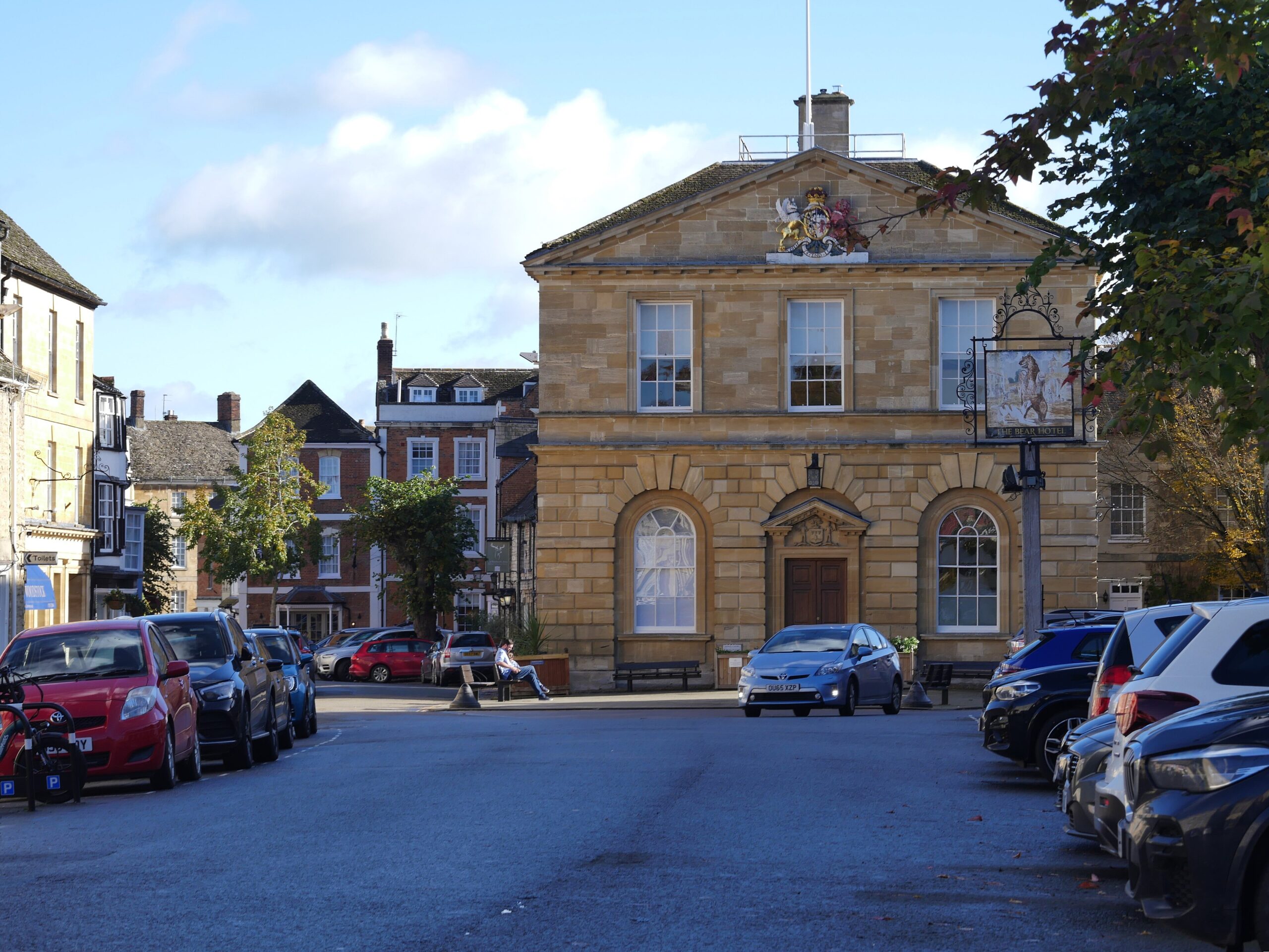
The town slopes, which gives the Market Place its character — a wide sloping triangle with the Town Hall of 1842 at the top, sitting above the street on a flight of steps. The Wednesday market fills it, and the farmers’ market takes the third Saturday of the month from 8.30am to 1.30pm.
Down Church Street stand the almshouses of 1640, a low stone row with dormers and tall chimneys, and one of the most photogenic buildings in the town precisely because nobody has ever done anything to it.
The Theatre and the Lido
The Chipping Norton Theatre occupies a converted Salvation Army citadel on Spring Street, seats around two hundred, and has been programming year-round since 1975 — touring drama, comedy, music, cinema and an annual pantomime that sells out in the autumn. For a town of six thousand people it is a remarkable thing to have, and it is the single best argument for staying here on a wet evening.
The Chipping Norton Lido is a heated outdoor pool, community-run and open through the warmer months. Between the two, Chippy has more genuine local amenity than towns three times its size elsewhere in the region.
Where the name comes from
“Chipping” is Old English cēping, a market — the same element that gives Chipping Campden, Chipping Sodbury and Chipping Barnet their names — and “Norton” is simply the north farmstead. So the town is, literally, the market at the north farm, which was granted its charter in the thirteenth century and has been holding one ever since.
The wool trade made it. Chipping Norton sat on the drove roads coming down off the wolds, and by the fifteenth century it was prosperous enough to rebuild St Mary’s on the scale you see. What is unusual is what happened next: where most Cotswold towns went quiet after the wool trade moved on, Chipping Norton reindustrialised. The Bliss family’s mill kept the town making cloth right through the Victorian period and into living memory, which is why it has terraced workers’ housing, a working-class political history and a Victorian gasworks — none of which the postcard towns have.
That is the whole character of the place in a sentence. Chipping Norton is a Cotswold wool town that also had an industrial revolution, and it has never quite decided which of the two it is.

Shopping and eating
The High Street and Market Place hold a good run of independents — a very good butcher, a deli, a bookshop, several charity shops that benefit from the surrounding houses, and a scatter of galleries — alongside the usual small-town chains. It is a working shopping street rather than a browsing one; our market towns shopping guide and independent shops guide compare it with Stow, Burford and Tetbury.
Eating is better than the town’s appearance suggests, largely because of what has happened to the surrounding countryside in the last twenty years: there is real money in the villages around Chipping Norton, and it wants somewhere to have dinner. Expect a couple of serious kitchens, several good pubs and a decent bakery. Book weekends. Our best pubs guide and restaurants guide cover the area.
The Clarkson effect
Diddly Squat Farm Shop sits on the Chipping Norton Road at Chadlington, four miles south-east, at OX7 3PE. It opens Tuesday to Sunday, 9.30am to 4.30pm, including bank holidays, and is closed on Mondays.
Be realistic about it. Queues of up to two hours are normal at weekends and after a new series airs, the car park is typically full by noon, and the shop itself is small. The Google Maps pin for the farm does not sit on the shop. If you are going, go on a Tuesday or Wednesday morning in term time, or do not go at all.
The town has absorbed the consequences with reasonable grace, but the traffic on the A361 and the lanes towards Chadlington is genuinely worse than it was, and local patience is finite. The Farmer’s Dog, Clarkson’s pub, is near Burford rather than here — a half-hour drive south. Our famous Cotswolds residents guide covers the wider phenomenon, of which this town is the unwilling capital.
Around Chipping Norton
- Chastleton House, 5 miles — a Jacobean house of 1612 preserved by the National Trust almost exactly as its declining family left it, unrestored and unheated. It stood in for the Cromwell house in Wolf Hall. Timed entry; book ahead.
- Stow-on-the-Wold, 9 miles — antiques and the famous yew door. Our Stow guide has the detail.
- Burford, 12 miles — the High Street down to the Windrush, and the wildlife park two miles beyond. See the Burford guide.
- Blenheim Palace, 12 miles — Vanbrugh, Capability Brown and Bridgerton‘s Buckingham House. Our Blenheim guide covers tickets and timings.
- Oxford, 20 miles — an easy day out; see the Oxford day trip guide in reverse.
- Long Compton and the Wolds — the villages north along the ridge are quiet, stone and almost entirely unvisited.
Walking
The d’Arcy Dalton Way passes through, running north–south across the county, and the walk out to the Rollright Stones and back along the ridge is about eight miles with big open views in both directions. Shorter options follow the Glyme valley below the mill. More in our circular walks guide and walking guide.
Chipping Norton with children
Better equipped than most Cotswold towns, because the facilities were built for residents rather than visitors. The lido in summer is the obvious one — a heated outdoor pool with a shallow end and a lawn. The theatre programmes family shows through the holidays and a pantomime in December. The recreation ground has a decent playground, and the castle earthworks behind the church are a hill to run down.
Further afield, Cotswold Wildlife Park at Burford is fourteen miles and the best family day in the region, and Blenheim’s park and adventure playground are twelve. Our family days out guide and family holidays guide have the options.
Getting to Chipping Norton
By train. Kingham is the nearest station, four miles west, with direct Great Western services to London Paddington in about an hour and a half. There is a connecting bus but it is infrequent — budget for a taxi. Our Cotswolds by train guide sets out the connections.
By bus. The S3 runs to Oxford via Woodstock, and there are services to Banbury, Stow and Moreton-in-Marsh. Better than most Cotswold towns; still thin on Sundays. See the bus routes guide.
By car. Chipping Norton sits on the A44 between Oxford and Evesham, with the A361 running north to Banbury. There is pay-and-display parking off the Market Place and a larger car park behind the High Street. Expect delays on the A361 towards Chadlington at weekends.
Where to stay
Rooms run £85–£130 for a mid-range double with breakfast, which is thirty to forty per cent below Stow nine miles away. There are a couple of old coaching inns on the High Street, several good B&Bs, and some genuinely expensive country places in the villages around — the gap between the two ends is wider here than anywhere else in the region.
As a base, it works well for the north-eastern Cotswolds and Oxfordshire: Stow, Burford, Moreton, Blenheim, Chastleton and Oxford are all within half an hour, and the Rollrights are on the doorstep. It is weaker for Cheltenham, Cirencester and the western escarpment. Our areas to stay guide and where to stay guide compare the alternatives.
Is Chipping Norton worth visiting?
Not as a beauty stop. If you have a single day and you want the Cotswolds of the postcards, go to Chipping Campden or Burford instead — Chippy’s High Street is handsome in places and ordinary in others, there is traffic through the middle, and it will not photograph the way you want.
It is worth visiting for three specific things: the mill, which is the best piece of Victorian industrial architecture in the Cotswolds; the Rollright Stones, which are among the best prehistoric sites in southern England and cost a pound; and the theatre, if you can time an evening around it. Add a Wednesday market and you have a genuinely good day.
And it is worth staying in, for the simple reason that it is cheap, central and real. You will hear people complaining about the parking rather than photographing a door.
Frequently asked questions about Chipping Norton
Is Chipping Norton in the Cotswolds?
Yes. It sits inside the Cotswolds National Landscape in north-west Oxfordshire, and at around 700 feet it is the highest town in the county.
What is Chipping Norton famous for?
Bliss Tweed Mill and its distinctive chimney, the Rollright Stones four miles north, its theatre, and — more recently — being the nearest town to Jeremy Clarkson’s Diddly Squat farm shop.
How much are the Rollright Stones?
A small honesty-box charge for the King’s Men circle — bring a couple of pound coins. The King Stone and the Whispering Knights are viewable without charge. The site is open in daylight hours and is run by a charitable trust.
How far is Diddly Squat from Chipping Norton?
About four miles south-east, on the Chipping Norton Road at Chadlington, OX7 3PE. It opens Tuesday to Sunday, 9.30am to 4.30pm, and is closed on Mondays. Queues of up to two hours are normal at weekends, and the car park is usually full by midday.
What day is Chipping Norton market?
Wednesday, in the Market Place. The farmers’ market runs on the third Saturday of the month from 8.30am to 1.30pm.
Can you go inside Bliss Mill?
No — it was converted into private flats in the 1980s. There is a public footpath along the valley below it, and the classic view is from the A44 on the western approach to the town.
Is Chipping Norton a good base for the Cotswolds?
For the north-eastern Cotswolds and Oxfordshire, yes, and it is the cheapest of the good options — Stow, Burford, Moreton, Blenheim and Oxford are all within half an hour. It is less convenient for Cheltenham, Cirencester and the western escarpment.
How long do you need in Chipping Norton?
Two to three hours for the town, church, market and mill view. A full day if you add the Rollright Stones and Chastleton House.
Come on a Wednesday, do the market and the church, drive up to the Rollrights in the afternoon and see whatever is on at the theatre. From here, our guide to the Cotswold towns compares Chippy with the fifteen others, the history and heritage guide puts the Rollrights in context, the north Cotswolds itinerary strings the area into a route, and the photography spots guide covers the mill among the region’s best views.
Most visitors who come to Chipping Norton now arrive via a farm shop ten minutes down the road. If Diddly Squat is on your list, go for the 09:30 opening on a weekday, then come back into town for coffee while the queue builds behind you — our Clarkson’s Farm guide explains the timings, the parking and Clarkson’s pub near Burford.
Photo Credits
Bliss Tweed Mill, Chipping Norton: Bliss Mill by Cliffkinch, CC BY-SA 4.0, via Wikimedia Commons.
The King’s Men at the Rollright Stones: The Rollright Stones, The King’s Men – geograph.org.uk – 8058921 by Mark Percy, CC BY-SA 2.0, via Wikimedia Commons.
Leave a Reply