This article contains advertising. My booking links are routed through a partner that adds commission tracking automatically, so if you book through one I earn a commission from the provider, at no extra cost to you. It never affects what I recommend. Affiliate disclosure
In about 1010, a monk here strapped a pair of wings to his arms, jumped from the abbey tower, glided something over two hundred yards, and broke both his legs on landing. His name was Eilmer, and he apparently spent the rest of his long life insisting that the failure was his own fault for forgetting to fit a tail. There is a stained-glass window of him in the abbey. It is the only medieval memorial in England to a man who tried to fly and very nearly got away with it.
That story is a fair introduction to Malmesbury Cotswolds, a town that has been quietly doing unlikely things for eleven hundred years. It claims to be the oldest borough in England on the strength of a charter from Alfred the Great in 880. Its abbey holds some of the finest Romanesque sculpture in the country, in a building that is only half there because the tower fell down. And it sits on a hill almost entirely encircled by two branches of the Avon, which means every approach is a climb and every view out is a good one.
It is also, technically, in Wiltshire rather than Gloucestershire — but it sits inside the Cotswolds National Landscape and belongs firmly among the Cotswold towns.
Malmesbury at a glance
| Detail | |
|---|---|
| Population | About 5,800 |
| County | Wiltshire, inside the Cotswolds National Landscape |
| Market day | Friday, 09:00–15:00 at the Market Cross — artisan and farmers’ |
| Main draws | Malmesbury Abbey, Abbey House Gardens, the Market Cross |
| Free to see | The abbey (donation), the Market Cross, the riverside walks, Cloister Garden |
| Nearest station | Chippenham, 10 miles, or Kemble, 9 miles |
| Typical double room | £100–£150 mid-range |
| Time needed | Half a day for the town; a full day with the gardens and a river walk |
Prices and times checked September 2026 — confirm before you travel.
Malmesbury Abbey
What you see is a fragment, and understanding that is the key to the building. The abbey church built here from the 1140s was enormous — comparable in scale to a small cathedral, with a spire that was reportedly taller than Salisbury’s. In about 1500 the spire and the crossing tower came down in a storm, taking the transepts and choir with them. Forty years later the Dissolution arrived, the monastery was sold to a rich clothier called William Stumpe, and he handed the surviving nave to the town as its parish church.
So the abbey today is the middle six bays of a much bigger building, with the ruined west end open to the sky at one end and a blocked wall where the crossing used to be at the other. It is a strange, moving shape: half a great church, still in use, with the outline of the rest lying in the grass around it.
The south porch
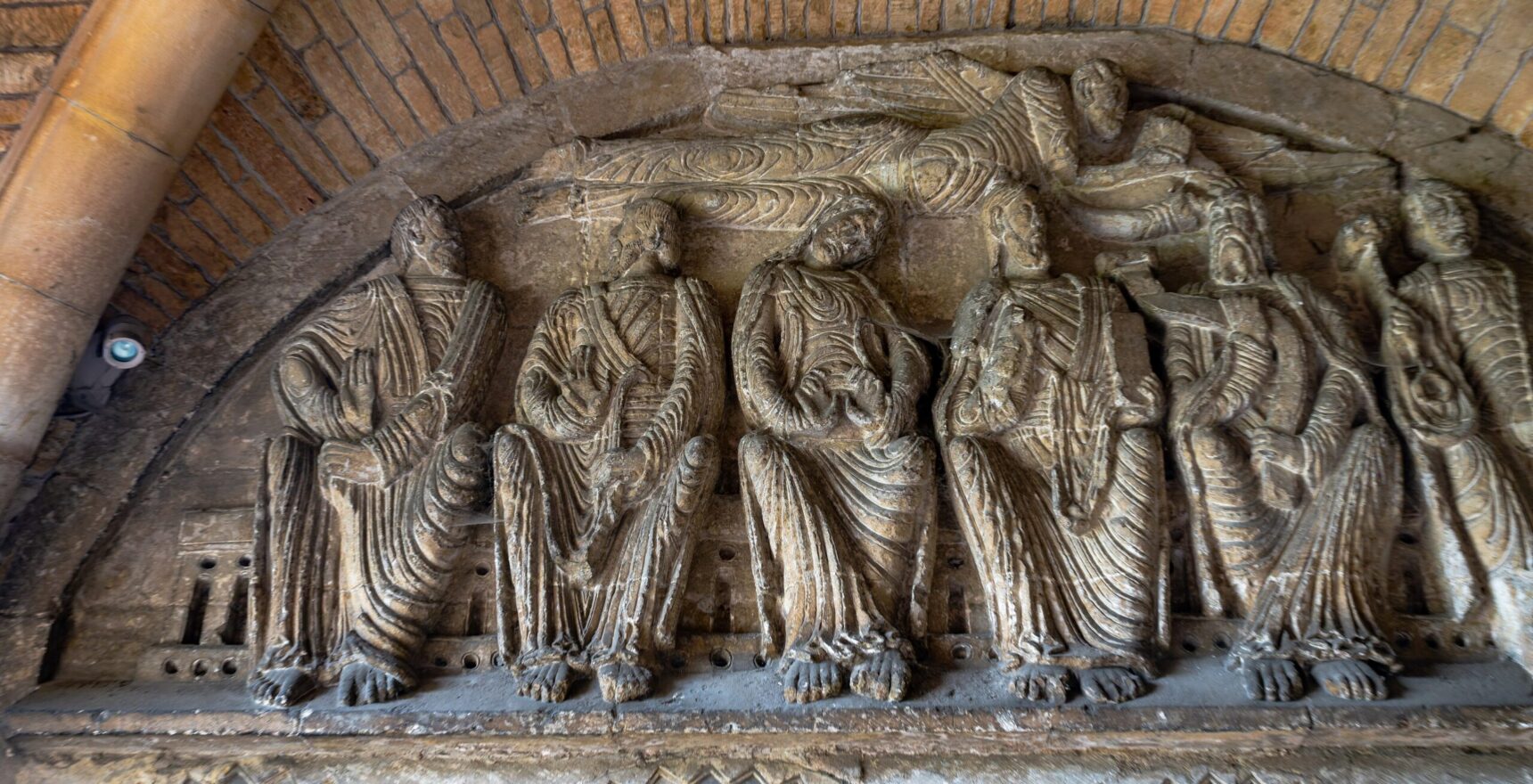
This is the reason to come. The Norman porch carries three deep bands of carving around the doorway — biblical scenes running in continuous roundels — and then, inside, two tympana showing the twelve apostles seated in ranks with an angel flying above each group, all of it worked around 1160. The drapery is extraordinary: fold on fold of it, deeply undercut, the feet of the apostles projecting over the ledge below.
It is among the finest surviving Romanesque sculpture in Britain, and there is no ticket office, no glass and usually nobody standing next to you. Take five minutes over it rather than one.
Inside
The nave is high, dark, Norman and impressive, with a watching loft high up on the south side reached by a stair in the wall. There is a tomb attributed to King Athelstan — Alfred’s grandson, the first king of a united England, who was buried here in 939, though the effigy is a fourteenth-century one and the body’s whereabouts are genuinely unknown. And there is Eilmer, in glass, arms outstretched.
Entry is by donation and the abbey is normally open through the day. Give it forty-five minutes.
Abbey House Gardens
Immediately next to the abbey, running down five acres of hillside to the Avon, and one of the more remarkable private garden projects in England — replanted from the 1990s onwards on the site of the medieval abbot’s house, with a very large collection of roses, a laburnum tunnel, a herb garden laid out on monastic lines and a river frontage.
Opening arrangements have changed over the years and the garden’s season and hours vary, so check its own site before you plan a day around it. When it is open it is one of the best gardens in this part of the Cotswolds and considerably less visited than Hidcote or Painswick. Our best gardens guide and garden open days guide cover the alternatives.

The town
The Market Cross
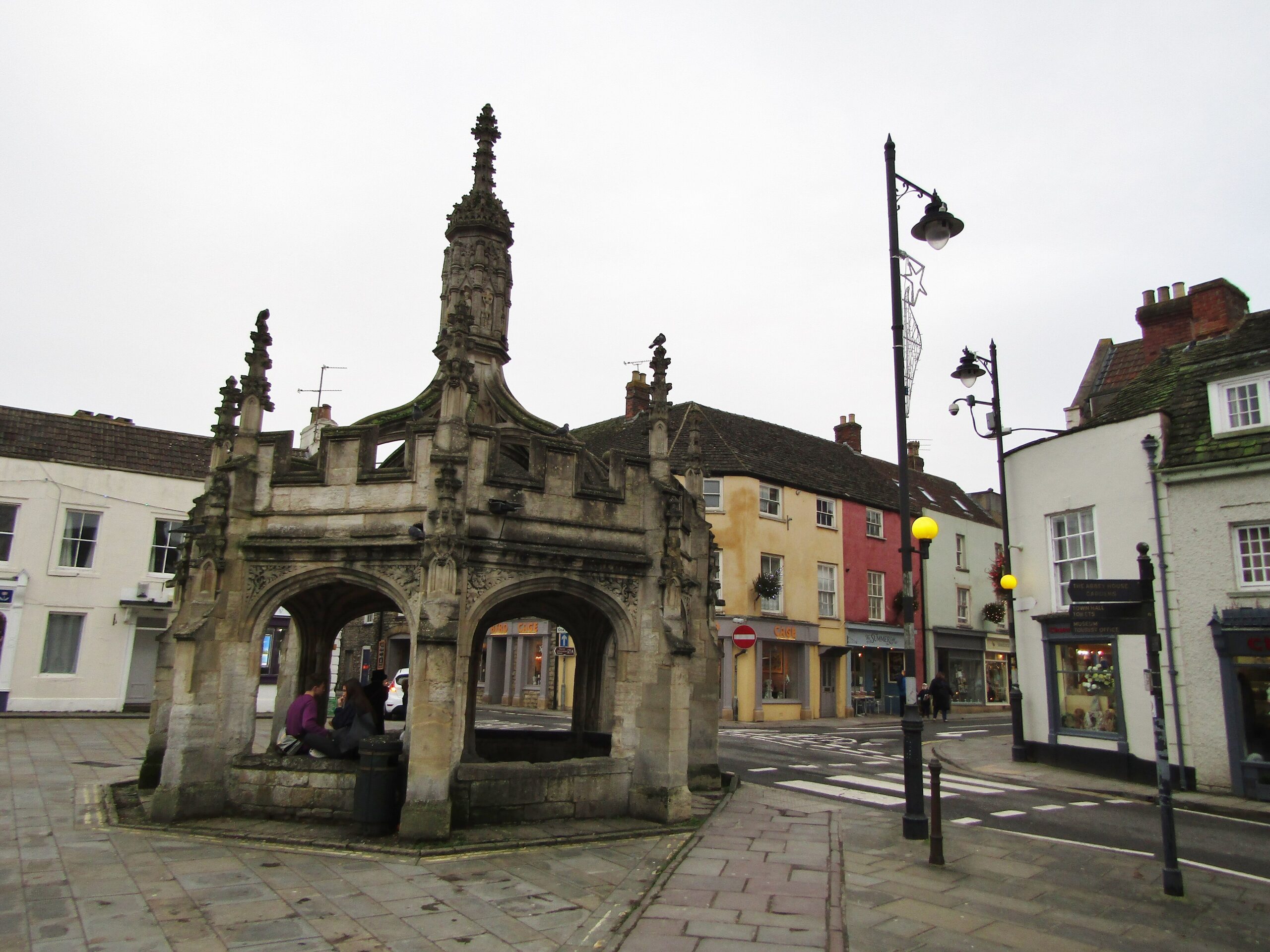
Standing at the top of the High Street, the Market Cross was built around 1490 — an octagonal, vaulted, richly pinnacled stone shelter, open on all sides, put up so that market traders had somewhere to stand out of the rain. John Leland, touring England in the 1540s, called it the finest of its kind he had seen, and he had seen a great many. People still sit in it. It is one of the best pieces of late-medieval street furniture in the country.
The Friday market
An artisan and farmers’ market runs at the Market Cross every Friday from 9am to 3pm — small, producer-led, local. It is the day to come if you want the town at its liveliest. Our farmers’ markets guide compares it with Stroud and Cirencester.
The High Street and the hill
Malmesbury’s shape is its best feature. The town occupies a steep spur with the Sherston and Tetbury branches of the Avon meeting below it, so the streets fall away sharply on three sides and the abbey sits at the top of everything. Walk down Silver Street to the river and back up the Old Bell steps for the best sense of it, and look for the town’s Victorian and Georgian frontages layered over much older cores.
The shopping is a short run of independents plus the usual small-town essentials — good enough for a browse, not a destination in itself. Our independent shops guide covers the region’s better options.
Athelstan Museum
Free, volunteer-run, on Cross Hayes, and better than its size suggests: local archaeology, the town’s lace and silk industries, an early bicycle collection and the Eilmer story properly told. Forty-five minutes.
Eleven hundred years in one hill
Malmesbury’s history is unusually continuous for a town this size, and knowing the sequence makes the streets legible.
A monastery was founded here in the seventh century, and by the eighth it had produced Aldhelm — abbot, poet, church builder and the first English writer of Latin verse whose work survives, later the town’s co-patron. In the ninth century Alfred fortified the hill as one of his burhs against the Danes, which is why the street plan still has the feel of a defended enclosure, and granted the charter the town still cites. His grandson Athelstan, who beat a combined army of Scots, Vikings and Britons at Brunanburh in 937 and became the first king of the whole of England, gave the townspeople five hundred acres of common land in gratitude for their support — land still held today by a body of Commoners descended from those families, which may be the oldest continuous land tenure in the country.
Then came the great Norman rebuilding, the collapse of the tower, the Dissolution and William Stumpe, the clothier who bought the abbey and filled its outbuildings with looms — turning a monastery into what was, briefly, one of the largest cloth factories in England. The town made woollens, then lace, then silk, and in the twentieth century became the unlikely global headquarters of a vacuum-cleaner company, whose research campus sits just outside.
Saxon burh, Norman abbey, Tudor cloth mill, Victorian silk, modern engineering — on the same hill, in that order. Our Cotswolds wool trade guide picks up the middle of that story across the wider region.
Walking around Malmesbury
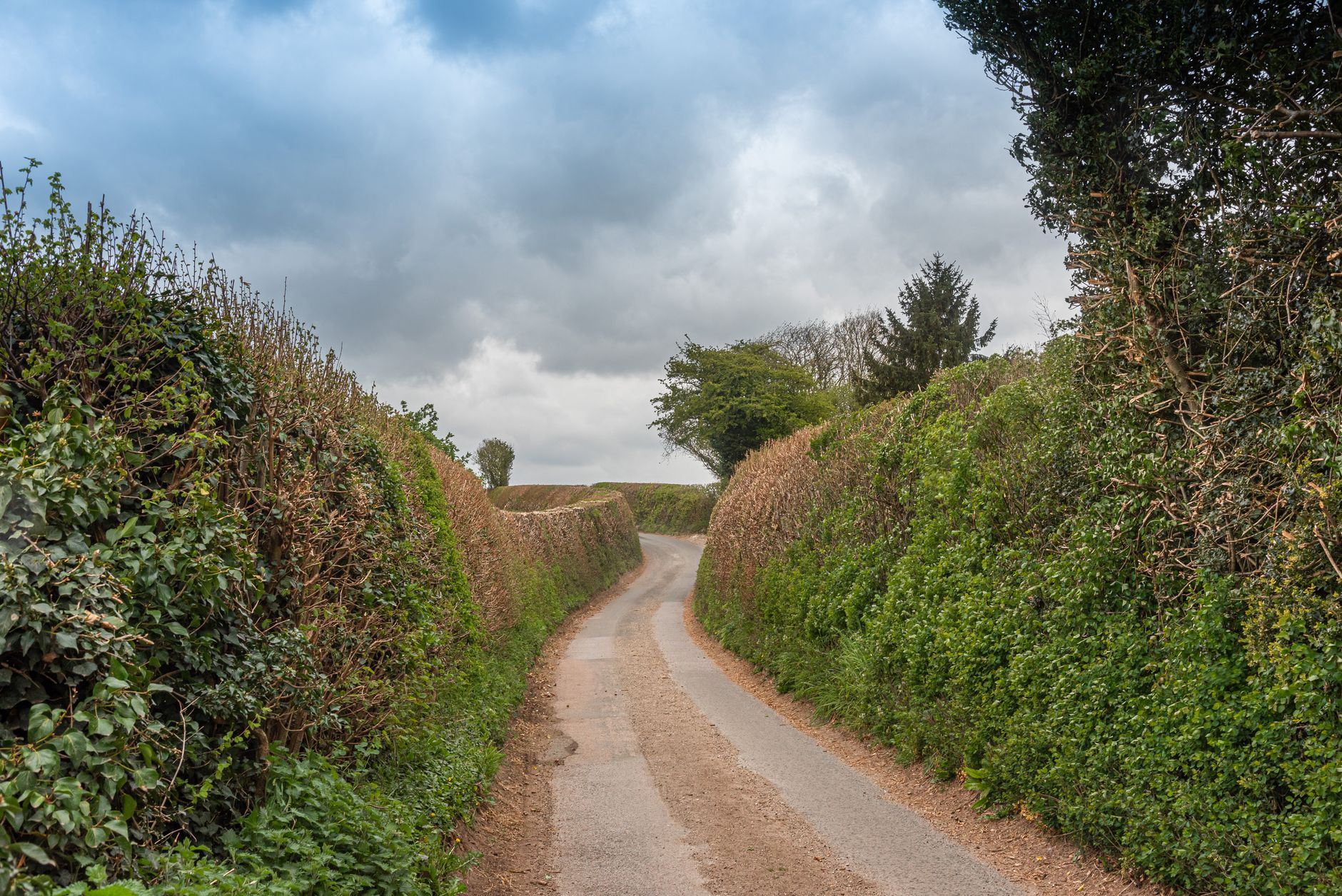
The river makes this town unusually good for short walks, and almost all of them are flat once you have got down the hill.
- The riverside circuit — around two miles, following the Avon around the base of the town past the old mills and back up. The classic view of the abbey rising above the trees is from the water meadows on the south side.
- Cole Park and the Sherston branch — quiet lanes and river meadow north-west of the town.
- Malmesbury to Tetbury — about six miles north on field paths and lanes, with a bus back if you time it.
- The Fosse Way runs a few miles east; Cirencester is eleven miles up it.
- Westonbirt Arboretum is nine miles north — the best autumn destination in the region. See our Westonbirt guide.
More routes in our circular walks guide and walks for beginners guide, and the town is at its greenest in April and May — our Cotswolds in spring guide has the seasonal detail.
Eating and drinking
Malmesbury has a couple of long-established inns near the abbey doing proper dining, several decent pubs, a good bakery and a handful of cafés. It is not a foodie destination in the way Nailsworth or Cheltenham are, but it feeds you well and it does not charge Tetbury prices — the gap between the two towns, six miles apart, is noticeable and consistently in Malmesbury’s favour.
Check what is open on a Sunday evening and a Monday out of season, which is the standard Cotswold trap. Our best pubs guide and historic pubs guide cover the area.
Around Malmesbury
| Destination | Distance | Why |
|---|---|---|
| Tetbury | 6 miles | Antiques, the Market House, the Highgrove shop |
| Westonbirt Arboretum | 9 miles | The best autumn colour in Britain |
| Castle Combe | 11 miles | Often called the prettiest village in England |
| Cirencester | 11 miles | Roman Corinium and two market days |
| Badminton | 8 miles | The estate; Bridgerton‘s Lady Danbury house |
| Lacock | 13 miles | Britain’s most-filmed village — Harry Potter and Wolf Hall |
| Bath | 20 miles | An easy day out |
| Cotswold Lakes | 10 miles | Watersports and the inland beach |
Our Castle Combe guide and southern Cotswolds itinerary put these into a route.
Getting to Malmesbury
By car. Malmesbury is a few minutes off the A429 between the M4 at junction 17 and Cirencester. There is pay-and-display parking near the town centre and at the Cross Hayes. The town is easy to reach and easy to park in, which is not true of most towns in this guide.
By train. There is no station — the branch line closed in the 1960s. Chippenham is ten miles south with fast services to London Paddington in about an hour and ten minutes; Kemble is nine miles north with direct services in about an hour and twenty. Both need a bus or taxi connection. Our Cotswolds by train guide compares them.
By bus. Services run to Chippenham, Swindon, Tetbury and Cirencester, but frequencies are modest and Sunday is thin. Check the bus routes guide and our car-free guide before relying on them.
Where to stay
The town has a well-known old inn by the abbey with a claim to being among the oldest hotels in England, plus a scatter of B&Bs and small hotels and a good deal of self-catering in the villages around. Expect £100–£150 for a mid-range double with breakfast — noticeably less than Tetbury six miles away for a town with more to look at.
As a base it works for the southern Cotswolds, Bath and the Wiltshire border, and it is a sensible cheaper alternative to Tetbury or Castle Combe. It is a long way from the northern villages. Our B&B guide and where to stay guide cover the options.
Is Malmesbury worth visiting?
Yes, and it is one of the better-value half-days in this whole guide. The abbey is genuinely first-rate — the porch sculpture alone would justify the trip, and it costs a donation — the Market Cross is one of the best in England, the museum is free, the hilltop setting is the most dramatic of any town here, and the riverside walk is lovely.
What holds it back is that it is not, at first glance, obviously pretty. The High Street has some indifferent twentieth-century infill, the approach roads are ordinary, and unless you come in from the water meadows the setting does not announce itself. People drive through Malmesbury without stopping in a way they never do in Burford, and they are wrong to.
The trade you are making is clear: less charm than Castle Combe or Chipping Campden, considerably more history, half the crowds and a third off the room rate. Come on a Friday for the market, and give the abbey porch the time it deserves.
Frequently asked questions about Malmesbury
Is Malmesbury in the Cotswolds?
Yes. It is in Wiltshire rather than Gloucestershire, but it sits inside the Cotswolds National Landscape at the southern end of the region, six miles from Tetbury and eleven from Cirencester.
Why is Malmesbury called England’s oldest borough?
Because of a charter granted by Alfred the Great in 880, which the town holds to be the earliest surviving borough charter in England. Alfred’s grandson Athelstan, the first king of a united England, endowed the town further and was buried at the abbey in 939.
Is Malmesbury Abbey free to enter?
Entry is by donation, and the abbey is normally open through the day. The south porch, with its Romanesque carving and apostle tympana of around 1160, is the highlight and can be seen without going inside.
What happened to Malmesbury Abbey’s tower?
The spire and crossing tower collapsed in a storm around 1500, destroying the transepts and choir. The Dissolution followed in 1539, and the surviving nave was given to the town as its parish church — which is why the building you see today is the middle section of a much larger church, open to the sky at the west end.
Who was Eilmer of Malmesbury?
An eleventh-century monk who fitted himself with wings and glided from the abbey tower, reportedly covering more than two hundred yards before crashing and breaking both legs. He blamed the lack of a tail. There is a stained-glass window commemorating him in the abbey.
What day is Malmesbury market?
Friday, 9am to 3pm, at the Market Cross — an artisan and farmers’ market rather than a general one.
How long do you need in Malmesbury?
Half a day covers the abbey, the Market Cross, the museum and the town. A full day if you add Abbey House Gardens and the riverside walk.
Is Malmesbury a good base for the Cotswolds?
For the southern Cotswolds, Bath and the Wiltshire border, yes, and it is cheaper than Tetbury or Castle Combe. Westonbirt, Badminton, Castle Combe, Lacock and Cirencester are all within twenty minutes. It is an hour or more from the northern villages.
Park at the Cross Hayes, walk up to the abbey and stand in the porch for a while — that is the town’s best five minutes and almost nobody takes them. From here, our history and heritage guide puts the abbey alongside Hailes and Chedworth, the guide to the Cotswold towns compares Malmesbury with the fifteen others, the Tetbury guide covers the town six miles north, and the wool churches guide explains what the region built with the money that came after the monasteries.
Photo Credits
The apostle tympanum in the south porch of Malmesbury Abbey: Abbey Church of St Mary and St Aldhelm, porch, Malmesbury by Tilman2007, CC BY-SA 4.0, via Wikimedia Commons.
The Market Cross, Malmesbury: Malmesbury – Market Cross – geograph.org.uk – 6630742 by Colin Smith, CC BY-SA 2.0, via Wikimedia Commons.
Leave a Reply