Stand in the middle of Stow-on-the-Wold’s Market Square on a clear winter morning and you feel the wind before you see anything else. At a shade over 800 feet, this is the highest of the Cotswold market towns, set on an exposed hilltop where the old roads meet, and the locals have a saying for it: “Stow-on-the-Wold, where the wind blows cold.” It does. Bring a coat. But that same hilltop is exactly why the town exists, and why, for the best part of a thousand years, drovers, wool merchants and travellers have been climbing up here to do business.
What you get for the climb is a broad, handsome square ringed with golden stone buildings, a tangle of antiques shops, a church with a door that fantasy fans cross continents to photograph, and some genuinely good pubs in which to thaw out afterwards. Stow wears its history lightly and gets on with the day job of being a working town. Give it a few hours, or use it as a base for the northern Cotswolds, and it repays you handsomely.
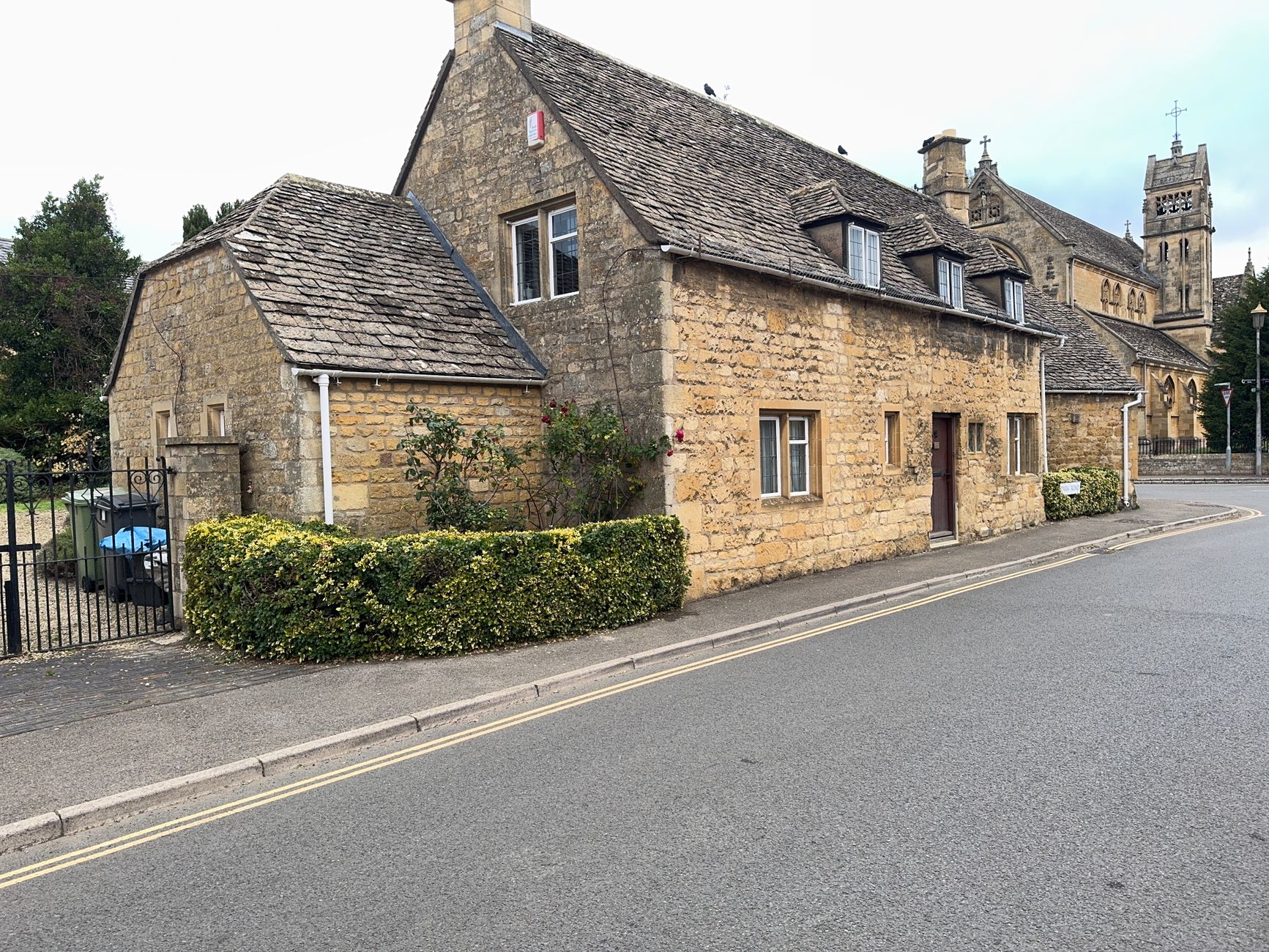
The Market Square and how Stow grew
Everything in Stow radiates out from the square, and the square tells you most of what you need to know about the place. It is large and open, far bigger than the town around it strictly needs, because it was built to hold sheep. Thousands of them. Stow won its market charter from Henry I in the early twelfth century, and its position at the junction of the Roman Fosse Way and a clutch of other old routes made it the natural place for farmers to bring their flocks down off the hills. By the medieval period this was one of the great wool and sheep fairs of England.
The numbers from those days are hard to credit. Daniel Defoe, passing through in the early eighteenth century, recorded that something like 20,000 sheep changed hands here in a single day. To move that many animals through the streets, the town developed a set of narrow alleyways running off the square, known locally as “tures”, which funnelled the sheep down into the market in a controlled trickle. You can still walk them today. Look for the gaps between the buildings on the square’s edges and slip through; they make atmospheric shortcuts and most visitors never notice they are there.
Around the square stand the old coaching inns, merchants’ houses and wool lofts, most now given over to shops, galleries and cafes. At the centre is the medieval market cross, restored over the years but originally a reminder to traders to deal honestly under the eye of God. Near it are the old stocks, set on the small green, where the town once dealt with wrongdoers rather more publicly. It is a fine square to sit in with a coffee and watch the place tick over, and unlike some Cotswold honeypots it is big enough to absorb a coach party without feeling overrun. For more on how these towns made their fortunes, our guide to Cotswolds history and heritage fills in the wider picture.
St Edward’s Church and the famous north door
Tucked just off the square down Church Street, St Edward’s is Stow’s parish church and the reason for a good number of modern visitors. The building has fabric ranging from the eleventh century to a heavy Victorian restoration, and it is named for Edward the Martyr, the murdered Anglo-Saxon king; the town itself was once Edwardstow in his honour. Inside it is worth a slow look for the medieval features, the brasses to wool merchants and a painting of the Crucifixion attributed to the school of the Flemish artist Gaspar de Crayer. Entry is free, as it should be.
But almost nobody comes for the inside. They come for the north door, a low wooden entrance flanked by two ancient yew trees whose trunks have grown up tight against the stone and arched over the top, framing the door like the gateway to somewhere enchanted. It is genuinely striking, especially in soft morning light or after rain, and it has become one of the most photographed spots in the Cotswolds.
You will see it described everywhere as the inspiration for the Doors of Durin, the entrance to the Mines of Moria in The Lord of the Rings, and the story goes that Tolkien, who taught at Oxford and toured the Cotswolds, sketched it here. It is a lovely tale and worth knowing. It is also, in plain truth, unproven. The Tolkien Society has never confirmed it, his own drawings of the Doors of Durin look nothing like this door, and the porch and its yews are only around three hundred years old rather than anything Saxon. Enjoy the door for what it certainly is, a beautiful and slightly otherworldly corner of an old church, and treat the Moria connection as the local legend it is. Either way, get there early if you want the photograph without a queue.
Antiques, galleries and independent shops
If Stow has a modern claim to fame beyond the church door, it is antiques. The town has one of the densest concentrations of dealers anywhere in the country, clustered around the square and along Sheep Street and Church Street, and it draws collectors and dealers from across Britain. This is not the bric-a-brac end of the trade. You will find Georgian silver, period oak and walnut furniture, antique maps and prints, sporting and scientific pieces, jewellery and the occasional thing you cannot quite identify but suddenly want.
Some of the shops are single-dealer specialists; others are multi-dealer centres where dozens of stands share a rambling old building, and you can lose a happy hour working through the rooms. Prices run from a few pounds for small collectables to many thousands for serious furniture, but the dealers are, on the whole, a knowledgeable and chatty lot who will happily talk you through a piece whether or not you are buying. Even if antiques leave you cold, the window displays alone are a pleasure to wander past. If old things are your weakness, pair Stow with our wider guide to Cotswolds shopping, markets and antiques.
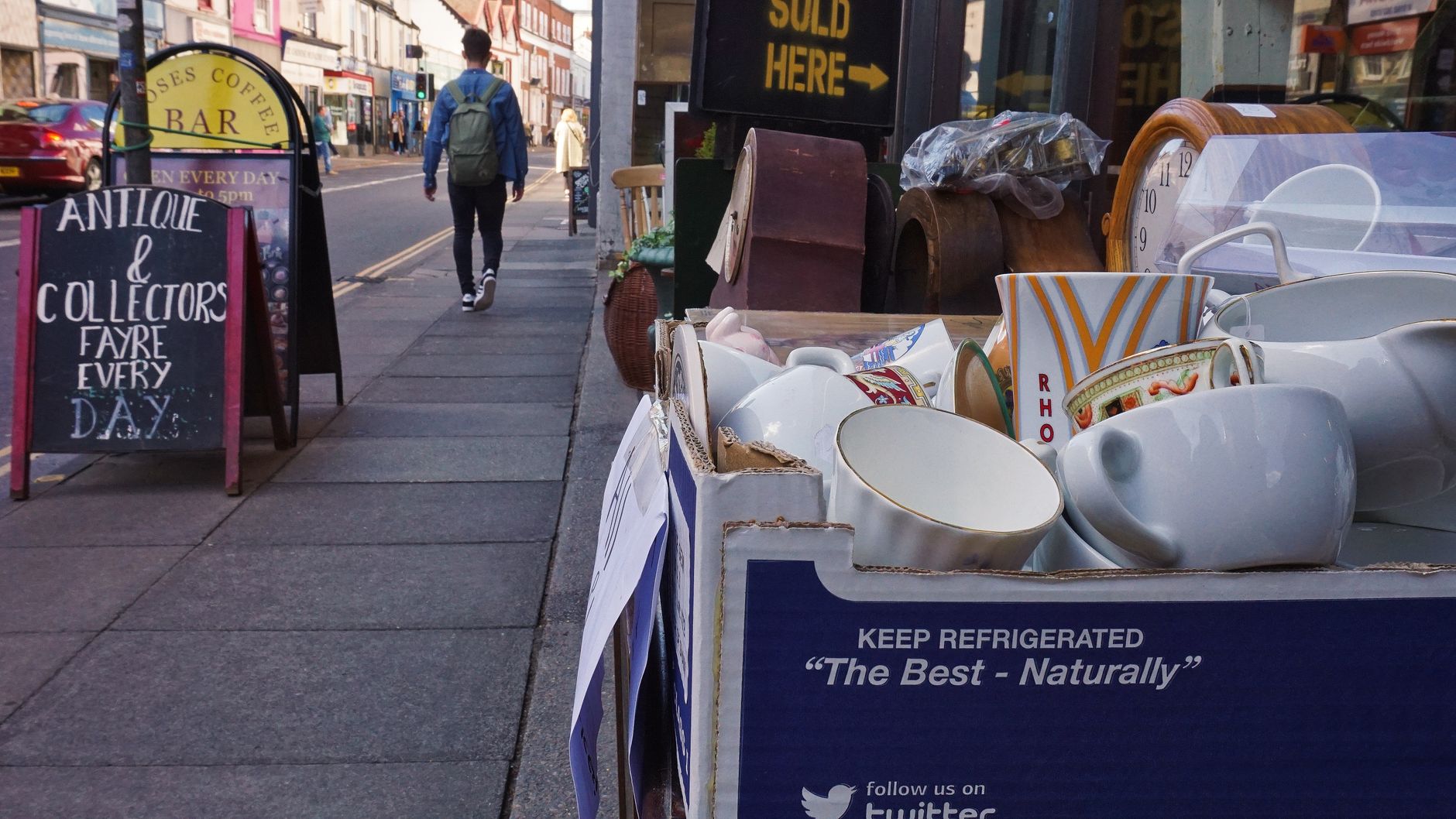
Beyond antiques there is a good crop of independent shops: a couple of proper bookshops, delis and food shops, gift shops, clothing boutiques and art galleries showing local work. It is the kind of high street that has largely held off the chains, which is rarer than it should be, and a big part of why the town is so pleasant to mooch around in the gaps between attractions.
The Porch House and the oldest inn debate
On Digbeth Street stands the Porch House, formerly the Royalist Hotel, and you will see it advertised, on its own sign and across half the internet, as “England’s Oldest Inn, c.947 AD”. It is a wonderful building, full of low beams, worn flagstones and a vast inglenook, and a fine spot for a pint or a meal. Whether it is genuinely the oldest inn in England is, to put it gently, a different matter.
The claim hangs on the date 947 and a story about a Saxon hospice on the site. Historians are sceptical, and with good reason. Stow was not laid out as a town until around 1086 to 1107, well after that tenth-century date, so the idea of a working inn here in 947 is hard to square with the evidence. One researcher at the University of Bristol has suggested the date may have been chosen to chime with a tenth-century land grant to Evesham Abbey covering this stretch of country, a transaction that mentions open land and no building at all. The “oldest inn” tag then gets repeated from one website to the next until it hardens into received fact. So treat it as a marketing claim rather than settled history. None of which stops the Porch House being an atmospheric, genuinely old place to drink and eat; just take the precise vintage with a pinch of salt.
The Battle of Stow, 1646
Stow has one firm and dramatic place in the history books. On 21 March 1646 the fields just north of the town saw the Battle of Stow-on-the-Wold, reckoned to be the last pitched battle of the First English Civil War. The ageing Royalist commander Sir Jacob Astley had scraped together a final field army of around 3,000 men and was trying to reach the King at Oxford when Parliament’s forces caught and broke him on the high ground above Stow.
The fighting spilled back into the town itself, and the defeated Royalists were rounded up and held in St Edward’s Church. Local tradition has it that blood ran down the gutters of Digbeth Street, which is the sort of detail that may owe more to storytelling than fact. What is recorded, and rather more moving, is Astley’s response to his capture. Sat down on a drum by his captors, the old soldier is said to have told them: “You have done your work, boys, and may go play, unless you will fall out among yourselves.” With that, the King’s last army in the field was gone. There is a memorial in the church to the men who fell.
Walks from Stow
Being up on the wolds, Stow makes a fine launchpad for walks, and several long-distance paths thread through or near the town, including the Monarch’s Way, the Macmillan Way and the Heart of England Way. The hilltop position means you generally start by going downhill into a valley and earn the climb back at the end, so plan your legs accordingly.
Stow, Lower Swell and Maugersbury circular
A lovely circuit of around five miles drops from the town into the valley of the little River Dikler, through the pretty village of Lower Swell with its golden stone bridge, then loops back via the hamlet of Maugersbury to climb home to Stow. It is gentle, classic Cotswold country of rolling fields, dry-stone walls and village churches, and you can do it comfortably in two and a half to three hours.
Stow to Bourton-on-the-Water
A well-signed four-mile route runs south across farmland to Bourton-on-the-Water, mostly downhill and easy underfoot, with the option of a riverside reward and a bus back if you would rather not walk the return. Many people pair it with a loop out to Upper and Lower Slaughter, which sit just to the west and are among the quietest, prettiest villages in the region.
The Donnington Way
Just outside Stow sits Donnington Brewery, one of the last traditional family breweries in England, still brewing by water power in a postcard-perfect spot by a millpond. The Donnington Way is a long circular route, roughly 62 miles, that links the pubs the brewery owns across the north Cotswolds. You do not need to walk the lot. Pick a section between two of its pubs and you have a fine half-day with a guaranteed reward at each end. For routes at every level, see our guide to walking and hiking in the Cotswolds.
Where to eat and drink
For its size, Stow eats and drinks very well, and the pubs are central to its character. The Porch House does proper food in that ancient, beamy setting, with a seasonal menu leaning on local meat and game. The Old Butchers on Park Street has been a Cotswold favourite for years and is the place to go for fish and good steaks in a relaxed, slightly stylish room. The Queen’s Head on the square is the classic option, a Donnington Brewery pub pouring their well-kept ales alongside honest pub cooking, and the kind of place that fills with locals as well as visitors.
For daytime, Huffkins is a Cotswold bakery institution that has been going since the late nineteenth century; its lardy cake is a local rite of passage, and the tearoom does a brisk trade in cakes and light lunches. There are several other cafes and delis around the square for a sandwich or a picnic before a walk. As ever in the Cotswolds, book ahead for dinner at weekends and check opening days out of season, when some kitchens close midweek. To plan a food-led trip more widely, our roundup of the best pubs in the Cotswolds and the broader Cotswolds food and drink guide are good starting points.
Where to stay in and around Stow
Stow’s central position and good pubs make it one of the best bases in the north Cotswolds, and there is a decent spread of places to stay. The Porch House offers characterful rooms in that famously old building. Number Four at Stow, just out on the Fosseway, is a smarter boutique hotel and restaurant with contemporary rooms. Several of the inns around the town do comfortable pub-with-rooms accommodation, and there are bed and breakfasts and self-catering cottages in the surrounding lanes.
For something special, Lords of the Manor in nearby Upper Slaughter is a seventeenth-century former rectory turned country-house hotel, a couple of miles down the road and a world away in pace. From Stow you can reach Cheltenham, Moreton-in-Marsh, Bourton and the Slaughters within half an hour, which makes it an easy hub for a longer stay. To weigh up areas before booking, our guide to where to stay in the Cotswolds breaks the region down by character and budget.
How to get to Stow-on-the-Wold
Stow sits at the meeting of the A429 (the old Fosse Way) and the A436, in the heart of the north Cotswolds. By car it is roughly an hour and three-quarters from London via the M40, about 40 minutes from Oxford, half an hour from Cheltenham and around 25 minutes from Stratford-upon-Avon. The nearest railway station is Moreton-in-Marsh, about four miles away on the line from London Paddington, with a regular bus (the 801) linking the two. For the full rundown on trains, buses and driving, see our guide to getting to and around the Cotswolds.
Parking
There is a pay-and-display car park off Maugersbury Road, a couple of minutes’ walk from the square, which is your most reliable bet; at the time of writing a full day costs in the region of a few pounds. Some free on-street parking exists but goes early. On busy summer weekends, the simplest approach is to arrive before mid-morning, or use the larger car park out on the Fosseway and walk in. The square itself has limited short-stay spaces that turn over quickly.
The best time to visit
Stow works the whole year round, but it changes character with the seasons. Summer weekends are busiest, though the big square copes with crowds better than tighter villages do. Spring and autumn are arguably the sweet spot, with softer light on the stone and the antiques shops quiet enough to browse properly. Winter is bracing up here, but the pubs are at their cosiest and you may have the place almost to yourself.
It is also worth timing a visit around the farmers’ market, which brings local cheese, meat, bread and produce to the square. Recently the schedule has run on the second and last Thursday of most months, usually from around 9am to 1pm, though the dates shift a little through the year, so it is worth a quick check before you set off. For help planning around the calendar, our guide to the best time to visit the Cotswolds goes through it month by month.
Using Stow as a base for the north Cotswolds
One of Stow’s quiet strengths is how much sits within easy reach. The Slaughters and Bourton are a short hop south; Broadway and its tower lie to the north-west; and Chipping Campden, with the finest high street in England and the start of the Cotswold Way, is a straightforward drive up the wolds. Moreton-in-Marsh, the area’s main railhead and home to a big Tuesday street market, is just up the road. You could spend a contented week here and barely cover the same ground twice.
That central location is exactly why so many first-time visitors choose Stow as their pillow even when they spend their days elsewhere. Good food, characterful rooms, easy roads in every direction and a square made for an evening stroll add up to a town that earns its keep. If you are sketching out a route, our guide to the prettiest Cotswolds villages and our complete guide to visiting the Cotswolds will help you slot Stow into the bigger picture.
Frequently Asked Questions
Is the Porch House really England’s oldest inn?
It claims to date from 947 AD, but historians are doubtful. Stow was not laid out as a town until around 1086 to 1107, which makes a working inn here in the tenth century hard to support. It is a genuinely old and atmospheric building worth visiting, but the “oldest in England” label is best read as a claim rather than established fact.
Did Tolkien really base the Doors of Durin on St Edward’s north door?
It is a popular local legend, but it has never been confirmed. The Tolkien Society does not endorse it, and Tolkien’s own sketches of the Doors of Durin look quite different. The yew-framed door is beautiful and well worth seeing; just enjoy the Middle-earth connection as a story rather than a documented fact.
Why is Stow-on-the-Wold famous for antiques?
The town has built up an unusually high concentration of antiques dealers over many decades, from single-dealer specialists to large multi-dealer centres, mostly around the Market Square, Sheep Street and Church Street. It draws collectors and trade buyers from across the country and is one of the best places in the Cotswolds to browse for period furniture, silver, maps and collectables.
How long do you need in Stow-on-the-Wold?
Two to three hours covers the square, the church door and a wander through the antiques shops with time for lunch. Keen browsers and walkers will happily fill a day. Because so much of the north Cotswolds is within half an hour, many people use Stow as a base for several days rather than a single stop.
When is Stow-on-the-Wold farmers’ market?
The market is held in the Market Square, recently on the second and last Thursday of most months, generally from around 9am to 1pm. Dates shift a little across the year, so check locally before travelling. Expect local cheese, meat, bread, preserves and seasonal produce from around twenty stalls.
Related guides
Stow is one of many in our roundup of the prettiest villages in the Cotswolds. To plan the wider trip, start with our complete guide to visiting the Cotswolds, then pair Stow with nearby Upper and Lower Slaughter, riverside Bourton-on-the-Water or the grand high street of Chipping Campden for a fuller day out.